📌 At a Glance — Key Takeaways
- Agentic AI refers to AI systems that autonomously perceive, reason, plan, and act to achieve goals — without waiting for human prompts at every step.
- Unlike traditional chatbots that respond passively, agentic AI systems proactively execute multi-step tasks, make decisions, and adapt to changing conditions in real time.
- Implementing agentic workflows requires starting with single-agent systems, fixing data quality, and maintaining human-in-the-loop oversight.
- By 2026, agentic systems are projected to become standard in enterprise software, reshaping industries from retail to healthcare to finance.
- Ethical governance, explainability, and bias mitigation are non-negotiable when deploying any agent system in production.
I. Introduction: From Chatbots to Autonomous Agents
Cast your mind back to 2023. Typing a prompt into ChatGPT, watching it generate a poem or debug a snippet of code — that felt like the future. We were genuinely impressed. A computer that talks back intelligently? Revolutionary.
Fast-forward to 2026, and the conversation has shifted entirely. We no longer want AI that merely talks. We want AI that does. AI that perceives a problem, formulates a plan, takes action, monitors the result, and adjusts course — all without a human hovering over its shoulder at every step.
That shift has a name, and it’s reshaping every industry on the planet. Agentic AI explained in its simplest form is the leap from passive response to proactive execution. It’s the difference between asking an assistant to draft an email and asking that same assistant to manage your entire inbox, respond to clients, schedule your meetings, flag urgent issues, and brief you on what happened — all while you slept.
In this comprehensive guide, I’ll walk you through exactly what agentic AI means, how agentic systems work under the hood, why traditional automation fell short, and how you can begin implementing agentic workflows in your business today. Whether you’re a developer, an enterprise leader, or simply someone trying to understand where technology is heading — this is the article you’ll want to bookmark.
📌 Why this matters now: According to McKinsey & Company’s 2025 research on agentic organizations, we are entering a new paradigm where autonomous AI agents become core to how enterprises operate — not as experimental tools, but as foundational infrastructure.
II. What Is Agentic AI? A Complete Definition
The Definitive Answer
Agentic AI is defined as a class of artificial intelligence systems that possess agency — the ability to autonomously perceive their environment, reason about goals, formulate multi-step plans, execute actions, and adapt their behavior based on outcomes, all with minimal or no human intervention between steps. Unlike traditional AI that waits passively for prompts, an agent system operates proactively, pursuing objectives through self-directed decision-making loops.
What separates agentic AI from the chatbots and generative AI tools most people are familiar with is a fundamental architectural difference. Traditional AI is reactive — you ask, it answers. Agentic AI is proactive — it observes, decides, acts, evaluates, and iterates.
Agentic AI vs. Traditional AI vs. Generative AI
To understand why agentic AI explained differently matters, consider this comparison:
| Characteristic | Traditional AI / Chatbots | Generative AI (e.g., ChatGPT) | Agentic AI Systems |
|---|---|---|---|
| Interaction Model | Rule-based responses | Prompt → Response | Goal → Autonomous action loop |
| Initiative | Fully passive | Passive (waits for prompts) | Proactive (self-initiates tasks) |
| Decision-Making | Pre-programmed rules | Suggests options to humans | Makes and executes decisions |
| Adaptability | Static — breaks when conditions change | Limited to conversation context | Learns and adapts in real time |
| Task Complexity | Single-step, simple | Single-turn or multi-turn conversation | Multi-step, multi-tool workflows |
| Autonomy Level | None | Low | High (with guardrails) |
| Memory | Session-based or none | Conversation context | Persistent, cross-session memory |
| Example | “What’s the weather?” → “72°F” | “Write me a marketing email” → [email] | Monitors weather → cancels outdoor event → rebooks indoor venue → notifies attendees |
The Real-World Analogy
I like to explain it with a scenario most people instantly understand:
Traditional AI: You ask, “What’s the weather?” It replies, “It’s raining.”
Generative AI: You ask, “Write me a message to reschedule lunch because of rain.” It drafts the message for you to review and send.
Agentic AI: It detects the rain forecast, cross-references your calendar, identifies the outdoor lunch reservation, cancels it autonomously, searches for nearby indoor restaurants matching your dietary preferences, books a new table, sends your lunch companion the updated location and time, and adds the new reservation to your calendar — all without you touching your phone.
That’s agency. That’s the difference. And that’s why agentic AI explained properly matters for every business leader, developer, and technology strategist reading this in 2026.
💡 Pro Tip: When evaluating whether an AI system is truly “agentic,” ask three questions: (1) Can it set and pursue sub-goals autonomously? (2) Can it use external tools and APIs without human mediation? (3) Can it adapt its plan when something unexpected happens? If all three answers are yes, you’re looking at a genuine agent system.
III. How Agentic AI Systems Actually Work
Let’s demystify the engineering behind agentic systems. You don’t need a PhD in machine learning to understand this — but you do need to grasp the core components that make autonomous AI possible.
The Core Architecture of an Agent System
Every functional agentic AI system consists of four fundamental components working in a continuous loop:
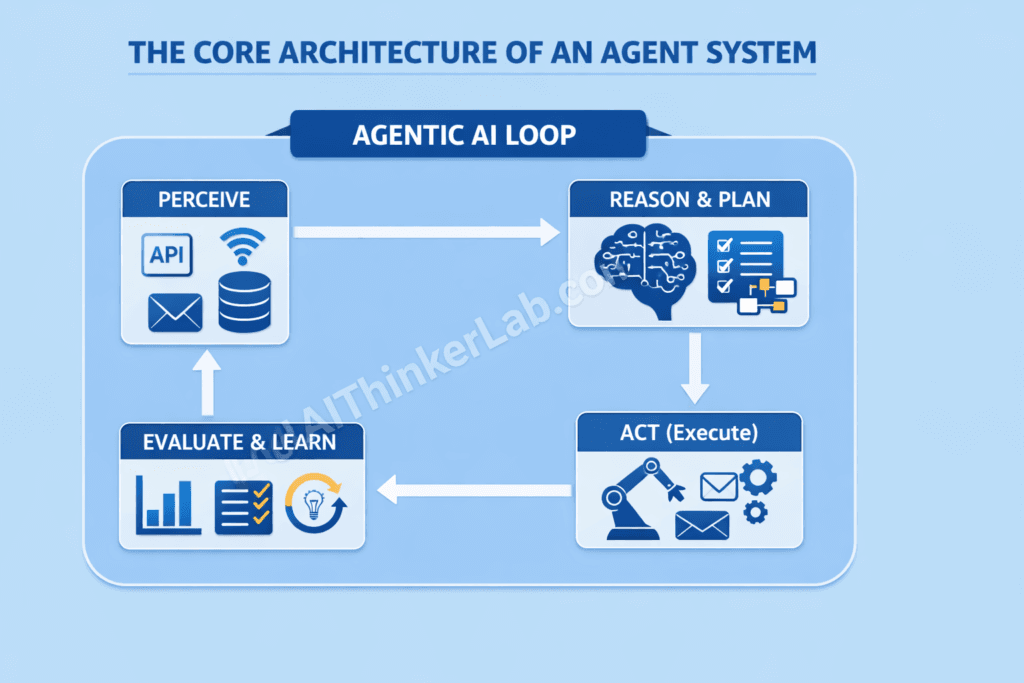
1. Perceive — The agent monitors its environment through data inputs: APIs, sensors, databases, user actions, emails, file uploads, or real-time data streams. It’s constantly “watching” for triggers and changes.
2. Reason & Plan — Using a Large Language Model (LLM) or specialized reasoning engine as its “brain,” the agent interprets what it perceives, decomposes complex goals into sub-tasks, and formulates a step-by-step action plan. This is where the intelligence lives.
3. Act (Execute) — The agent carries out its plan by calling tools, invoking APIs, writing files, sending messages, updating databases, or triggering other systems. It doesn’t just recommend actions — it performs them.
4. Evaluate & Learn — After acting, the agent assesses the outcome. Did the action achieve the desired result? If not, it adjusts its plan and tries again. This feedback loop is what makes agentic AI fundamentally different from static automation.
Real-Life Example: The Autonomous Document Processor
Let me walk you through a practical agent system that’s saving businesses hours of manual work every day:
The Scenario: A legal team receives dozens of PDF contracts daily. Each contract needs to be read, summarized, and checked for specific risk clauses.
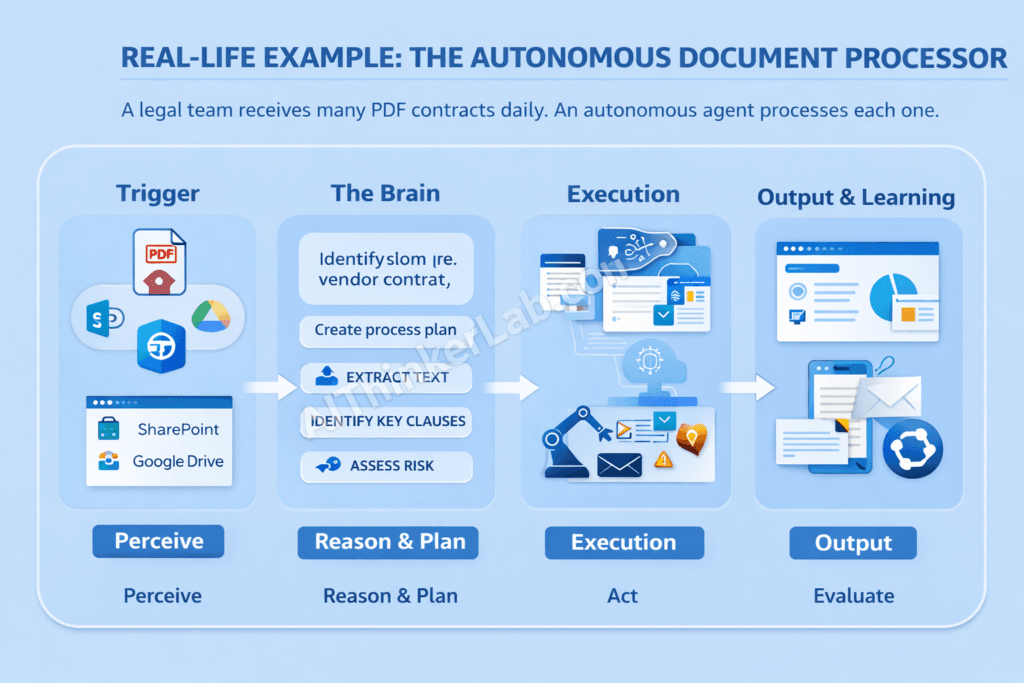
The Agentic AI Workflow:
- Trigger (Perceive): A new PDF is uploaded to the company’s cloud storage (e.g., SharePoint, Google Drive, or Azure Blob Storage).
- The Brain (Reason & Plan): The orchestrator agent detects the new file. Without any human instruction, it identifies the document type, determines it’s a vendor contract, and creates a processing plan: extract text → identify key clauses → assess risk → generate summary → notify legal team.
- Execution (Act): The agent extracts the text using OCR if needed, breaks the document into logical sections (chunking), sends each section to an LLM for analysis, identifies liability clauses, termination conditions, payment terms, and non-compete provisions, then generates a structured risk assessment.
- Output & Learning (Evaluate): It saves a formatted summary to the legal team’s dashboard, emails the lead attorney with flagged high-risk items, and logs the processing results for future model improvement. If the attorney provides feedback (“this clause was actually low risk”), the agent incorporates that correction into future assessments.
The result: A process that previously took a paralegal 2-3 hours per contract now happens in under 90 seconds — with greater consistency and zero fatigue-related errors.
This is the power of even single-agent systems handling discrete tasks. Now imagine chaining ten of these agents together — one for document intake, one for contract analysis, one for compliance checking, one for vendor communication, one for approval routing. That’s a multi-agent system, and that’s where the transformative potential truly emerges.
Single-Agent vs. Multi-Agent Systems
| Architecture | Description | Best For | Complexity |
|---|---|---|---|
| Single-Agent Systems | One agent handles one task end-to-end | Invoice processing, email triage, data entry | Low — ideal starting point |
| Multi-Agent Systems | Multiple specialized agents collaborate | Supply chain management, customer journey orchestration | Medium to High |
| Hierarchical Agent Systems | Manager agents coordinate worker agents | Enterprise-wide operations, complex decision trees | High — requires robust governance |
⚠️ Warning: A mistake I see many organizations make is jumping straight to complex multi-agent architectures before proving value with single-agent systems. Start simple. Prove ROI on one workflow. Then scale. The organizations that try to “boil the ocean” with agentic AI almost always fail or stall.
IV. The Evolution: Why Traditional Automation Failed
To fully appreciate why agentic AI explained matters so urgently in 2026, you need to understand what it replaced — and why the old approach was fundamentally broken.
The Problem with Rule-Based Automation
For decades, businesses relied on rule-based automation. Robotic Process Automation (RPA), scripted workflows, and if-then-else logic chains. These systems worked — barely — as long as nothing changed. And in business, everything changes.
Here’s what went wrong:
Brittleness: If a supplier changed their invoice format by a single field — moved the total from column C to column D — the entire automated pipeline would crash. A human had to intervene, identify the change, update the rules, test, and redeploy. For one field.
Data Silos: Marketing data lived in HubSpot. Inventory data lived in SAP. Customer data lived in Salesforce. Financial data lived in QuickBooks. These systems didn’t communicate. You had highly paid, talented people doing fundamentally dumb work — manually copying data between spreadsheets, reconciling numbers that should have been synchronized automatically.
Retrospective, Not Proactive: Traditional analytics could tell you what happened last quarter. They couldn’t tell you what’s about to happen next week. By the time you spotted a trend in a dashboard, the window for action had often already closed.
Agentic AI systems are the antidote to every one of these failures. They connect disparate data sources. They learn from patterns instead of following rigid rules. They adapt to new formats, new conditions, and new requirements without needing a programmer to rewrite code every time something changes.
Before vs. After: The Operational Shift
| Dimension | Before (Rule-Based) | After (Agentic AI Systems) |
|---|---|---|
| Adaptability | Breaks when conditions change | Adapts autonomously to new patterns |
| Data Integration | Siloed systems, manual bridges | Connected, real-time data streams |
| Decision Speed | Hours to days (human analysis required) | Milliseconds to seconds (autonomous) |
| Error Handling | Stops and waits for human fix | Identifies issue, attempts resolution, escalates if needed |
| Scaling | Linear (more tasks = more humans) | Exponential (agents handle increased load) |
| Intelligence | Static rules, no learning | Continuous learning and improvement |
The most critical factor in understanding this evolution is recognizing that agentic AI doesn’t just automate tasks faster — it automates judgment. That’s a fundamentally different capability than anything businesses have had access to before.
V. Agentic AI and Autonomous Decision-Making
One of the most transformative aspects of agentic AI explained for business leaders is how it revolutionizes decision-making processes.
From Retrospective to Prescriptive
In my experience working with organizations implementing AI strategies, the decision-making evolution follows a clear progression:
DECISION-MAKING EVOLUTION:

Level 1: DESCRIPTIVE (What happened?)
├── Traditional dashboards and reports
├── "Sales dropped 12% last month"
└── Value: Low — information arrives too late

Level 2: DIAGNOSTIC (Why did it happen?)
├── Analytics identifying root causes
├── "Sales dropped because competitor launched a promotion"
└── Value: Medium — explains but doesn't prevent

Level 3: PREDICTIVE (What will happen?)
├── Machine learning forecasting
├── "Sales will likely drop 8% next month if we don't act"
└── Value: High — provides warning

Level 4: PRESCRIPTIVE (What should we do?)
├── Agentic AI systems
├── "I've detected the trend, adjusted pricing by 4%,
│    increased ad spend in the affected region, and
│    prepared a competitive response campaign for your approval"
└── Value: Very High — recommends AND executes

Level 5: AUTONOMOUS (Done — here's what I did)
├── Fully agentic systems with guardrails
├── "Competitor launched promotion at 2:14 PM. I adjusted
│    regional pricing, reallocated $5K ad budget, updated
│    inventory orders, and briefed the sales team.
│    Estimated impact: stockout prevented, margin preserved."
└── Value: Transformative — acts in real time
Agentic systems operate at Levels 4 and 5. They don’t just analyze — they simulate scenarios in parallel, calculate trade-offs between competing objectives (cost savings vs. customer satisfaction vs. brand perception), and make optimized decisions in milliseconds.
How an Agentic Decision Loop Works in Practice
Here’s a concrete example of autonomous decision-making:
Scenario: An e-commerce company’s agentic system monitors social media sentiment, weather forecasts, supply chain data, and competitor pricing simultaneously.
What happens:
- The agent detects a spike in negative sentiment about a product category on Twitter
- It cross-references with weather data showing a heatwave approaching the northeastern US
- It identifies that the negative sentiment correlates with delivery delays caused by a logistics bottleneck
- It checks inventory levels and finds sufficient stock in a western distribution center
- It autonomously reroutes pending orders to the western fulfillment center
- It adjusts delivery time estimates on the website to reflect accurate timelines
- It triggers a proactive customer communication: “Your order is being expedited from our priority fulfillment center”
- It files a report for the logistics team highlighting the bottleneck for human review
Total elapsed time: 47 seconds. Human involvement: Zero (during execution). Customer impact: Negative experience prevented before the customer even noticed a problem.
That’s the power of agentic AI systems in decision-making. It’s not replacing human judgment — it’s extending it to operate at speeds and scales that humans physically cannot match.
VI. Industry Applications: Where Agentic AI Is Making the Biggest Impact
Agentic AI explained through industry-specific applications makes its transformative potential concrete. Here’s where the most significant disruption is happening in 2026:
Retail & E-Commerce
| Application | What the Agent Does | Business Impact |
|---|---|---|
| Dynamic Pricing | Adjusts prices in real time based on demand, competition, inventory levels, and customer segments | 5-15% margin improvement |
| Inventory Optimization | Predicts demand, triggers reorders, and manages seasonal fluctuations autonomously | 30-40% reduction in stockouts |
| Personalized Customer Journeys | Orchestrates individualized shopping experiences across channels | 20-35% increase in conversion rates |
| Returns Processing | Categorizes returns, determines disposition (restock/refurbish/recycle), and processes refunds | 60% faster processing time |
Financial Services
- Algorithmic Trading: Agentic trading systems execute orders in microseconds based on micro-market shifts, news sentiment analysis, and cross-market arbitrage opportunities
- Fraud Detection: Agent systems monitor transactions in real time, flag suspicious patterns, freeze accounts when thresholds are breached, and generate investigation reports — all before a human analyst reviews the case
- Loan Processing: Agents gather applicant data from multiple sources, verify documents, assess risk, and either approve or route to human review with a recommendation and justification
Healthcare
- Personalized Treatment Planning: Agentic systems analyze patient history, genetic data, current medications, and latest research to recommend optimized treatment plans that balance efficacy, cost, and side-effect profiles
- Clinical Trial Matching: Agents automatically match patients to relevant clinical trials based on their medical profiles, dramatically accelerating recruitment
- Administrative Automation: Scheduling, billing, insurance verification, and prior authorization — all handled by agent systems that reduce administrative burden by 40-60%
Supply Chain & Manufacturing
- Predictive Maintenance: Agents monitor equipment sensor data, predict failures before they happen, and autonomously schedule maintenance during optimal windows
- Supplier Management: Agents track supplier performance, detect delivery risks, identify alternative suppliers, and renegotiate terms — all within governance guardrails
- Demand Forecasting: Multi-variable forecasting that incorporates weather, social trends, economic indicators, and competitor activity
📌 Key Insight: The industries seeing the fastest agentic AI adoption share a common characteristic: high-volume, data-rich decision-making where speed provides a competitive advantage. If your business involves making hundreds or thousands of similar decisions daily, agentic systems will likely deliver transformative ROI.
VII. Implementing Agentic AI: A Strategic Framework for 2026
You’re convinced that agentic AI systems represent the future of business operations. But implementing agentic workflows isn’t just about installing software. It’s a strategic transformation that requires careful planning, cultural preparation, and technical rigor.
After working with organizations across multiple industries on AI implementation strategies, I’ve developed what I call The AIThinkerLab Agentic Readiness Framework — a structured approach to deploying agentic AI successfully.
The AIThinkerLab Agentic Readiness Framework
PHASE 1: IDENTIFY (Weeks 1-4)
├── Map all business processes
├── Score each by: volume × repetitiveness × data availability
├── Identify top 3 candidates for agentic automation
├── Calculate potential ROI for each
└── Select ONE process for initial deployment

PHASE 2: PREPARE (Weeks 4-8)
├── Audit data quality for selected process
├── Establish data pipelines and integrations
├── Define success metrics and KPIs
├── Design human oversight protocols
├── Set ethical guardrails and governance rules
└── Train stakeholders on agentic AI concepts

PHASE 3: BUILD (Weeks 8-16)
├── Deploy single-agent system for selected process
├── Configure monitoring and logging
├── Implement human-in-the-loop checkpoints
├── Test extensively with edge cases
├── Run parallel (agent + human) for validation
└── Document everything for compliance

PHASE 4: SCALE (Weeks 16-24)
├── Analyze results against KPIs
├── Optimize based on real-world performance data
├── Expand to additional processes
├── Begin connecting single-agent systems into multi-agent workflows
├── Establish center of excellence for agentic AI
└── Plan long-term agentic architecture

PHASE 5: EVOLVE (Ongoing)
├── Continuous monitoring and improvement
├── Regular ethical audits
├── Expand capabilities as technology advances
├── Knowledge sharing across the organization
└── Stay current with agentic AI developments
Step 1: Start Small with Single-Agent Systems
The most important piece of advice I can give anyone implementing agentic workflows: don’t try to replace your CEO with an AI.
Start with single-agent systems targeting a specific, measurable pain point:
- Processing invoices
- Sorting and routing customer support tickets
- Generating weekly reports from multiple data sources
- Monitoring social media mentions and sentiment
- Screening job applications against defined criteria
Prove value on one workflow. Measure the results. Build organizational confidence. Then scale.
Step 2: Fix Your Data First
I cannot stress this enough. Agentic AI systems are only as good as the data they consume.
If your data is messy — duplicate records, inconsistent formats, outdated information, missing fields — your agent will make messy decisions. Except now it’ll make those messy decisions at lightning speed and at scale. Garbage in, garbage out, but amplified by automation.
Data readiness checklist before deploying any agent system:
☐ Data is centralized or accessible via APIs
☐ Data formats are consistent and standardized
☐ Real-time or near-real-time data feeds are available
☐ Historical data exists for training and validation
☐ Data quality metrics are established and monitored
☐ Data governance policies are documented
☐ PII and sensitive data handling protocols are in place
☐ Data access permissions are properly configured
Step 3: Maintain Human-in-the-Loop Oversight
This is where many early agentic AI implementations fail. Organizations either give agents too much autonomy too quickly, or they add so many approval gates that the agents become nothing more than glorified recommendation engines.
The balanced approach:
| Decision Type | Autonomy Level | Human Role |
|---|---|---|
| Low-risk, high-frequency (sorting emails, generating reports) | Full autonomy | Periodic review |
| Medium-risk (adjusting inventory, routing support tickets) | Autonomous with logging | Review flagged exceptions |
| High-risk (financial transactions, customer-facing communications) | Agent recommends, human approves | Active approval required |
| Critical (legal decisions, safety-related actions) | Human-only with AI support | AI provides analysis, human decides |
💡 Pro Tip: The goal of implementing agentic AI isn’t to remove humans from the equation — it’s to ensure humans focus on the decisions that genuinely require human judgment, creativity, and ethical reasoning. Everything else can be delegated to agents.
VIII. The Elephant in the Room: Ethics, Risks, and Governance
Any honest discussion of agentic AI explained must address the risks head-on. When you give machines the power to make autonomous decisions, the stakes rise dramatically.
The Core Ethical Challenges
Bias Amplification: Without proper guardrails, agentic systems can perpetuate and amplify biases present in their training data. An agent that processes loan applications might systematically disadvantage certain demographics if the historical data reflects past discriminatory practices. And unlike a human loan officer who makes one biased decision at a time, an agentic system can make thousands of biased decisions per second.
Accountability Gap: If an autonomous agent system denies a loan application, routes a delivery truck into a hazardous area, or makes a medical recommendation that causes harm — who is responsible? The developer who built the agent? The company that deployed it? The AI itself? Current legal frameworks are still catching up to this reality.
Transparency Deficit: Many agentic decisions are made within complex neural network architectures that resist simple explanation. A decision that affects someone’s livelihood or health demands justification. “The algorithm decided” is not an acceptable answer.
The Governance Framework
Implementing agentic AI responsibly requires a robust governance structure:
AGENTIC AI GOVERNANCE PILLARS:

1. EXPLAINABILITY
   ├── Every consequential agent decision must be traceable
   ├── "Explainable AI" (XAI) techniques must be implemented
   ├── Decision logs must be human-readable
   └── Agents must be able to justify WHY, not just WHAT

2. OVERSIGHT
   ├── Human-in-the-loop for high-stakes decisions
   ├── Regular bias audits of agent behavior
   ├── Real-time monitoring dashboards
   └── Kill switches for immediate agent shutdown

3. ACCOUNTABILITY
   ├── Clear ownership chain for every agent
   ├── Documented responsibility matrix
   ├── Incident response procedures
   └── Regular compliance reviews

4. FAIRNESS
   ├── Bias testing across demographic groups
   ├── Disparate impact analysis
   ├── Training data audits
   └── Third-party fairness assessments

5. SECURITY
   ├── Agent action boundaries (what it CAN'T do)
   ├── Data access controls
   ├── Adversarial attack protections
   └── Regular penetration testing
The counterintuitive truth about agentic AI governance is this: the organizations that invest most heavily in guardrails and oversight are the ones that ultimately deploy the most powerful and trusted agentic systems. Governance isn’t a brake on innovation — it’s the foundation that enables it.
IX. Future Perspectives: What’s Coming in 2026 and Beyond
The trajectory of agentic AI explained through the lens of converging technologies paints a picture that’s both exhilarating and humbling.
Near-Term (2025-2027)
- Agentic AI + Edge Computing + 5G: Agents won’t just live in cloud data centers. They’ll operate at the edge — in robots, drones, autonomous vehicles, and IoT devices — making ultra-low-latency decisions measured in single-digit milliseconds. Your smart factory won’t send data to the cloud for processing; the agents will live on the factory floor.
- Multi-Agent Orchestration Platforms: Enterprise platforms that allow non-technical users to design, deploy, and manage networks of collaborating agents using visual interfaces. Think “no-code agent building” for business teams.
- Standardized Agentic Frameworks: Industry standards for agent communication, interoperability, and governance. Right now, every vendor has their own approach. Standardization will accelerate adoption dramatically.
Medium-Term (2027-2030)
- Federated Learning for Agents: Organizations will train agents collaboratively — sharing learned behaviors across companies without sharing proprietary data. Your supply chain agent could learn from the collective experience of thousands of supply chains while your data never leaves your servers.
- Agent Marketplaces: Pre-built, specialized agents available for purchase or subscription — like app stores, but for autonomous AI workers. Need a compliance agent? An inventory optimization agent? A customer churn prediction agent? Browse, deploy, customize.
- Agentic AI as Standard Enterprise Infrastructure: By 2030, according to industry projections, agentic frameworks will be as standard in enterprise software as databases are today. Not having agentic capabilities will be like not having email — technically possible, but a significant competitive disadvantage.
The Convergence Map
        2025                2027                2030
         |                   |                   |
    Single-Agent  ──▶  Multi-Agent  ──▶  Agent Ecosystems
    Systems             Orchestration       (Inter-org)
         |                   |                   |
    Cloud-Based  ──▶  Edge + Cloud  ──▶  Distributed
    Processing          Hybrid              Autonomous
         |                   |                   |
    Human-Heavy  ──▶  Human-Light  ──▶  Human-Strategic
    Oversight           Oversight           Oversight
         |                   |                   |
    Vendor-Specific ──▶ Standards  ──▶  Universal
    Frameworks          Emerging            Protocols
X. Conclusion
Agentic AI explained isn’t just another buzzword for the next investor pitch deck. It represents a fundamental shift in how organizations operate — the transition from tools that passively wait for our instructions to autonomous partners that actively work alongside us.
The technology has matured beyond proof-of-concept. Agentic systems are processing invoices, managing supply chains, personalizing customer experiences, detecting fraud, and making thousands of optimized decisions per second in production environments around the world.
But here’s what most guides won’t tell you: the organizations winning with agentic AI aren’t the ones deploying the most sophisticated technology. They’re the ones that started with a single, well-chosen agent system, proved measurable value, built organizational trust, and scaled methodically.
Whether you’re running a Fortune 500 enterprise or building a startup, the ability to leverage agentic AI systems effectively will increasingly determine whether you lead your market or get disrupted by someone who does.
The agents are ready. The frameworks exist. The question isn’t whether agentic AI will transform your industry — it’s whether you’ll be the one leading that transformation or reacting to it.
Your next step: Start by identifying one high-volume, data-rich process in your organization that would benefit from autonomous handling. Apply the AIThinkerLab Agentic Readiness Framework outlined in this guide. Prove value. Then scale. To learn more about how agentic AI connects to monetization strategies, explore our applied AI guides.
However, large-scale deployment brings challenges — learn what breaks when enterprises deploy AI agents in production and how organizations are solving these issues.
XI. Further Reading & Authoritative Resources
- McKinsey & Company — “The Agentic Organization: Contours of the Next Paradigm for the AI Era” (2025)
- OpenAI — “Introducing ChatGPT Agent: Bridging Research and Action” (2025)
- NVIDIA — “What Is Agentic AI?” (2024)
- Anthropic — Research on AI Agent Safety and Alignment
- Google DeepMind — Agent-Based Systems Research