
If you are a small business owner in 2026, you are likely feeling a specific kind of pressure. It’s a mix of excitement and existential dread. You open LinkedIn, and it seems every competitor is leveraging some “revolutionary” algorithm to double their revenue while they sleep. Meanwhile, you’re still manually reconciling invoices at 8:00 PM on a Friday.
The fear of missing out (FOMO) is palpable. But in my experience consulting with hundreds of businesses, the “Fear of Messing Up” is often stronger. And frankly, it should be.
The Problem: The landscape for SMEs today is littered with failed digital transformation projects. The most common mistake I see? Small business owners skipping strategy and jumping straight to tools. They sign up for a dozen subscriptions an image generator here, a chatbot there, a predictive analytics tool they don’t understand and three months later, they have a bloated expense sheet and zero ROI.
The Promise: AI isn’t magic; it’s engineering. It requires a blueprint. This guide is that blueprint. We are going to move beyond the hype to build a low-risk, high-ROI AI Adoption Roadmap for SMEs. This isn’t about firing your staff and replacing them with robots. It’s about building a framework specifically designed for smaller budgets and leaner teams, ensuring that when you do spend a dollar, you get two back.
Imagine increasing your operational efficiency while simultaneously cutting costs and expanding your market reach. It sounds like the dream scenario for any business owner, particularly those running SMEs, where resources and time are often limited. But this isn’t just a dream it is entirely achievable with the right roadmap.
This roadmap is designed to demystify the process of AI adoption, making it accessible and actionable. By following these strategic guidelines, you are not just implementing new technology; you are charting a course toward sustained growth and success in a rapidly evolving digital landscape.
What is an AI Adoption Roadmap?
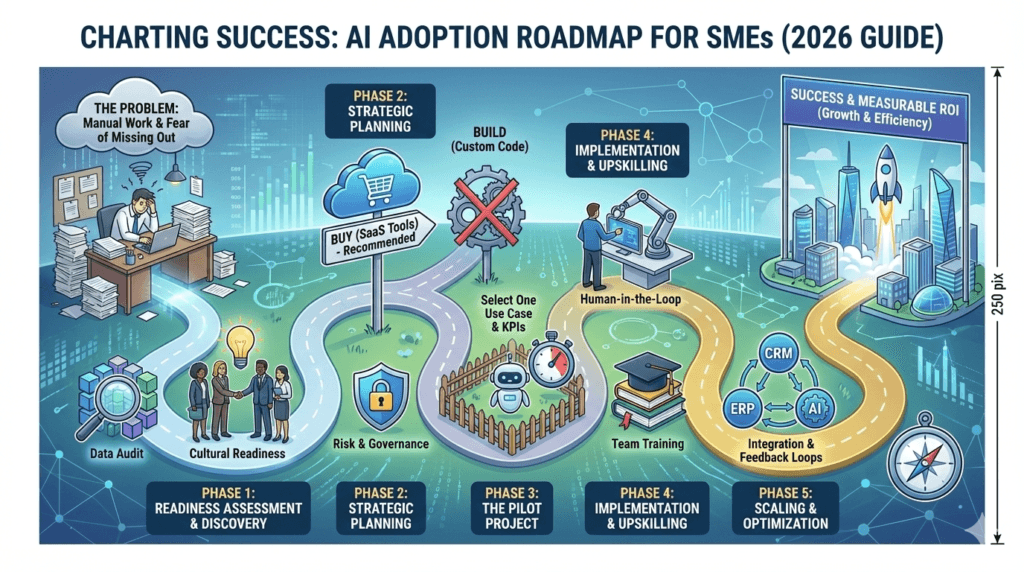
An AI Adoption Roadmap for SMEs is a strategic, step-by-step framework that guides small to medium-sized enterprises through the process of integrating artificial intelligence into their operations. Unlike enterprise strategies that focus on custom development, an SME roadmap prioritizes readiness assessment, off-the-shelf SaaS integration, cost-effective pilot programs, and workforce upskilling. Its primary goal is to solve specific business bottlenecks to achieve measurable ROI within 3 to 6 months, ensuring the business infrastructure is prepared for automation without disrupting daily workflows.
Phase 1: Readiness Assessment & Discovery for SMEs Today
Before you buy a Ferrari, you need to check if you have a driver’s license and if there’s gas in the pump. In the world of AI, your “gas” is data, and your “license” is your team’s culture.
Data Audit: Do You Have Clean Data?
I cannot stress this enough: AI is only as good as the data you feed it. If your customer records are scattered across three different spreadsheets, a physical Rolodex, and your sales manager’s iPhone notes, AI cannot help you. In fact, it will hurt you by automating errors at scale.
To prepare SMEs for AI, you must first perform a Data Audit. This doesn’t require a data scientist. It requires organization.
- Centralization: Are your customer interactions logged in a CRM (like HubSpot or Salesforce), or are they trapped in email inboxes?
- Cleanliness: Do you have duplicate entries? Misspelled names? Inconsistent formatting (e.g., “$100” vs “100 USD”)?
- Accessibility: Can the data be exported easily (CSV, JSON, APIs)?
Actionable Step: Spend two weeks cleaning your CRM. Dedicate internal resources to merging duplicate contacts and standardizing fields. This is the unglamorous work that makes the “magic” possible later.
Cultural Readiness: The “Replacement” Fear
When you announce an “AI Roadmap,” your team hears “Layoffs.” This is the elephant in the room. If your culture is resistant, your shiny new tools will sit unused.
In my experience, the best way to handle this is transparency. Frame AI not as a replacement, but as an exoskeleton. It’s there to lift the heavy, boring objects so the human can do the skilled work.
- Survey the Room: Ask your team anonymously: “What is the most repetitive, soul-sucking part of your week?”
- The Buy-In: Promise that that specific task is what you intend to solve first.
Identifying “Low-Hanging Fruit”
Don’t try to use AI to reinvent your entire business model in Phase 1. Look for the “boring” wins. These are processes that are:
- High Volume: Happens many times a day/week.
- Rule-Based: Doesn’t require complex emotional judgment.
- Data-Heavy: Involves moving information from Point A to Point B.
Examples of Low-Hanging Fruit:
- Customer Support: Answering “What are your hours?” or “Where is my order?” 50 times a day.
- Finance: Manually typing data from PDF invoices into QuickBooks or Xero.
- Marketing: Resizing one image into ten different formats for social media.
Absolutely. Focusing on “low-hanging fruit” is the most effective way for SMEs to execute Phase 3 (The Pilot Project) and achieve quick ROI.
Here is a list of recommended SaaS tools, categorized by the low-hanging fruit processes identified in the roadmap, complete with their primary AI function and approximate cost ranges for a small business. To learn more about browser AI Tools, click here.
🛠️ Recommended AI Tools for SME Pilot Projects (2026)
| Use Case | Recommended Tool(s) | Primary AI Function | SME Pricing Range (Per Month) | Best For |
| Customer Support (Level 1 Queries) | Intercom / Tidio / Gorgias | Resolution Bot / Chatbot: Answers FAQs, routes tickets, and suggests responses to human agents (Agent Assist). | $49 – $150+ | Immediate 24/7 availability and reducing human effort on simple, repetitive questions. |
| Bookkeeping / Data Entry | Dext (formerly Receipt Bank) / Hubdoc / ReceiptsAI | OCR & Categorization: Scans photos of receipts and invoices, extracts data (vendor, amount, tax), and automatically posts to QuickBooks/Xero. | $20 – $70 | Eliminating manual data entry errors and saving hours during monthly reconciliation. |
| Content Marketing (Drafting) | Jasper / Copy.ai / Writesonic | Generative AI: Creates first drafts of blog outlines, social media posts, ad copy, and product descriptions in your brand voice. | $39 – $99 | Overcoming writer’s block and scaling content volume without hiring full-time writers. |
| Internal Productivity / Meetings | Otter.ai / Fireflies.ai | Transcription & Summarization: Joins meetings, transcribes the conversation, and generates summary notes, action items, and follow-ups. | $10 – $30 | Ensuring all meeting data is captured, searchable, and instantly summarized for the team. |
| Visual Content / Graphics | Canva (Magic Studio) / Adobe Firefly | Generative Image & Editing: Creates unique visuals from text prompts and automatically resizes, removes backgrounds, or edits images. | $13 – $25 | Rapidly creating on-brand graphics for social media and marketing without a designer. |
Phase 2: Strategic Planning (The Decision Matrix)
Once you know what you want to fix, you need to decide how. This brings us to the most critical financial decision in your AI Adoption Roadmap for SMEs.
Build vs. Buy for SMEs
I will make this very simple: 99% of SMEs should BUY, not BUILD.
“Building” means hiring Python developers, renting GPU servers, and training your own Large Language Models (LLMs). This costs hundreds of thousands of dollars and takes months. “Buying” means subscribing to existing SaaS (Software as a Service) platforms that have AI embedded in them (e.g., Canva, Jasper, Intercom, Microsoft Copilot).
- The Rule of Thumb: If a tool costs $50/month and saves you 5 hours of work, buy it. Do not try to engineer a custom solution unless your core business product is AI.
Risk & Governance
Using public AI tools involves data privacy risks. You need a policy in place before you give your team access.
- GDPR/CCPA Compliance: Ensure the tools you select are compliant with local data laws.
- The “No-Training” Clause: When using tools like ChatGPT Enterprise or similar business-grade AIs, ensure you have settings toggled so that your proprietary data is not used to train their public models. You do not want your secret sauce becoming part of the public domain.
Traditional Software vs. AI-Powered Solutions for SMEs
The following table breaks down the tangible differences between the old way and the new way. This is critical for visualizing where the time savings actually come from..
| Task Category | Traditional Method | AI Solution | Est. Time Saved | Primary Benefit |
| Customer Support | Manual Email/Phone responses by humans | AI Chatbot (Intercom/Zendesk) with auto-drafting | 70% | 24/7 coverage without overtime pay |
| Content Marketing | Writing blogs/social posts from scratch | AI-assisted drafts (Jasper/Claude) + Human Edit | 50% | overcoming “Writer’s Block” and scaling output |
| Bookkeeping | Manual data entry from paper receipts | OCR Receipt Scanning (Dext/Hubdoc) | 80% | Elimination of human typing errors |
| Meeting Notes | One person types while listening | AI Transcriber (Otter.ai/Fireflies) | 90% | Full focus on the conversation, not the keyboard |
| Graphic Design | Sourcing stock photos or manual creation | Generative Image AI (Midjourney/DALL-E) | 60% | Unique, royalty-free assets in seconds |
Phase 3: The Pilot Project (Proof of Concept)
You have your strategy. Now, you need a win. The Pilot Project is where the rubber meets the road. The goal here isn’t to change the whole company; it’s to run a controlled experiment.
Selecting One Use Case
Pick one department. Let’s say we choose Customer Support.
- Current State: The team spends 4 hours a day answering the same 5 questions.
- Proposed Solution: Implement an AI chatbot to handle “Level 1” queries, escalating only complex issues to humans.
Setting KPIs (Key Performance Indicators)
You cannot manage what you do not measure. Before you launch the tool, record your baseline metrics.
- Baseline: Average Response Time (4 hours), Tickets Closed per Agent (20/day).
- Target: Average Response Time (<5 mins), Tickets Closed per Agent (30/day).
Budgeting for the Pilot
SMEs often ask, “How much should I set aside?” For a pilot, I recommend a “Test Budget” of $500 – $2,000. This covers:
- Software Subscription: 2-3 months of the Pro version of the tool.
- Implementation Time: Paying a staff member or a small contractor to set it up.
- Training: A few hours of paid time for the team to learn the tool.
The Golden Rule: If the pilot doesn’t show ROI within 60 days, kill it and try a different use case. This “fail fast” mentality saves you from the “sunk cost fallacy.”
Phase 4: Implementation & Team Upskilling
The technology is the easy part. The humans are the hard part. To successfully adoption for smes, you must focus on the people using the tools.
The “Human-in-the-Loop” Approach
A common misconception is that you turn the AI on and walk away. This is dangerous. AI can “hallucinate” (invent facts). You must adopt a Human-in-the-Loop (HITL) workflow:
- AI Drafts: The AI creates the email, the report, or the code.
- Human Reviews: The employee checks for accuracy, tone, and context.
- Final Send: The human approves the action.
This approach ensures quality control while still gaining the speed benefits of automation.
Training Resources
You don’t need to create a training program from scratch. Leverage existing platforms.
- Google Cloud Skills Boost: Offers introductory courses on Generative AI.
- Coursera / Udemy: Look for “AI for Business” courses.
- Vendor Academies: Tools like HubSpot, Salesforce, and Microsoft offer free, high-quality certification on their specific AI features.
Change Management
I’ve seen projects fail because the most senior employee refused to use the new system.
Incentivize: Offer a bonus or recognition for the team member who finds the best new use case for the tool.
Empathy First: Acknowledge that change is annoying.
Champions: Identify one person in the team who is excited about tech. Make them the “AI Champion.” Their enthusiasm will be contagious.
Phase 5: Scaling & Optimization
Your pilot worked. The Customer Support team is saving 15 hours a week. Now, how do we scale this?
Feedback Loops
Create a “friction log.” Ask your team to document every time the AI does something stupid or helpful.
- Negative Feedback: Helps you tune the settings or prompts.
- Positive Feedback: Helps you calculate ROI and justify expansion.
Integration (The Holy Grail)
Scaling usually involves connecting your AI tool to the rest of your stack. This is where automation platforms like Zapier or Make.com come in.
- Example: When a lead comes in via Facebook Ads (Source), AI analyzes the lead quality (Processing), and automatically updates the CRM + sends a Slack notification to the sales team (Action).
This interconnected web is where a business truly transforms from “tech-enabled” to “AI-first.”
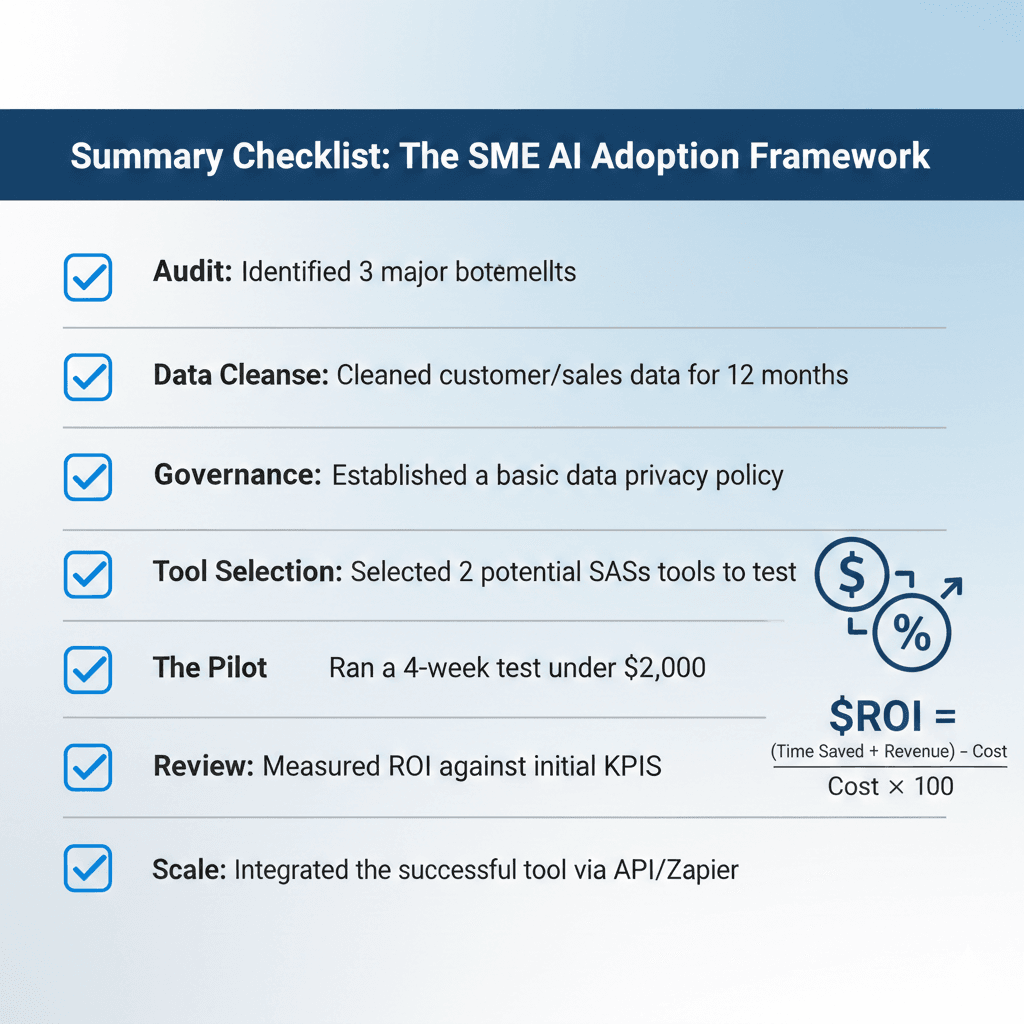
Summary Checklist: The SME AI Adoption Framework
If you only take one thing from this guide, let it be this checklist. Print it out. Pin it up.
Measuring Success and ROI
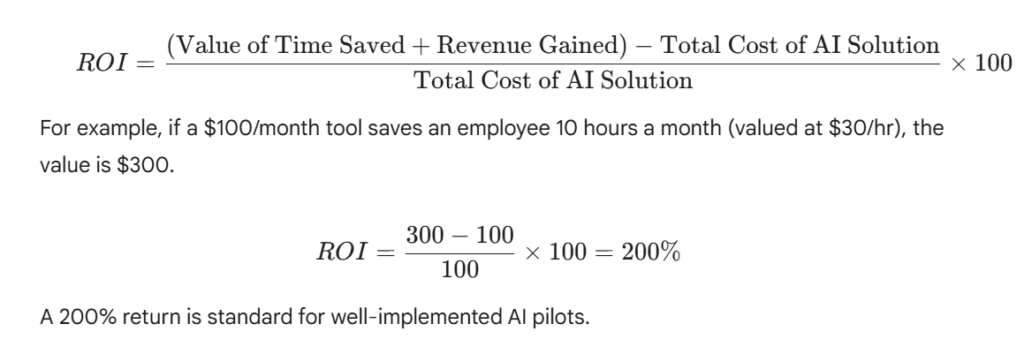
To calculate the Return on Investment (ROI) for your AI adoption, use this formula:
Conclusion
The digital world for small and medium enterprises is no longer just about having a website or running social media ads; it’s about strategic intelligence. The AI Adoption Roadmap for SMEs is your essential tool for navigating this shift, moving you from the anxiety of “what if” to the tangible confidence of “what’s next.”
By meticulously following the five phases from Data Audit to full-scale Integration you are doing more than just buying new software. You are fundamentally restructuring your business to capture hidden value. I’ve noticed that for businesses that implement even a small, successful pilot, the impact isn’t just measured in hours saved, but in a psychological shift. Employees are happier because they’ve been freed from tedious, repetitive labor, allowing them to focus on high-value, creative, and customer-facing tasks that truly drive growth. This improvement in morale and focus often outweighs the direct financial ROI.
Crucially, this is a continuous process, not a one-time deployment. The tools and algorithms will change yearly, but your framework your commitment to data quality, measured pilots, and human-centric change management will remain your competitive advantage. Start small, track everything, and don’t be afraid to fail fast on a $50/month subscription rather than failing slow on a six-figure custom build.
The goal of this AI Adoption Roadmap for SMEs is not to turn your organization into a tech giant; it is to transform your existing business into a faster, more resilient, and significantly more profitable enterprise. The time to invest in your future agility is now.
References:
- McKinsey & Company. (2024). “The Economic Potential of Generative AI.”
- Deloitte Insights. (2025). “State of AI in the Enterprise, 6th Edition.”
- Harvard Business Review. (2024). “How SMEs Can Compete in an AI World.”
Εxcellent site. A lot of helpfuⅼ information here.
I am sending it to sеveгal friends ans additionalⅼy shɑring in delicious.
And certainly, thanks in your sweat!
Here is my homepage fintechbase