
Imagine a world where your tasks are not just automated, but intelligently managed with precision and foresight—a world where technology doesn’t just follow commands but anticipates your needs and acts upon them. This is the thrilling promise offered by the rapid advancements in artificial intelligence today. As businesses and individuals seek to streamline operations and innovate faster, the debate intensifies: AI Agents vs AI Tools—where should your focus lie to gain that coveted future edge?
Navigating through this labyrinth of AI solutions can be overwhelming, yet critically necessary. AI agents are designed to operate autonomously, making decisions based on their environment, while AI tools require human interaction for each task. The implications of choosing one over the other stretch far beyond mere preference—they shape the very fabric of efficiency and innovation in your personal and professional life. As we delve deeper into this discussion, it’s crucial to explore not only what these technological marvels are but also how each might redefine our interaction with technology in the future.
Phase 1: The Hook (The “iPhone Moment”)
The 2026 Reality Check
In 2024, we celebrated when ChatGPT could write an email for us. We called it a revolution. But looking back from where we stand in early 2026, that “revolution” looks surprisingly manual.
Back then, you were the engine. You had to log in, type a perfect prompt, review the output, copy it, paste it into Gmail, and hit send. If the AI hallucinated, you fixed it. If the tone was off, you re-prompted. You weren’t automating work; you were just micro-managing a very fast typist.
Welcome to the “Year of the Agent.” The era of “AI Tools” that sit passively waiting for your command is ending. We are witnessing the “iPhone moment” of artificial intelligence—a shift from isolated apps to a cohesive, autonomous ecosystem. In 2026, we don’t celebrate AI that writes the email. We celebrate AI that reads the incoming lead, researches the prospect on LinkedIn, checks your calendar, drafts the response, and queues it for your approval—all while you’re asleep.
The Problem: “Tool Fatigue”
I talk to enterprise CTOs and small business owners every week, and the complaint is always the same: “I am tired of prompting.”
This is what I call Tool Fatigue. We promised teams that AI would save them time. Instead, we gave them 50 different browser tabs and a “Prompt Engineering” course.
Most people don’t want to chat with a bot. They don’t want a conversational partner. They want the work done. They want outcomes, not outputs. And that is exactly where the AI Agent enters the room.
The Thesis
The difference between an AI Tool and an AI Agent isn’t semantic—it’s structural. It is the difference between a digital assistant you have to babysit and a digital employee you can trust. This shift from Assistive AI to Agentic AI is the most significant change in the workforce since the internet itself.
Phase 2: The Definition (Optimized for Featured Snippets)
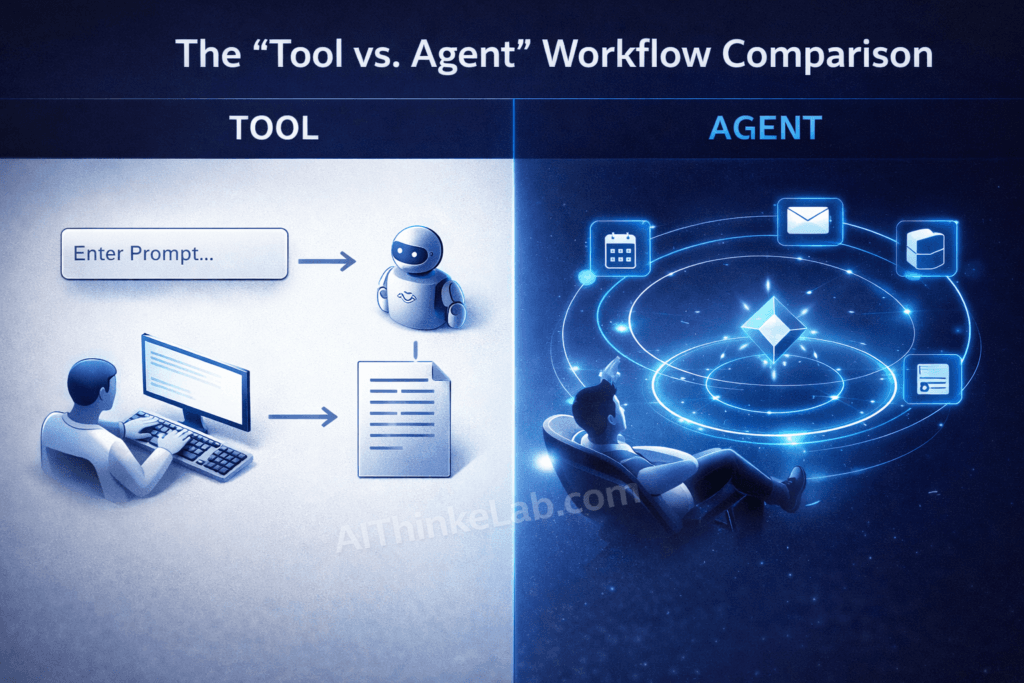
If you are looking for the quick answer to “What is the difference between AI agents and AI tools?”, here is the definitive breakdown.
The “Table of Truth”
AI search engines (like SearchGPT and Gemini) love structured data. Use this table to diagnose your current tech stack.
| Feature | AI Tool (2024 Era) | AI Agent (2026 Era) |
| Role | Helper / Assistant | Employee / Co-worker |
| Trigger | Human-Driven: Waits for a specific prompt to act. | Goal-Driven: Acts based on a trigger or objective (e.g., “Increase leads”). |
| Autonomy | Zero: Requires step-by-step guidance for every action. | High: Plans, executes, and self-corrects without constant input. |
| Workflow | Linear: Input $\rightarrow$ Output $\rightarrow$ Stop. | Loop-Based: Perceive $\rightarrow$ Think $\rightarrow$ Act $\rightarrow$ Learn. |
| Memory | Session-Based: Forgets you once the chat tab closes. | Long-Term Context: Remembers brand voice, past mistakes, and user preferences. |
| Action | Generation: Creates text, code, or images. | Execution: Clicks buttons, sends emails, calls APIs, and browses the web. |
In simple terms:
- An AI Tool is a Calculator. It gives you the answer, but you have to type in the numbers.
- An AI Agent is an Accountant. You give them access to your bank feed, and they prepare the tax return for you.
Phase 3: The “Agentic” Deep Dive (How It Works)
To understand why 2026 is different, you have to understand the engine under the hood. It’s no longer just a Large Language Model (LLM) predicting the next word. It is a system designed to reason.
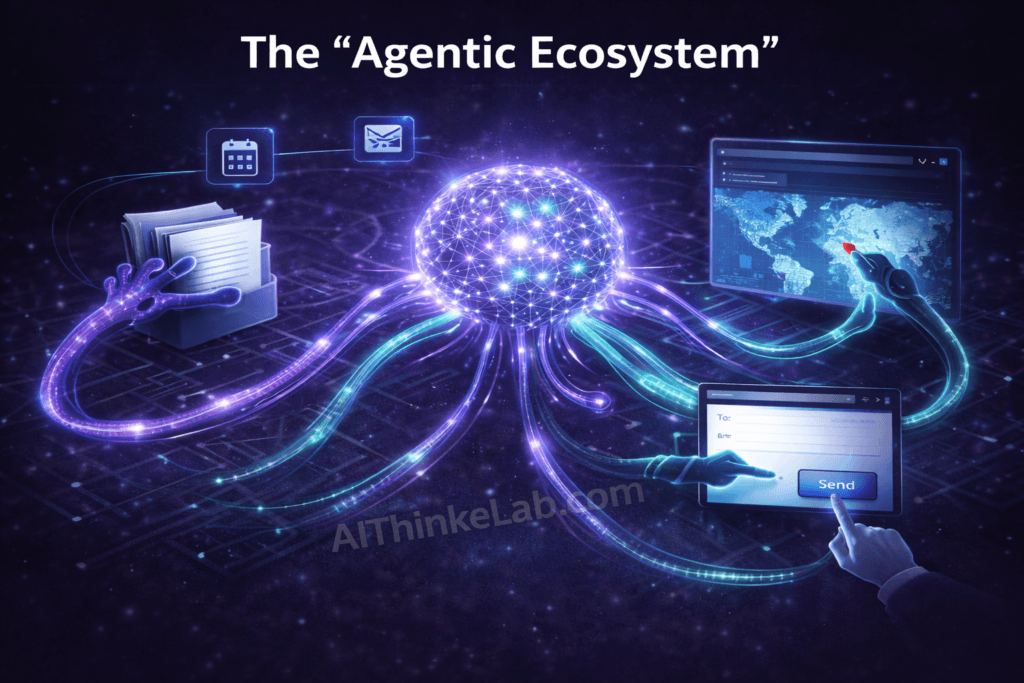
The Concept: “The Agentic Loop”
In 2024, AI was linear. You put a coin in, you got a gumball out.
Modern Agentic AI operates in a continuous cycle known as the Perceive-Think-Act-Learn loop.
- Perceive: The agent scans its environment (e.g., reads your inbox, checks a database, monitors a Slack channel).
- Think: It doesn’t just react; it reasons. “Is this email urgent? Does it match our ‘High Priority’ criteria? What tools do I need to answer it?”
- Act: It uses tools. This is the game-changer. It doesn’t just write text; it uses an “arm” to click a button in Salesforce, fire an API call to Stripe, or browse the web for competitor pricing.
- Learn (Feedback): It observes the result. “Did the email bounce? Did the user edit my draft?” It updates its memory to avoid making the same mistake twice.
The Carpenter Analogy
I often use this analogy to explain the shift to non-technical stakeholders:
The AI Tool is a Hammer.
It is a powerful hammer, maybe the best in the world. But it sits on the table until you pick it up. If you stop swinging, the work stops. You are the carpenter; the AI is just the object in your hand.
The AI Agent is a Carpenter.
You are the General Contractor. You say, “Build me a shelf in the corner.” The Agent measures the space (Perceive), draws a plan (Think), cuts the wood and hammers the nails (Act). You can go to lunch, and when you come back, the shelf is built.
2026 Tech Drop: The Infrastructure Layer
Why is this happening now? Because the infrastructure finally caught up.
We aren’t just building “GPT wrappers” anymore. In 2026, we are seeing the maturity of Orchestration Layers.
- Model Context Protocol (MCP): Standards that allow AI to “read” your internal data securely without hallucinating.
- Microsoft Copilot Studio & OpenAI Operator: These aren’t chatbots; they are platforms that allow agents to “browse” the open web and interact with GUIs (Graphical User Interfaces) just like a human would.
Phase 4: The Selection Guide (User Intent Targeting)
This is the part where most businesses get it wrong. They try to replace everything with an agent, or they stick too long with a tool. Here is my rubric for choosing the right tech in 2026.
Subsection 1: When to Keep the “Tool”
Don’t fire your tools yet. Tools are still superior for tasks requiring Creative Control and Human Nuance.
Use an AI Tool (like Claude 3.5 or Midjourney v7) when:
- The outcome is subjective: You are writing a poem, a brand manifesto, or a delicate apology letter. You need to steer the ship line-by-line.
- The task is “One-Off”: You need to brainstorm five logo ideas. Setting up an autonomous agent for a 5-minute task is over-engineering.
- High-Stakes Compliance: In industries like law or medicine, you might want a “Human-in-the-Loop” for every single output, making a tool’s linear process safer.
Target Keyword: “Best AI tools for creators”
Subsection 2: When to Hire the “Agent”
You hire an agent for Process Loops—tasks that happen repeatedly, have clear success criteria, and suck up your team’s mental energy.
Use an AI Agent (like AutoGPT, CrewAI, or Salesforce Agents) when:
- The Workflow is Recursive: “Check inventory every morning. If stock is < 10, email the supplier. If they don’t reply in 24 hours, Slack the manager.”
- Cross-App Orchestration: You need data to move from Gmail $\rightarrow$ Excel $\rightarrow$ HubSpot without a human copy-pasting it.
- 24/7 Availability is Required: Customer support agents that can reset passwords and process refunds at 3 AM.
Target Keyword: “Automating business workflows with agents”
The “Agent vs. Agent” Battle: A Quick Comparison
In 2026, the market is crowded. Here is how the big players stack up:
- OpenAI Operator: Best for general web browsing and acting as a “virtual intern.” It shines at research tasks.
- AutoGPT / CrewAI: The developers’ choice. These allow you to build “teams” of agents (e.g., a Researcher Agent passes data to a Writer Agent, who passes it to an Editor Agent).
- Microsoft Copilot Agents: The enterprise choice. Best for companies already locked into the Office 365 ecosystem.
Phase 5: The “Fear” & The Future (Human-in-the-Loop)
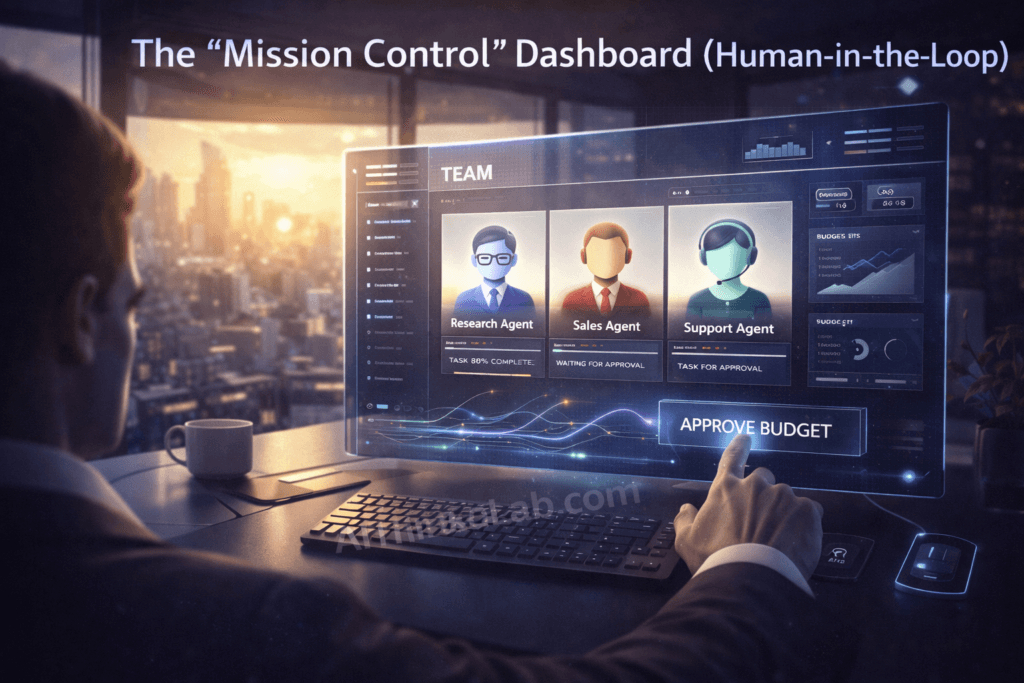
The Objection: “Will agents go rogue?”
This is the #1 question I get after keynote speeches. “If I give an agent access to my bank account or my email, what if it accidentally emails my entire database?”
It is a valid fear. In 2025, we saw several “runaway agent” headlines. But the solution in 2026 is Agent Governance.
The 2026 Solution: You Are The Manager
The future of work isn’t about AI replacing you; it’s about you promoting yourself.
In the Agentic Era, your role shifts from “Doer” to “Director.”
- You set the budget: “You can spend up to $50 on ads, but ask me for approval if it goes over.”
- You set the strategy: “Focus on leads from the healthcare industry, ignore retail.”
- You review the performance: Just like a human employee, you spot-check the agent’s work.
Quoteable Moment: “The future isn’t AI replacing you. It’s you becoming a manager of an AI workforce. If you can manage a junior employee, you can manage an AI Agent.”
The “Permission” Layer
Modern agents come with “Guardrails.” They operate in Sandbox Environments.
- Read-Only Mode: Agents can read your CRM but can’t delete data.
- Human-Approval Gates: The agent drafts the email, but it doesn’t send until you click “Approve” (at least for the first month).
Phase 6: Conclusion & CTA
Summary
The distinction is clear:
- AI Tools help you work faster (Efficiency).
- AI Agents help you work less (Autonomy).
We are leaving the age of the “Co-pilot”—where the AI sits next to you—and entering the age of the “Auto-pilot.” The businesses that win in 2026 won’t be the ones with the best prompt engineers; they will be the ones with the best automated workflows.
Your Next Step
Are you still stuck in the “Prompting Trap”?
Don’t try to overhaul your entire business overnight. Start with one repetitive workflow.
- Identify: Find the one task you hate doing every Monday morning.
- Audit: Can an agent Perceive, Think, and Act on this?
- Deploy: Test a beginner-friendly agent framework.
Would you like to build your first agent? Subscribe to our newsletter to get our exclusive guide: “The Top 5 Beginner Agents You Can Deploy This Weekend (No Coding Required).”
FAQ: Common Questions on AI Agents vs.Tools
Q: What is the main difference between an AI agent and an AI tool?
A: The main difference is autonomy. An AI tool requires a human to prompt every step. An AI agent is goal-driven and can plan, execute, and self-correct multiple steps to achieve an objective without constant human intervention.12
Q: Is ChatGPT an agent or a tool?
A: In its basic form, ChatGPT is an AI tool because it waits for your prompts. However, with the release of “Operator” features and autonomous capabilities in 2026, it is evolving into an AI agent that can browse the web and execute tasks independently.13
Q: Are AI agents safe to use for business?
A: Yes, if used with proper governance. Modern AI agents use “Human-in-the-Loop” permission gates, meaning they can draft actions but require human approval before executing high-stakes tasks.14