
In an era where digital landscapes evolve at lightning speed, the concept of SEO being “dead” isn’t merely hyperbole it’s a reflection of the seismic shifts in how we navigate the internet. As we stand on the brink of 2026, the once unshakeable foundations of Search Engine Optimization are giving way to something far more intuitive and impactful: Generative Engine Optimization. Just as the tides of change are inevitable, so too is the transformation from traditional SEO practices to the more dynamic realm of Gnerative Engine Optimization, which promises to redefine how information is created, accessed, and valued online.
I remember the first time I ranked #1 on Google. It was 2012. I had stuffed a blog post with the keyword “best running shoes for flat feet” about 35 times, built a few sketchy backlinks, and boom traffic started pouring in like rain. It felt like magic. I felt like a wizard who had cracked the code to the internet.
Fast forward to today, and that same strategy won’t just get you ignored; it’ll get you buried.
If you’ve been feeling like your traditional SEO tactics are hitting a wall lately, you’re not crazy. You’re just living through the biggest tectonic shift in digital marketing history. The era of “Search Engine Optimization” as we knew it—fighting for ten blue links on a page—is gasping for air. In its place, something smarter, faster, and frankly, a bit more terrifying is taking over: GEO.
So, is SEO dead? Not exactly. But the SEO you knew is gone. And if you want to survive 2026, you need to stop optimizing for a search bar and start optimizing for an answer.
Let’s dive deep into why 2026 is the year of the Generative Engine.
Evolution of Digital Landscapes and the Decline of Traditional SEO
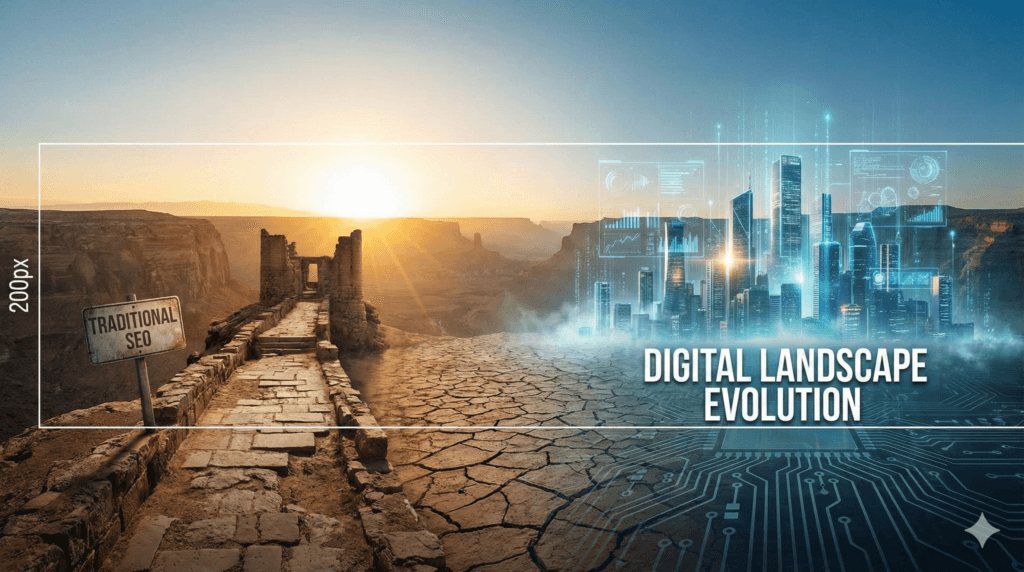
Remember when we used to “Googling” something meant scrolling through a list of websites to find an answer? That behavior is becoming as vintage as renting a DVD.
For the last two decades, the internet was a library. Google was the librarian, and SEO was the Dewey Decimal System. Your job was to make sure your book had the right sticker on the spine so the librarian would recommend it. But today, users don’t want to borrow the book. They don’t even want to open the book. They just want the information inside it, instantly.
The decline of traditional SEO isn’t because Google hates your website. It’s because user behavior has fundamentally shifted toward “zero-click” experiences. When a user asks, “How do I fix a leaky faucet?” they don’t want to read a 2,000-word life story about your grandfather’s plumbing business. They want a bulleted list of steps.
Traditional search engines are evolving into Answer Engines. We are seeing a massive drop in organic click-through rates (CTR) for informational queries because AI Overviews (formerly SGE) and tools like ChatGPT and Perplexity are answering the question right there on the interface. If your entire strategy relies on people clicking a blue link to read a definition, you are in trouble.
Emergence of Generative SEO in the Digital Era
If SEO is about convincing a robot to rank your link, GEO is about convincing an AI to speak your content.
Think of generative engines (like ChatGPT, Claude, Gemini, and Perplexity) as incredibly smart, well-read scholars. They have read the entire internet. When you ask them a question, they synthesize an answer based on what they “know.” GEO is the art of influencing what they know and crucially what sources they cite.
In 2026, visibility isn’t just about ranking; it’s about citation. Being the #1 link matters less than being the brand that the AI recommends in its summarized answer.
The Reality Check: In a GEO world, your website transforms from a “destination” into a “source.” You aren’t trying to trap users on your page; you are trying to feed the engine high-quality facts so it references you as the authority.
The rapid technological advancements have paved the way for the Emergence of Generative SEO in the Digital Era, signifying a pivotal shift from traditional keyword targeting to optimizing content for sophisticated AI-driven answer engines and conversational interfaces.
The Core Principles of Generative Engine Optimization
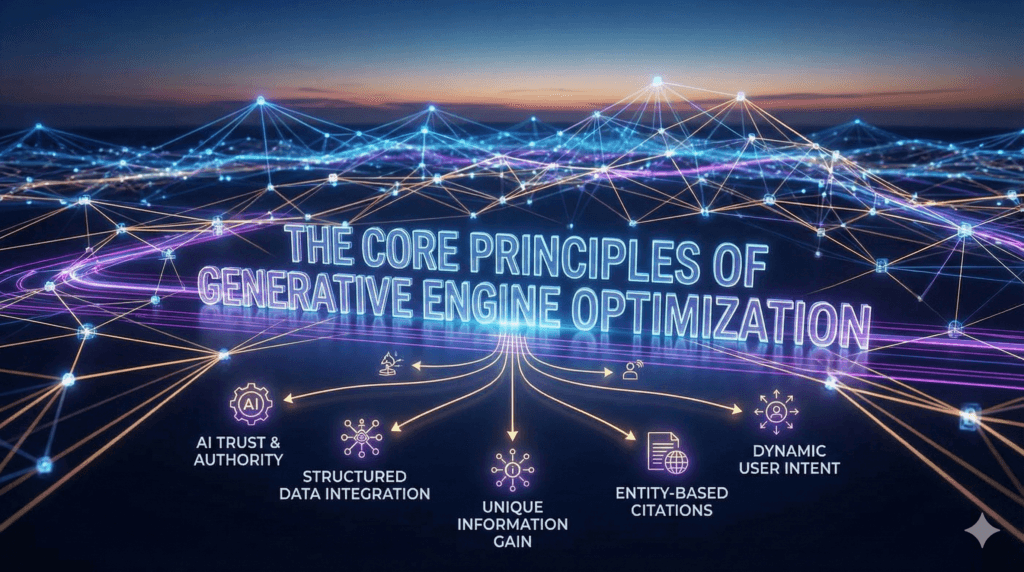
So, how do we actually do this? You can’t just stuff keywords into a ChatGPT prompt. The algorithms that power Large Language Models (LLMs) function differently than traditional search spiders.
Here are the pillars of GEO that I’ve seen working in the wild:
- Citation and Mentions: In the old days, a backlink was a vote. In GEO, a “brand mention” in a relevant context even without a link is a signal. If Reddit, Quora, and major news sites are talking about your brand in the context of “best CRM software,” the AI learns that association
- Authority and Trustworthiness (E-E-A-T on Steroids): Generative engines are terrified of “hallucinating” (making things up). They prioritize sources that look factually unimpeachable. If your content is fluffy opinion, AI will ignore it. If it’s data-backed and cited, AI will love it.
- Structure is King: LLMs read code and structure better than they read flowery prose. Using Schema markup, clear headings, and direct answers in your first 50 words helps the engine parse your content.
Harnessing Cutting-edge AI for Dynamic Content Creation
Here is where it gets meta. We are using AI to optimize for AI.
However, there is a trap here. If you use AI to write bland, generic content, you will disappear. Generative engines are trained on the “average” of the internet. If your content sounds like the average, you provide no value.
To win at GEO, you need to focus on Information Gain.
What is Information Gain? It’s the new value you bring to the table that isn’t already in the model’s training set.
- Bad Approach: Asking AI to “Write a blog post about coffee.” (Result: Generic fluff).
- GEO Approach: conducting a survey of 100 local baristas about their favorite bean, publishing the unique data, and then writing the article.
When you publish unique data, stats, or contrarian expert takes, the Generative Engine has to cite you because you are the only source of that specific truth.
Personalized Experiences: The Heart of Generative Engines Optimization
One of the most fascinating aspects of generative engine optimization is how it handles intent.
Old SEO was keyword-based. You searched “best running shoes,” and everyone got the same result. GEO is intent-based and personalized.
- User A asks: “I’m training for a marathon and have bad knees. What shoes should I buy?”
- User B asks: “I need cheap running shoes for a 5k.”
The AI will generate completely different answers for these two people. To optimize for this, your content needs to cover specific use cases. Stop writing “The Ultimate Guide to X.” Start writing “How X helps [Specific Audience] solve [Specific Problem].”
I’ve started updating my old content to include specific scenarios. Instead of just listing features, I list “Who this is for” and “Who this is NOT for.” AI engines love this nuance because it helps them answer complex, multi-layered prompts.
Navigating the Transition from SEO to GEO: Key Strategies
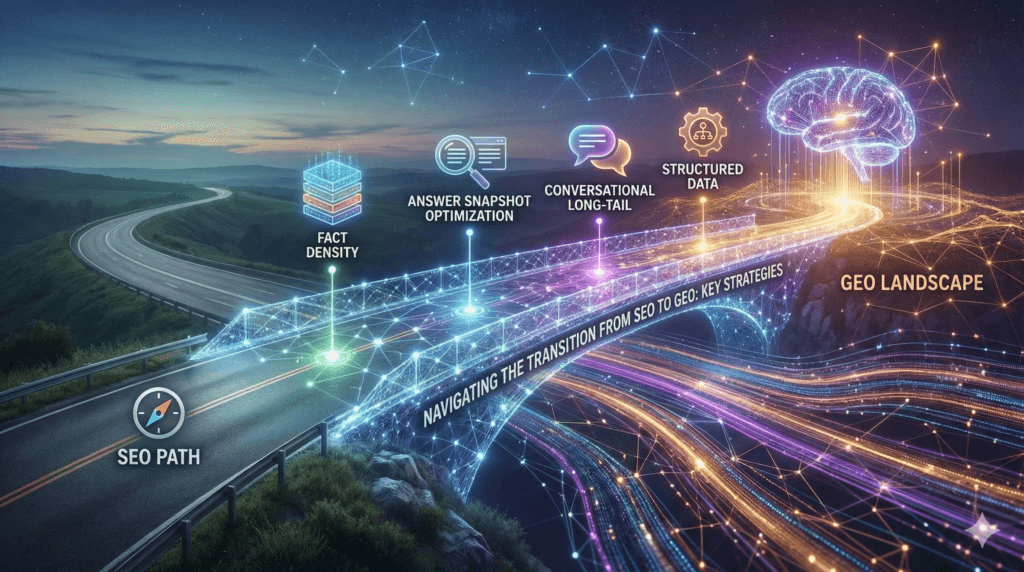
Okay, let’s get tactical. You’re sitting there thinking, “Great theory, but what do I do on Monday morning?”
Here is your transition checklist for 2026:
From Keywords to “Fact Density”
A recent study from Princeton University highlighted that increasing “Fact Density”—the number of unique facts, figures, and distinct entities per paragraph—directly correlates with visibility in generative snapshots.
- Action: Audit your top pages. Remove the fluff. Add statistics, dates, and concrete examples.
Optimize for the “Answer Snapshot”
LLMs often grab the most direct answer to a question.
- Action: If you are targeting “What is the best time to post on TikTok?”, don’t bury the answer in paragraph 4. Put it in the very first sentence, bolded. Then explain the “why” afterwards.
Own the conversational Long-Tail
People talk to chatbots differently than they type in Google. They use full sentences.
Action: Update your FAQs. Instead of “Pricing,” use the heading “How much does this software cost for a small team?” Match the natural language patterns of voice and chat search.
The Impact of GEO on Online Visibility and User Engagement
I won’t lie to you: Your traffic might go down.
I know, that’s not what you want to hear. But in the world of Generative Engine Optimization, we are trading volume for intent.
If 1,000 people search for an answer and the AI gives it to them immediately, 900 of them might never click your website. But the 100 who do click? They aren’t looking for a definition. They are looking for a deep dive, a purchase, or a community.
The “Dark Funnel” becomes darker. A lot of your brand awareness will happen inside a chat window where you can’t track it. A user might ask ChatGPT, “What are the top 3 email marketing tools?” ChatGPT answers, listing your brand. The user says, “Cool, thanks,” and closes the tab. Three days later, they type your URL directly into their browser to sign up.
attribution is going to be a nightmare, but the impact is real. You have to get comfortable with the idea that visibility doesn’t always equal a click in your analytics dashboard.
Building Connections Through Dynamic Content Evolution
Because the AI handles the basic “what is” and “how to” queries, your website needs to become a place for connection.
Content that thrives in the GEO era is content that AI cannot easily replicate:
- Personal Stories: AI hasn’t lived a life (yet). Your personal failures and successes are high-value unique content.
- Community Forums: Notice how Reddit is dominating Google results? That’s because real human discussion is the antidote to AI sludge. Building a community or forum on your site can be a huge GEO signal.
- Video and Audio: AI is getting better at reading video, but the trust established by seeing a human face is unbeatable.
I’ve shifted my focus from just writing articles to embedding video walkthroughs within them. It increases dwell time (a user signal AI picks up on) and builds a relationship that a text summary can’t replace.
Future-proofing Your Digital Strategy with Generative Engine Optimization
If you want to future-proof your business, you need to think beyond Google.
GEO is about omnipresence. It’s about being cited on Wikipedia, being discussed on Reddit, being listed in industry directories, and having a technically flawless site that bots can crawl easily.
The “Citation Network” Strategy
In 2026, focus on Digital PR. Getting your brand mentioned in news outlets and authoritative industry blogs is more valuable than a random footer backlink. These mentions feed the Knowledge Graph. When an LLM connects “Your Brand” with “Reliable Solution,” you win.
Also, don’t ignore your data. Structured data (Schema.org) is the language you use to tell the AI exactly what you are. If you aren’t using Organization, Product, and FAQ schema, you are essentially whispering in a noisy room.
Embracing Change: Thriving in the Era of GEO
Change is scary. I still miss the days when I could just tweak a meta title and watch my rankings jump. But honestly? The internet was getting cluttered with garbage.
GEO is forcing us to be better marketers. It’s forcing us to create content that actually says something new, rather than just rehashing the top 5 results. It’s forcing us to build real brands, not just affiliate sites.
So, is SEO dead? The game of SEO is dead. The art of optimization is just beginning.
2026 doesn’t belong to the person who can hack the algorithm. It belongs to the person who provides the best answer. If you can be that source the one the AI trusts, cites, and recommends you won’t just survive the death of SEO. You’ll thrive in the birth of something much bigger.
Conclusion
We are standing at the edge of a new frontier. Generative Engine Optimization isn’t just a buzzword; it’s the survival kit for the next decade of digital marketing. By focusing on authority, structured data, and high-value unique insights, you can ensure your brand remains part of the conversation, even when that conversation is happening between a human and a machine.
Don’t fight the AI. Feed it.
- If you want to learn more about Agentic AI click here.
- If you want to know that how today’s enterprices monetize AI Agents than click here.
- To know more about AI chrome browser extensions, click here.
Frequently Asked Questions (FAQs)
Q: Will GEO replace SEO entirely? A: No, they will coexist. Traditional SEO will still matter for navigational queries (finding a specific website) and e-commerce shopping tabs. However, for informational queries, Generative Engine Optimization will be the dominant driver of visibility.
Q: How do I track GEO success if I can’t see the clicks? A: It is difficult. We are moving toward metrics like “Share of Voice” in AI responses. Some new tools are emerging that track how often your brand is cited in ChatGPT answers, but you should also look at direct traffic and branded search volume as indicators of brand health.
Q: Does keyword density still matter? A: Not really. In fact, “keyword stuffing” can hurt you in GEO because it makes the text read unnaturally, and LLMs are trained to prefer natural, high-quality language. Focus on “topic coverage” and “entity richness” instead.
Q: What is the single most important thing I can do for GEO today? A: Add unique data or expert quotes to your content. If you are the primary source of a fact, the engine has to cite you.
References
- Princeton University & Google DeepMind (2024). GEO: The Definitive Study. This research paper introduced the concept of GEO and tested strategies like adding quotes and statistics. Read Complete Report here.
- Search Engine Land (2024). How AI Overviews are shifting organic traffic patterns. An insightful breakdown of the move toward zero-click searches. Read More…
- HubSpot (2025). The State of Marketing Report: AI and the Future of Search. A comprehensive look at how marketers are adapting to generative engines. Read Complete Report here.
Pingback: GraphRAG vs RAG : The Ultimate Guide to Building "Reasoning" AI Search in 2026 - AIThinkerLab
Pingback: How to Run AI Models Locally Without Internet in 2026: 7 Private, Offline Methods (Tested & Free) - AIThinkerLab