
Embarking on the journey to build your first AI agent can be both exciting and daunting. To successfully create your own intelligent assistant, it is crucial to understand the fundamentals of AI technology. Starting with the basics and gradually advancing through each step will allow you to grasp the intricacies of AI development.
By following a structured approach and learning how to orchestrate various components, you will be able to build a functional AI agent that meets your specific needs. This blog post will guide you through the process, focusing on empowering you to confidently navigate the world of AI development.
Introduction: The Death of the “Static Prompt”
You ask ChatGPT to write an email. It does it perfectly.
You then ask it to send the email.
It replies: “I can’t browse the internet.”
That moment is familiar to almost everyone experimenting with AI today and it’s exactly where traditional prompting breaks down. This is the wall we’re breaking in this guide.
At AIThinkerLab, we’ve noticed a clear shift happening beneath the hype. The real value of AI is no longer in clever prompts or chat-based interactions. It’s in execution. And execution requires something fundamentally different: AI agents.
By the end of this article, you won’t just understand AI agents conceptually you’ll know how to build your first AI agent that performs real work automatically.
The Shift: From Prompt-Based AI to Agentic AI
We are entering a new phase of AI adoption. By 2026, organizations won’t measure AI success by how well it answers questions, but by how effectively it achieves goals. This transition is known as Agentic AI.
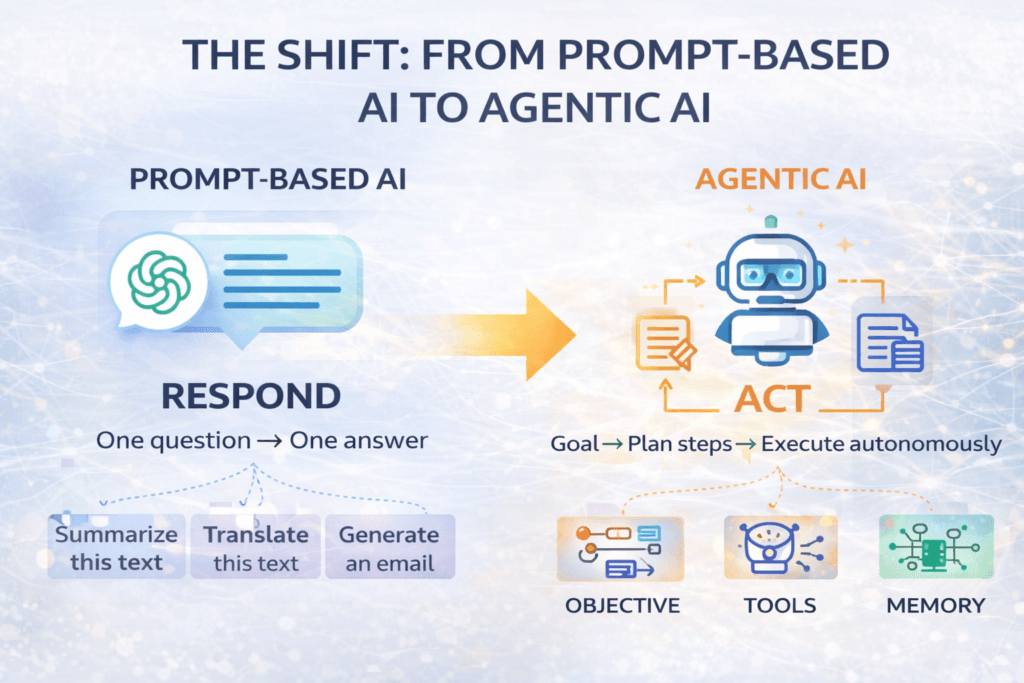
Agentic systems don’t wait for human instructions every step of the way. Instead, they:
- Understand an objective
- Break it into steps
- Use tools
- Make decisions
- Remember past actions
- Improve over time
Prompt-based AI responds.
Agentic AI acts, And that difference changes everything.
Why Prompting No Longer Scales
When it comes to building your first AI agent, prompting may seem like a powerful tool initially, but its limitations become apparent when integrated into real workflows. Through experience, four significant ways in which prompting fails at scale have been identified.
These include inconsistent responses, limited context understanding, lack of adaptability, and difficulty in handling complex queries. To truly succeed in creating an effective AI agent, it is essential to move beyond mere prompting and instead focus on orchestrating a seamless flow of interactions that can address a wide range of scenarios.
1. Manual by Design
Manual by Design” epitomizes the meticulous craftsmanship and intentional approach required in every step of creating your first AI agent. Each decision and action is carefully curated to orchestrate a seamless and effective process, emphasizing the importance of hands-on involvement and strategic planning.
This method ensures a deep understanding of the AI agent’s architecture and functionality, setting a solid foundation for future advancements and innovations in the field of artificial intelligence.
2. Fragile Results
Fragile Results” symbolize outcomes that are delicate, easily broken, or vulnerable to external influences. When embarking on the journey to build your first AI agent, ensuring robust and reliable results is crucial to success.
By meticulously orchestrating each step of the process, from data collection and preprocessing to model training and evaluation, you can shield your project from fragility. Attention to detail, consistency in approach, and proactive problem-solving are the cornerstones of building a resilient AI agent that delivers consistent and impactful results.
3. Non-Repeatable
Non-repeatable” signifies a unique occurrence that cannot be replicated. In the context of building your first AI agent, understanding the non-repeatable nature of certain experiences or data points is crucial. Each interaction, decision, or input contributes to the individuality of your AI agent, making it distinct and tailored to its environment.
By acknowledging and leveraging these non-repeatable elements, you can create a more adaptive and efficient AI agent that responds effectively to various scenarios, ultimately enhancing its performance and capabilities.
4. No Memory or Autonomy
In the realm of AI development, “no memory or autonomy” refers to an AI agent lacking the ability to retain past interactions or make independent decisions. This can limit the agent’s effectiveness in learning and adapting to new situations, hindering its overall performance.
To truly build AI agent successfully, it is crucial to equip it with both memory to store data and experiences, and autonomy to make decisions based on learned patterns. By incorporating these key elements, your AI agent can evolve into a more intelligent and efficient system, capable of orchestrating complex tasks with ease.
The Promise of This Guide
This guide is about moving beyond conversations.
By the end, you’ll understand how to build your first AI agent a system that:
- Runs on its own
- Uses tools
- Makes decisions
- Stores results
- Executes repeatable workflows
This isn’t theory. This is practical orchestration.
Prompting vs Orchestrating: The Mental Model Shift
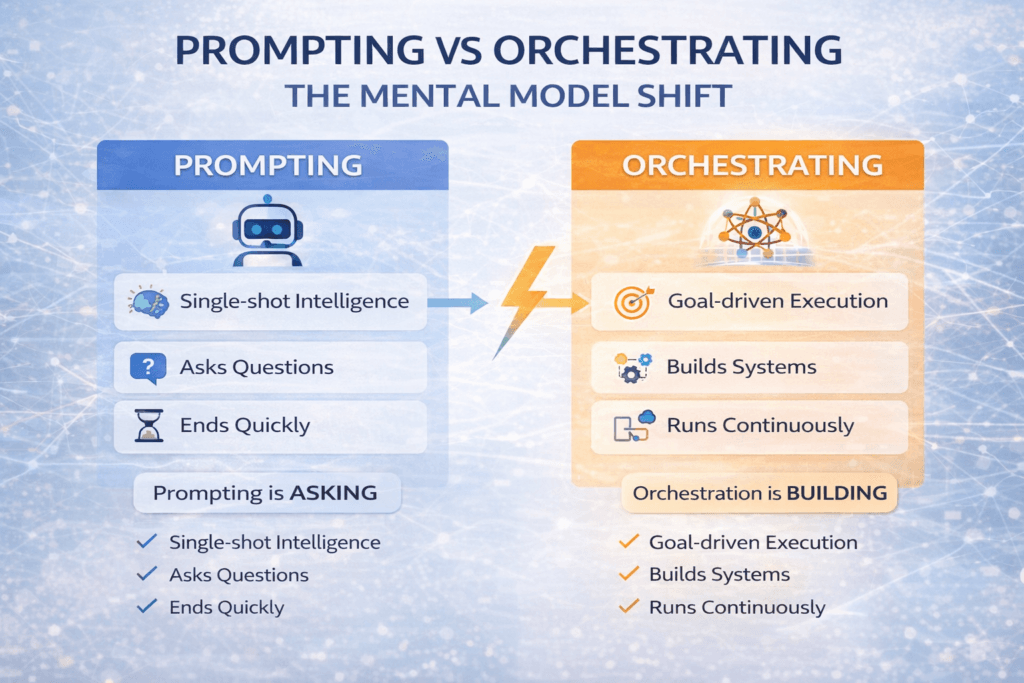
What Prompting Really Is
Prompting is single-shot intelligence.
You give context.
The AI responds.
The interaction ends.
It’s like asking a brilliant intern one question at a time without letting them take notes or follow up.
What Orchestration Means
Orchestration is goal-driven execution. Instead of asking questions, you design a system that:
- Knows its goal
- Selects actions
- Uses tools
- Checks results
- Decides what happens next
This is the difference between an AI-powered chatbot and an AI system that actually works for you.
Why Orchestration Wins
Real-world tasks are:
- Multi-step
- Ongoing
- Data-driven
- Tool-dependent
No prompt—no matter how clever—handles this reliably.
Where Prompting Still Fits
Prompting isn’t dead. It’s just no longer the star of the show. Inside orchestrated systems, prompts are used for:
- Classification
- Summarization
- Decision scoring
- Evaluation
Prompting is a component. Orchestration is the system.
Anatomy of an AI Agent: Core Building Blocks
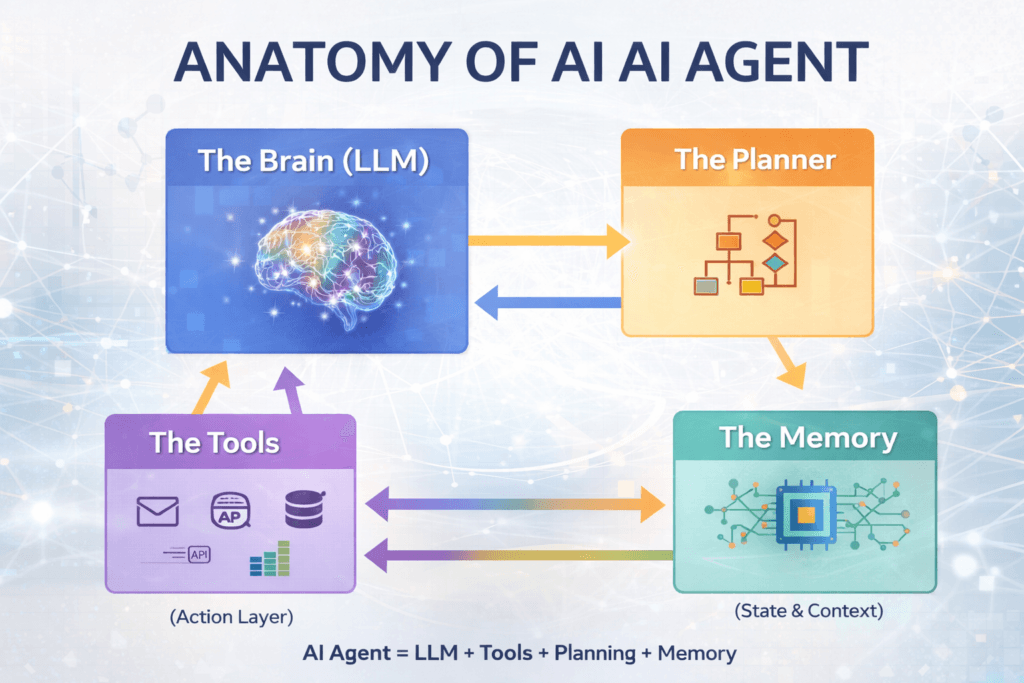
Every AI agent—regardless of platform—consists of four essential components.
1. The Brain (LLM)
This is the reasoning engine:
- GPT-4o
- Claude
- Llama
In practice, structure matters more than model choice. A well-designed agent using a smaller model often outperforms a poorly designed system running an advanced one.
2. The Tools (Action Layer)
Tools turn AI from talking into doing:
- Web search APIs
- Scrapers
- Databases
- Google Sheets
This is what transforms AI into a worker.
3. The Planner (Orchestration Layer)
The planner:
- Breaks goals into steps
- Selects tools
- Makes decisions at checkpoints
Planning can be static or dynamic—but without it, autonomy is impossible.
4. The Memory (State & Context)
Agents need memory to avoid repeating mistakes:
- Short-term task context
- Long-term summaries
- State tracking to prevent loops
Without memory, you don’t have an agent—you have an expensive prompt.
The Simple Formula
AI Agent = LLM + Tools + Planning + Memory
Everything else is implementation detail.
What You’re Building: A Real AI Agent
Let’s keep this practical.
You’ll design a Competitor Intelligence Agent—a system that:
- Monitors competitor websites
- Detects new content
- Extracts insights
- Logs results automatically
This replaces hours of manual work every week.
Step-by-Step: Designing the Agent
Step 1: Define the Goal
Clear goals prevent chaos.
Goal:
Monitor competitor updates and extract meaningful product or strategy changes.
Step 2: Define Inputs
- Competitor URLs
- RSS feeds or sitemaps
- Web search results
Step 3: Define Outputs
Each run should produce:
- Summary
- Key insights
- Potential impact
- Source links
This clarity enables reliable orchestration.
Choosing Your Build Approach
No-Code / Low-Code (Best for Beginners)
- n8n
- Flowise
These tools act as an agent platform, allowing you to visually design workflows without heavy coding.
Code-First (Best for Developers)
- CrewAI
- LangGraph
- Custom Python or Node workflows
Same logic. Different tools.
Think of this as building your own agent factory.
Build your First AI Agent with n8n (Hands-On Overview)
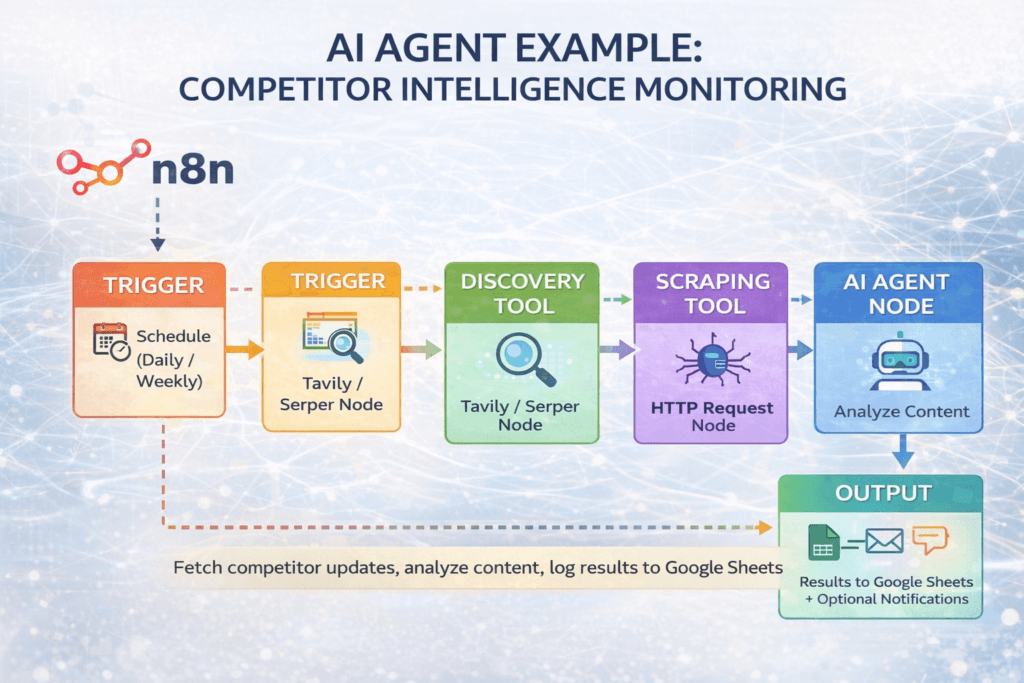
- Trigger – Scheduled or webhook-based
- Discovery Tool – Tavily or Serper to find new content
- Scraping Tool – Extract webpage text
- AI Agent Node – Analyze relevance and information gain
- Output – Store results in Google Sheets or send notifications
This is orchestration in action.
Agent Workflow Logic (Orchestration Flow)
- Fetch new content
- Check if it’s new
- Extract text
- Analyze relevance
- Generate insights
- Store results
- Wait for next trigger
This loop is the heart of agentic AI.
Common Pitfalls (And How to Avoid Them)
Infinite Loops
Track visited URLs and enforce stop conditions.
Cost Explosion
Use smaller models during testing and cache aggressively.
Hallucinations
Ground outputs in source text and add human review where needed.
Governance & Safety: Making Agents Production-Ready
This is where many teams fail. You need:
- Data classification rules
- Tool access control
- Decision logging
- Controls to prevent shadow agents
This directly connects to the Shadow AI Crisis—agents without governance create invisible risk.
When Prompting Is Still Useful
Prompting remains powerful for:
- Classification
- Style rewriting
- Evaluation
- Micro-decisions inside agents
Prompting isn’t obsolete—it’s just no longer the main event.
Scaling Up: From One Agent to Agent Swarms
Once you master one agent, you can chain many:
- Research agent
- Writing agent
- Publishing agent
The challenge becomes coordination—not intelligence.
Clear roles, shared memory, and explicit handoffs prevent chaos.
The Future of AI Orchestration (2026+)
What’s coming next:
- Policy-aware agents
- Multi-agent collaboration
- AI-native workflows replacing traditional automation
- Orchestration as a core AI skill
Platforms like Azure AI Foundry are already pointing in this direction.
Conclusion: Build Systems, Not Prompts
Prompting is conversation.
Orchestration is capability.
If you want real, compounding value from AI:
- Stop chasing clever prompts
- Start designing systems
- Focus on repeatable execution
That’s how you build your AI agent—and why it matters.
Call to Action
What task do you want to automate first?
Tell us in the comments. At AIThinkerLab, we may build it in our next tutorial.
FAQ (Schema-Optimized)
What does it mean to build your first AI agent?
It means creating a system that plans, uses tools, remembers state, and executes tasks autonomously.
Do I need coding skills?
No. Tools like n8n and Flowise enable no-code or low-code agent creation.
What’s the difference between a chatbot and an AI agent?
A chatbot responds. An AI agent acts, decides, and executes workflows.
Are AI agents expensive?
They can be—but good orchestration keeps costs under control.
Is prompting still relevant?
Yes, but only inside orchestrated systems.