
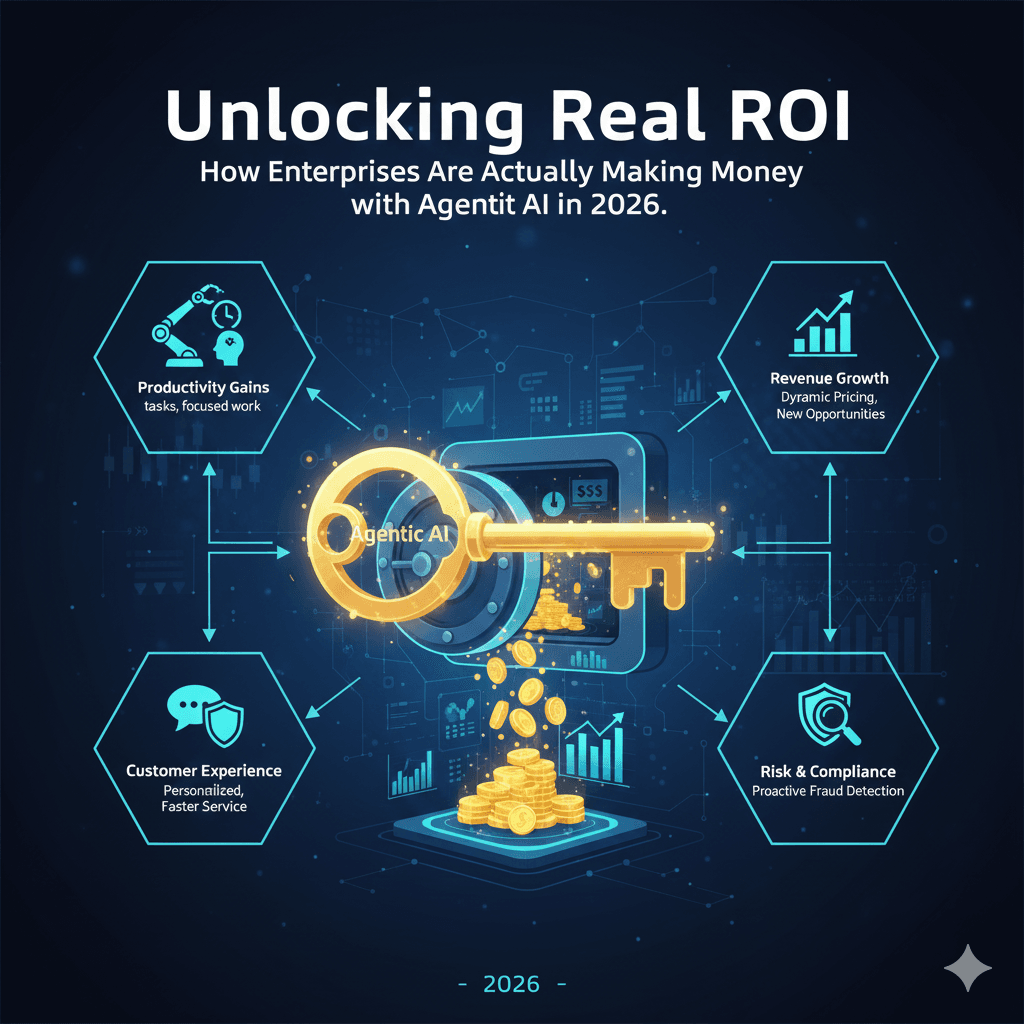
Look, I’m going to be honest with you. A year ago, if someone told me that agentic AI would be the thing separating companies printing money from those burning through pilot budgets I’d probably have nodded politely and moved on.
But here we are in 2026, and it’s not hype anymore. It’s measurable, real, bottom-line impact. We’re talking 171% average ROI, companies cutting costs by 30-50%, and some enterprises seeing returns in as little as two weeks. Not months. Weeks.
So if you’ve been wondering whether agentic AI is just another buzzword or if it’s something you should actually pay attention to—let me walk you through what’s really happening out there, with real companies, real workflows, and real dollar signs.
What Even Is Agentic AI? (And Why Should You Care)
Let’s clear this up first. Agentic AI isn’t just a fancy chatbot or another tool that waits for you to tell it what to do. It’s AI that acts. It makes decisions. It executes tasks. It learns from outcomes and adjusts its approach all on its own, with minimal hand-holding from humans.
Think of it this way: traditional AI is like that coworker who’s super smart but only answers when you ask them something. Agentic systems, on the other hand, are like the person who sees a problem, figures out a solution, implements it, checks if it worked, and tweaks it the next time without you having to micromanage every step.
That’s why enterprises are betting big on this. According to recent surveys, 62% of companies expect over 100% ROI from their agentic AI investments, and nearly 52% already have agents running in production. These aren’t pilot projects gathering dust in a PowerPoint. They’re live, working systems delivering value today. To learn more about Agentic AI than click here.
Why Agentic AI Is Different This Time
Here’s what I’ve noticed talking to folks actually implementing these systems: past AI projects often failed because they required too much upkeep. You’d build something cool, it would work for a few weeks, and then as soon as your data changed or a new edge case popped up, everything broke.
Agentic systems flip that script. They’re designed to adapt. They can reason through new scenarios, call the right APIs, escalate when they’re uncertain, and most importantly get better over time without someone rewriting the code every month.
And the agentic AI ROI? It shows up fast. Companies like Salesforce Agentforce are reporting measurable returns in just two weeks, while Microsoft Copilot Agents are cutting customer service response times by 30-50% right out of the gate. That’s not “we’ll see benefits in Q4.” That’s immediate operational lift.
Turning AI (Machine Learning) Pilots into Profit-Generating Machines
Enterprises are maximizing profits by implementing agentic AI pilots to achieve operational excellence in 2026. By enabling agentic automation and leveraging machine learning capabilities, companies are driving revenue growth through enhanced efficiency and personalized customer experiences. These agentic AI systems streamline operations, optimize processes, and deliver tailored services, ultimately unlocking substantial ROI for businesses.
Through the strategic implementation of data-driven strategies and predictive analytics, enterprises are capitalizing on agentic AI to stay competitive and agile in a rapidly evolving market landscape.
This transformative technology empowers organizations to make informed decisions swiftly, adapt to market dynamics efficiently, and seize new opportunities for sustainable growth in the digital era. By monetizing AI pilots effectively, companies are ensuring long-term success and profitability in the age of intelligent automation.
Real Companies, Real Results
Let me give you a few concrete examples, because numbers on a slide deck are one thing seeing how this plays out in actual businesses is another.
Bank of America’s Erica: 1 Billion Interactions, 98% Resolution Rate
Bank of America’s virtual assistant, Erica, isn’t just answering FAQs. She’s proactively monitoring accounts, alerting customers to unusual activity, suggesting ways to save money, and even helping dispute charges all without a human stepping in.
The agentic ROI here isn’t just about cutting support costs (though that’s real). It’s about building trust. Customers feel like their bank is working for them, not just reacting when they’re frustrated enough to call.
Bud Financial: Money Management on Autopilot
Bud Financial took agentic AI to the consumer finance side and built something genuinely useful: AI that learns each customer’s spending patterns, income cycles, and goals, then acts on their behalf.
It’ll move money between accounts to avoid overdraft fees. It’ll shift funds into higher-interest savings when it spots an opportunity. It’s doing the smart financial things most of us know we should do but forget to actually do.
Amazon’s Logistics: $100 Million Saved Annually
Amazon’s using agentic AI to optimize last-mile delivery routes dynamically. The system doesn’t just plan routes once it continuously adapts based on traffic, weather, and real-time demand, saving the company an estimated $100 million per year.
DHL’s doing something similar, with agentic systems predicting shipping demand, optimizing routes, and controlling warehouse operations, cutting operational costs by 15%.
Where the Money Actually Comes From
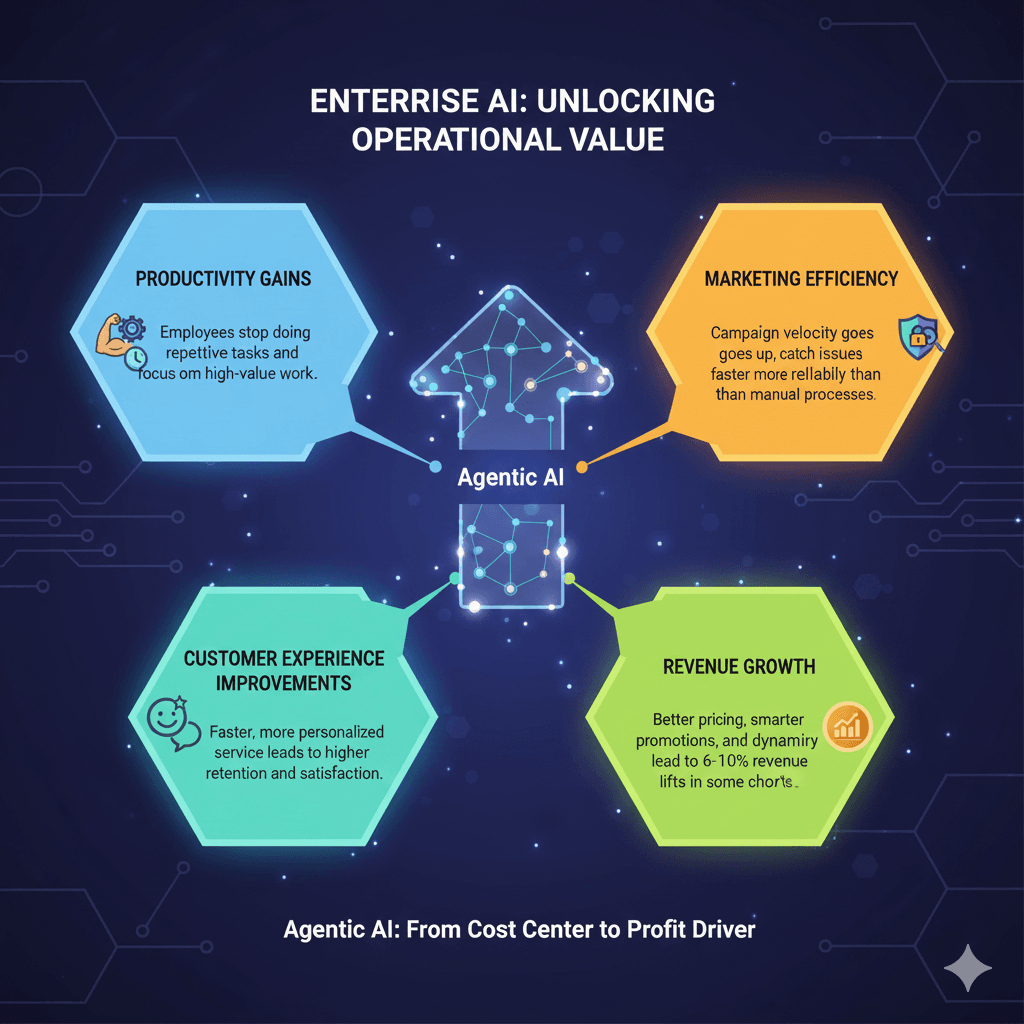
So where does agentic ROI show up in the P&L? Based on what companies are reporting, it clusters around five areas:
- Productivity gains – Employees stop doing repetitive tasks and focus on high-value work.
- Customer experience improvements – Faster, more personalized service leads to higher retention and satisfaction.
- Revenue growth – Better pricing, smarter promotions, and dynamic inventory lead to 6-10% revenue lifts in some cohorts.
- Marketing efficiency – Campaign velocity goes up, customer acquisition costs go down.
- Security and compliance – Autonomous agents catch issues faster and more reliably than manual processes.
What’s interesting is that the companies seeing the best agentic AI ROI aren’t necessarily the ones with the biggest budgets or the fanciest tech stacks. They’re the ones who identified a painful, repetitive workflow, gave an agent a clear goal and the right tools, and trusted it to figure out the best path forward.
How to Actually Get Started (Without Burning Money)
Here’s my take after watching a bunch of companies try this: don’t start with the moonshot project. Start with something annoying, repetitive, and high-volume something where even a 20% improvement would make people’s lives noticeably better.
For example:
- Automate the first tier of customer support inquiries
- Build an agent that handles routine HR or IT requests
- Deploy an agentic system that monitors your supply chain and flags anomalies before they become expensive problems
Pick one workflow. Deploy an agent. Measure the results. Then expand.
The data backs this up: 60% of DIY agentic AI initiatives fail to scale past pilot stages, usually because the ROI wasn’t clear or the project was too complex from the start. The companies that succeed are the ones who started small, proved value quickly, and then scaled methodically.
The Bottom Line
Here’s what I’ve learned watching this space: agentic AI isn’t magic, but it’s also not another overhyped tech fad. It’s a fundamental shift in how AI interacts with business processes from reactive assistance to proactive execution.
The companies that are winning right now the ones seeing those 100%+ returns, cutting costs by double digits, and actually enjoying their AI deployments they’re the ones who stopped asking AI to assist and started letting it act.
And honestly? That’s a shift any business can make. You just have to be willing to trust the process, start small, measure everything, and scale what works. Because in 2026, agentic AI ROI isn’t a promise. It’s a track record.
References
- McKinsey & Company – “Seizing the Agentic AI Advantage”
- Genesis Human Experience – “The ROI of Agentic AI 2025″
- Futurum Group – “Rise of Agentic AI: Leading Solutions Transforming Enterprise Workflows in 2025”
Pingback: GraphRAG vs RAG : The Ultimate Guide to Building "Reasoning" AI Search in 2026 - AIThinkerLab