Key Takeaways:
- On Sunday, May 17, 2026, Linus Torvalds said in his Linux 7.1-rc4 release post that the kernel’s private security mailing list had become “almost entirely unmanageable” because of duplicate, AI-generated bug reports.
- The list went from 2–3 reports a week two years ago to 5–10 per day in early 2026, according to kernel maintainer Willy Tarreau (LWN, March 2026).
- Linux 7.1 ships new documentation, written by Tarreau, instructing researchers to treat any AI-assisted finding as public — not as a private security disclosure.
- Torvalds is not anti-AI: AI-generated code is already allowed in the kernel, and he asked researchers to submit a tested patch alongside any report.
- The same pressure killed curl’s bug bounty on January 31, 2026 and triggered an 80-developer petition at Node.js — this is an industry-wide pattern, not a Linux quirk.
- The real shift: finding bugs got cheap, but triaging and fixing them stayed expensive. That asymmetry is the whole story.
A Routine Release Post With One Loaded Sentence
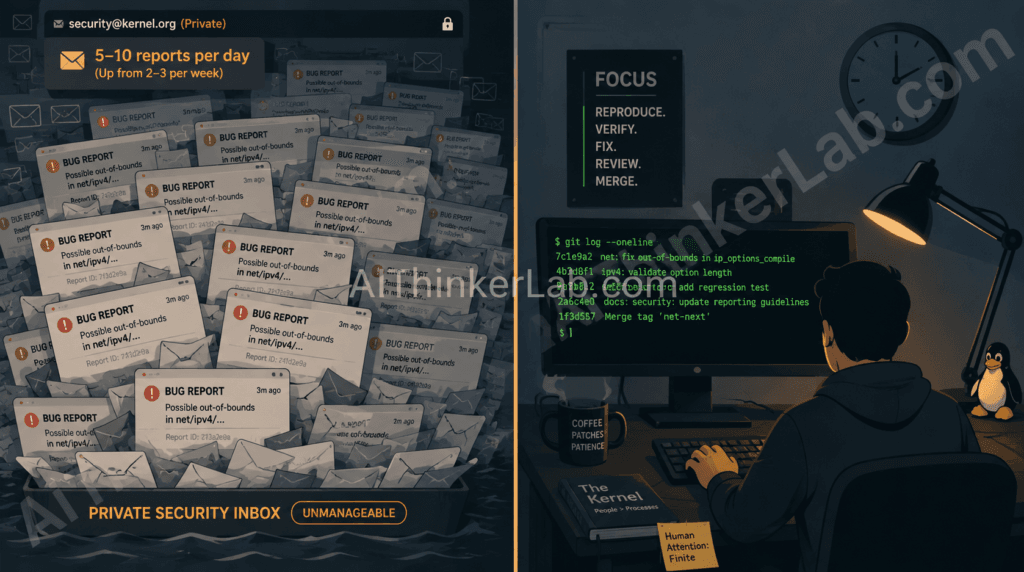
The relationship between AI bug hunters and Linux security reached a visible turning point on May 17, 2026. Buried inside an otherwise unremarkable release-candidate announcement, Linus Torvalds — the kernel’s founder and final-call maintainer — told contributors that the project’s private security mailing list had become “almost entirely unmanageable.”
The cause wasn’t a sophisticated attack or a zero-day. It was a flood of bug reports: mostly real, mostly generated with the help of AI tools, and mostly duplicates of one another.
That single line set off a week of coverage and a sharper question for anyone who builds on or depends on Linux. What happens to a 30-year-old security process when machines can find bugs faster than humans can sort them? Here’s what Torvalds actually said, what changed in Linux 7.1, and what it means the next time you file a kernel bug.
What Linus Torvalds Actually Said on May 17, 2026
In his Linux 7.1-rc4 post on May 17, 2026, Torvalds said the kernel’s private security mailing list had become “almost entirely unmanageable” because of duplicate AI-generated reports. He called the pattern “entirely pointless churn” and told researchers to read the documentation and submit a tested patch — not just a raw AI finding.
The post itself was ordinary. Torvalds described release candidate four for Linux 7.1 as fairly normal: drivers made up roughly half the patch, with GPU drivers leading that share as usual, and the rest spread across networking, core kernel, filesystems, and architecture updates. He flagged the documentation changes as worth a closer look, then turned to the problem.
His complaint was specific. Multiple researchers are running the same AI scanners against the same kernel code, finding the same flaws, and submitting them independently. Because they file through a private channel, none of them can see that someone else already reported the issue — sometimes weeks or months earlier. Maintainers, as The Register reported, now spend their time forwarding duplicates or pointing reporters to a public discussion that already resolved the bug.
And here’s the part worth sitting with: Torvalds wasn’t describing bad reports. He was describing good ones, arriving in volumes the process was never designed to absorb.
The Numbers Behind the Flood
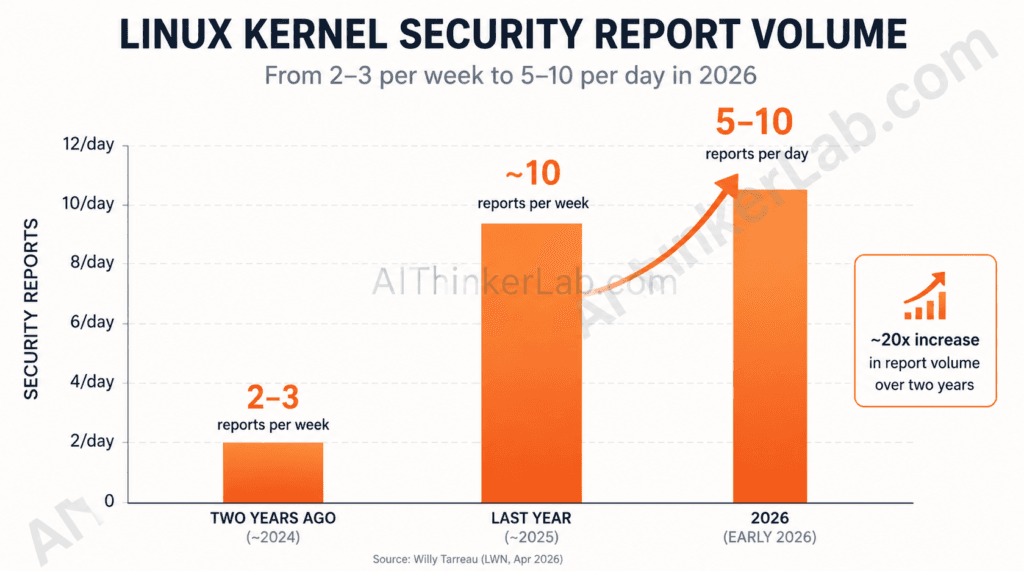
The scale is the part most summaries skip. The kernel security list received 2–3 reports per week two years ago, rose to roughly 10 a week last year, and now sits at 5–10 reports per day in 2026 — with Fridays and Tuesdays the worst, according to maintainer Willy Tarreau in comments posted to LWN and circulated in April 2026.
Tarreau, the creator of HAProxy and a longtime Linux stable maintainer, was blunt about the consequence: the team had to bring in more maintainers just to keep pace. And he named the genuinely new failure mode — duplicate reports, where two people independently surface the same bug using slightly different tools on the same day.
The trouble first showed up during the Linux 7.0 release-candidate cycle, when the project received a much larger volume of reports than usual. Most were minor and didn’t delay the release, so it didn’t trigger alarms. By the 7.1 cycle, the trend was impossible to ignore.
So what does a 20x increase in intake actually cost? Every report — duplicate or not — needs a human to read it, reproduce it, check whether a fix already exists, and respond. A volunteer security team doesn’t scale with submission volume. That gap is exactly where a security process quietly breaks.
Why AI-Found Bugs Don’t Belong on a Private List
A private security list exists for one purpose: handling flaws that are genuinely secret, so a fix can ship before attackers learn the bug exists. Torvalds’ argument is that AI-discovered bugs fail that test almost by definition.
The reasoning is mechanical, not ideological. The AI tools doing this work — code-review assistants, LLM-powered static analyzers, automated fuzzing harnesses — are widely available. When the same model scans the same public kernel source, it tends to surface the same weaknesses. Two researchers an ocean apart can independently “discover” an identical bug within hours. A finding that predictable is not a secret.
There’s a second, subtler problem. The private channel actively worsens duplication. Because reporters can’t see each other’s submissions, each one assumes they’re first. On a public bug tracker, the second person would see the existing thread and move on. Privacy, the very feature meant to protect a disclosure, becomes the thing that multiplies the noise.
The honest counterpoint: a private channel still matters for the rare flaw a single skilled researcher finds before anyone else. The new policy doesn’t deny that — it just stops treating every AI finding as if it qualifies.
Inside the New Linux 7.1 Security Documentation
Linux 7.1 ships a structural answer, not just a complaint. New security-bug documentation — authored by Willy Tarreau and merged ahead of the rc4 release — redraws the line between a security vulnerability and an ordinary bug.
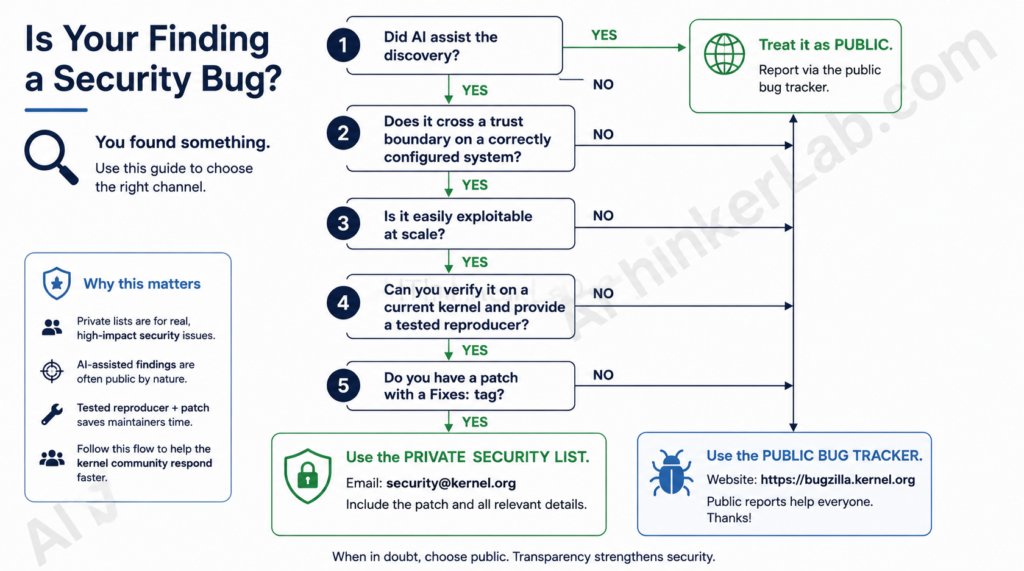
The core rule is direct: if you used AI assistance to find a bug, treat it as public. The documentation states plainly that bugs discovered this way systematically surface across multiple researchers simultaneously, often on the same day, so routing them privately helps no one.
The private list is now explicitly reserved for urgent flaws that grant an attacker a capability they shouldn’t have on a correctly configured production system, and that are easy to exploit at scale. To help reporters self-assess, the docs lean on a refreshed threat model covering process memory separation, ptrace restrictions, IPC and network isolation, user namespaces (CONFIG_USER_NS), and Linux capabilities like CAP_SYS_ADMIN and CAP_NET_ADMIN. It also clarifies what does not automatically count — obsolete kernel branches, insecure build options, debug-only features like KASAN.
For findings that genuinely qualify, the bar is concrete. Verify the bug against a recent kernel. Provide a tested reproducer — but mention it rather than post it, since the thread will become public. Propose a fix that follows submitting-patches.rst and carries a Fixes: tag pointing at the offending commit. The documentation notes, pointedly, that many AI tools write code better than they assess impact, so it asks reporters to stick to demonstrated facts and skip speculative consequences.
Run that as a quick checklist before you file: Does it cross a trust boundary? Does it work on a current kernel? Do you have a working reproducer? Do you have a patch? Two “no” answers, and it belongs on a public list.
AI Bug Hunters and Linux Security: Where the Maintainers Disagree
The most interesting part of this story is that the kernel’s own leadership doesn’t fully agree — and that disagreement is more useful than Torvalds’ headline.
In March 2026, fellow maintainer Greg Kroah-Hartman told The Register that AI bug reports had crossed a threshold from low-quality noise to genuinely useful contributions. “The tools are good,” he said, arguing the community can’t ignore them. He has skin in the game: as Tom’s Hardware noted, Kroah-Hartman runs an AI bug-finding setup of his own — discover the issue, write the fix, take responsibility, submit it publicly.
That’s the resolution hiding inside the apparent conflict. Torvalds and Kroah-Hartman aren’t arguing about whether AI can find real bugs. They agree it can. They’re arguing about workflow — and Kroah-Hartman’s own practice is precisely the behavior Torvalds asked for.
Here’s the contrarian read worth stating clearly: the duplication problem is not evidence that AI bug hunting fails. It’s evidence that it works. If these tools produced only hallucinated nonsense, you wouldn’t get two researchers independently confirming the same real flaw. The kernel’s crisis is a queue-design problem wearing the costume of an AI-quality problem.
This Isn’t Just a Linux Problem
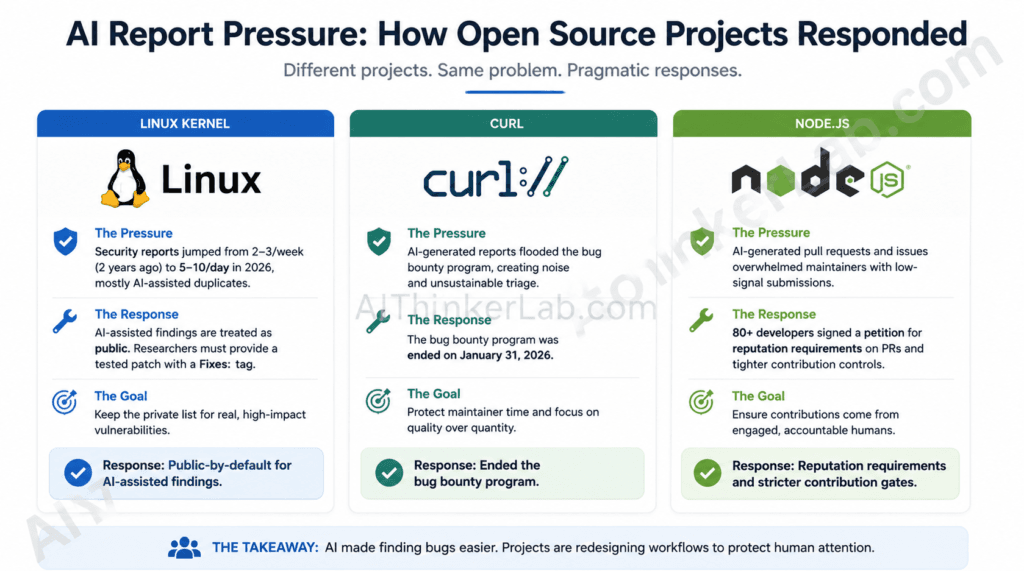
Linux is the loudest case, not the first. The same dynamic has been reshaping open-source security for months.
The clearest precedent is curl. On January 31, 2026, lead maintainer Daniel Stenberg shut down the project’s HackerOne bug bounty after a sustained wave of AI-generated reports. The program had run since 2019, paid out more than $100,000, and confirmed 87 real vulnerabilities — but the validity rate had collapsed below 5%, and Stenberg coined the phrase “death by a thousand slops” to describe the grind. He removed the monetary reward specifically to remove the incentive for low-effort submissions.
Node.js hit a different version of the same wall: a single 19,000-line, AI-generated pull request that reviewers estimated would take days to assess, followed by an 80-plus developer petition asking for an AI-contribution ban. The project compromised on a minimum reputation-score requirement instead. Other projects — Ghostty, tldraw — simply closed themselves to outside contributions.
“A 2026 Excel zero-day” (or) “the same shock hit proprietary software like Microsoft Excel”
The starkest escalation came in February 2026 with an attack security firm Snyk named “Clinejection.” Researcher Adnan Khan disclosed a vulnerability chain in Cline — a popular AI coding assistant with over 5 million users — where a single malicious GitHub issue title could hijack the project’s own AI triage bot. On February 17, an unknown actor chained that prompt injection into GitHub Actions cache poisoning and stolen npm credentials to publish a tampered release that silently installed a second AI agent, OpenClaw, on roughly 4,000 developer machines during an eight-hour window before it was caught. It’s the same structural story as the Linux flood — AI lowering the cost of an action faster than defenses adapt — but pushed to its logical conclusion: here the AI wasn’t just generating noise in a queue, it was the attack surface itself. As Zenity’s Chris Hughes put it to The Hacker News, AI supply chain risk had moved “from theoretical to operational reality.”
For developers, the practical defense is the same one that applies to any AI tool pulled from a public registry: verify exactly what it installs before you run it. We break that process down in our guide to spotting and avoiding malicious AI tool downloads.
And because a compromised tool can quietly reach for credentials and secrets on the host, it’s worth understanding how that exfiltration actually happens — see our breakdown of how AI tools can be turned into data-theft vectors and how to lock yours down.
The thread connecting all of it: AI collapsed the cost of producing a credible-looking contribution while leaving the cost of reviewing it untouched. If you maintain anything open source, this is now a structural risk to plan for, not a curiosity.
What Good AI Bug Hunting Actually Looks Like
The pessimistic framing misses a real counterexample. AI-assisted security research, done with human judgment in the loop, has produced excellent results.
The case people keep citing is an expert-guided AI analysis of OpenSSL that surfaced 12 zero-day vulnerabilities — and was praised by maintainers for the quality of the reports and the constructive disclosure, with no flood of invalid submissions clogging the queue. On the Linux side, the “Copy Fail” privilege-escalation flaw in the crypto subsystem (tracked as CVE-2026-31431) was identified through an AI-assisted scan and is exactly the kind of serious, novel finding the technology should be used for.
The dividing line isn’t AI versus no-AI. It’s a skilled person using a powerful tool versus a person forwarding unreviewed machine output. The first investigates the finding, confirms impact, writes a fix, and owns it. The second pastes and submits. Same tool, opposite value — and your reputation as a researcher now depends entirely on which side of that line you land.
“What Good AI Bug Hunting Actually Looks Like” —the Copy Fail privilege-escalation flaw” (or) “tracked as CVE-2026-31431“
What This Means If You Report Kernel Bugs
If you contribute security findings to Linux, the practical guidance changed, and it’s worth internalizing before your next report.
Start with the trust-boundary question. Before anything else, decide whether the issue actually lets an attacker do something they shouldn’t on a correctly configured system. If it doesn’t clearly cross that line, it’s a normal bug — file it on the public tracker.
Default AI findings to public. If a tool helped you find it, assume someone else found it too, and route it through the standard public reporting process unless it unambiguously meets the urgent-and-exploitable bar.
Then add the value the AI can’t. Verify the bug against a current kernel. Build and test a reproducer. Write the patch, follow submitting-patches.rst, and include the Fixes: tag. Disclose that you used AI — the new documentation expects it, and hiding it only erodes trust.
The blunt consequence: in a world where everyone has the same scanner, the finding itself is worth almost nothing. Your understanding, your tested fix, and your track record are the only things that still carry weight.
The Bigger Shift: Finding Bugs Got Cheap, Fixing Them Didn’t
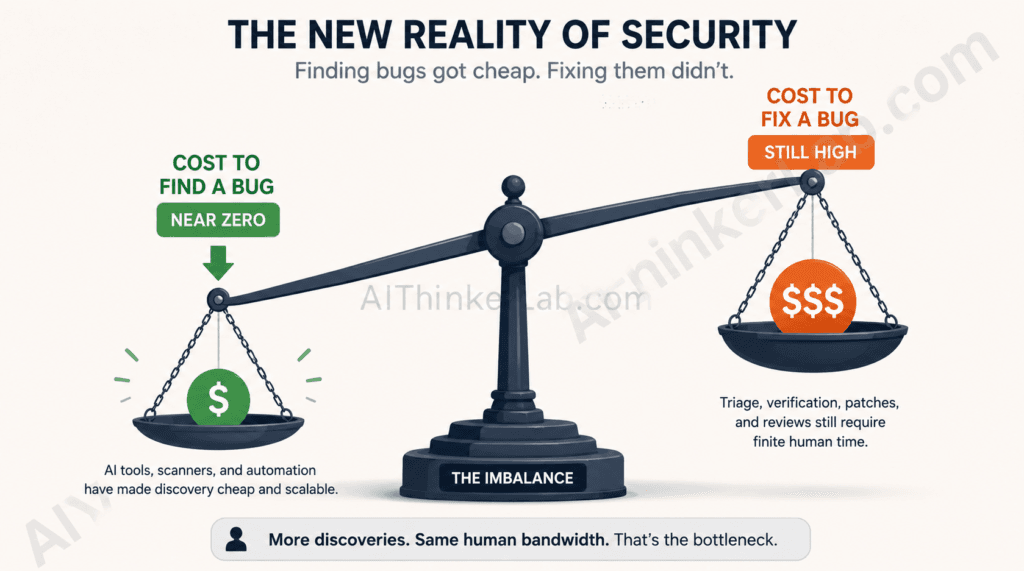
Step back from Linux and the pattern is an economics problem.
A bug bounty — or any volunteer security list — worked for years because writing a credible vulnerability report was expensive. It took time, codebase knowledge, and genuine skill. That cost was an accidental quality filter: only people who’d done real work bothered to submit.
AI demolished the submission cost without touching the triage cost. Producing a report that looks like expert analysis now takes minutes. Reading it, reproducing it, and fixing it still takes a human hours. When you remove a cost from one side of a transaction and leave the other side unchanged, the system floods. That’s not a moral failing of AI bug hunters — it’s predictable mechanics.
It also explains why the obvious fix is harder than it sounds. “Just have the maintainers run the scanners themselves” sounds tidy, and it would deduplicate intake. But it doesn’t touch the bottleneck, because someone still has to understand, prioritize, and fix every real flaw. The scarce resource was never bug discovery. It was human attention — and AI made everything around that attention cheaper while leaving the attention itself exactly as finite as before.
The projects that come through this well won’t be the ones that ban AI or embrace it wholesale. They’ll be the ones that redesign their queues around the assumption that machine-scale participation is now the default. Linux 7.1 is the first serious attempt. It won’t be the last.
Where This Leaves Linux
The headline writes itself as “AI is breaking Linux security,” and that framing is wrong. Nothing was breached. What buckled was a workflow built for human-scale participation, suddenly handling machine-scale input.
If you take one thing from this: stop treating bug discovery as the valuable part of security research. It isn’t anymore. The value moved to verification, prioritization, a tested fix, and the judgment to know which findings actually matter — the things an AI scanner still can’t do for you. Report accordingly, disclose your tools, and bring a patch.
Linux 7.1’s documentation is the first major open-source project trying to formally absorb that reality. Watch how well it works over the next few release cycles, because every project you depend on will be writing some version of the same rules soon.
Sources
- WebProNews — Linux kernel draws the line on security bugs amid AI report flood
- The Register — Linus Torvalds on the AI-flooded Linux security mailing list
- Phoronix — Linux 7.1 kernel documentation on security bugs and responsible AI use
- BetaNews — Torvalds warns AI bug reports are straining Linux security work
- Tom’s Hardware — Duplicate AI vulnerability reports and the kernel security list
- Simon Willison — Willy Tarreau’s figures on kernel security report volume
- daniel.haxx.se — Daniel Stenberg on the end of the curl bug bounty
- Snyk — How “Clinejection” Turned an AI Bot into a Supply Chain Attack
- The Hacker News — Cline CLI 2.3.0 Supply Chain Attack Installed OpenClaw