
Key Takeaways (Updated May 2026)
- Generative Engine Optimization (GEO) is the practice of structuring web content so that AI engines like ChatGPT, Perplexity, Google AI Overviews, Gemini, and Claude cite it as a source when generating answers.
- The original Princeton + Georgia Tech + IIT Delhi study (Aggarwal et al., KDD 2024) proved GEO methods can lift content visibility in AI answers by up to 40% — with “Statistics Addition,” “Cite Sources,” and “Quotation Addition” driving the biggest gains.
- Organic CTR has collapsed 61% on Google queries where an AI Overview appears (Seer Interactive, Sept 2025). AI Overviews now show in ~25% of all Google searches.
- But AI traffic is the highest-ROI channel on the web: ChatGPT converts at 14.2–15.9%, Perplexity at 10.5%, Claude at up to 16.8% — vs. Google organic’s 1.76% (Seer Interactive, 2025; First Page Sage 2026).
- The overlap between Google’s top-10 organic results and AI citations has crashed from ~75% in mid-2025 to 17–38% in early 2026 (Demand Local / BrightEdge, 2026). Ranking #1 no longer guarantees AI visibility.
- 44.2% of all LLM citations come from the first 30% of a page (Zyppy, 2025). Lead with the answer.
- Only 14% of marketers track AI search performance today (Conductor, 2026) — the first-mover window is still open.
Is SEO Dead in 2026? The Honest, Data-Backed Answer
No — SEO is not dead. But the version you optimized for in 2022 is. Classic ten-blue-link SEO has been absorbed into a larger discipline called Generative Engine Optimization (GEO), where success is measured by citations inside AI-generated answers, not by rank position. Traditional organic search still sends roughly 345× more traffic than ChatGPT, Gemini, and Perplexity combined as of late 2025 (Ahrefs) — so SEO still pays the bills. What changed is where the next click comes from, who gets attribution, and how fast that pie is being redistributed.
Here is the structural shift in one sentence:
Search engines used to send users to your website. Generative engines now consume your website for the user.
That single change rewrites every assumption behind two decades of search marketing. This isn’t just an industry opinion — it’s now Google’s official position. In documentation published in 2026, Google Search Central states plainly that, from Google Search’s perspective, optimizing for generative AI search is optimizing for the search experience, and is therefore still SEO. Google also cautions publishers against chasing unsupported “GEO hacks”: you don’t need to create LLMs.txt files or other special machine-readable markup to appear in Google’s generative results, because Google Search doesn’t use them. In other words, the discipline has a new surface area — AI answers — but the foundation is the same fundamentals, done well. [Source: Google Search Central, “Optimizing your website for generative AI features,” 2026]
The 2026 Search Landscape in Numbers
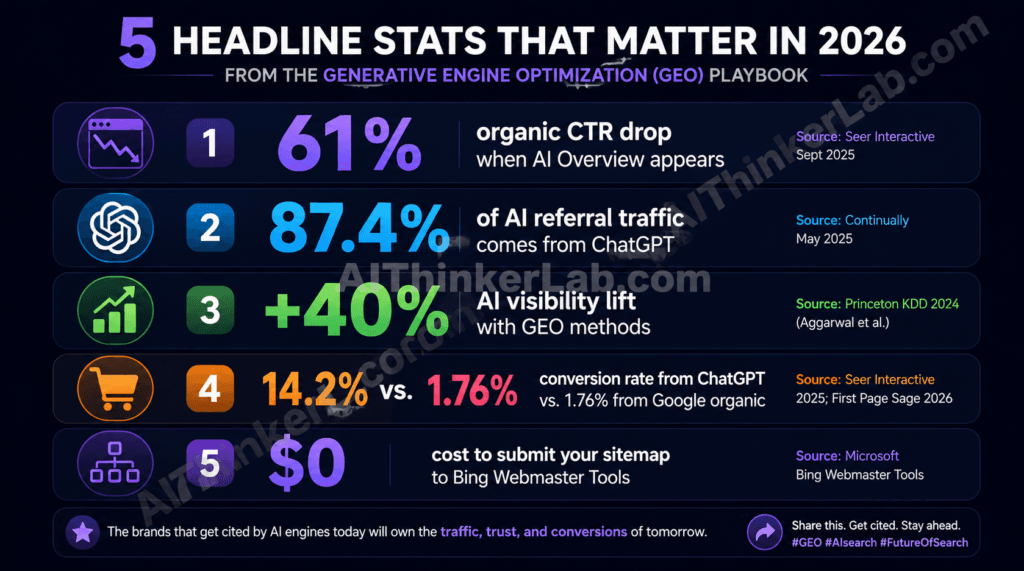
Before we get into tactics, let us anchor the conversation in actual data. These are the figures I keep tabbed open while planning client content:
| Metric | 2024 Baseline | 2026 Reality | Source |
|---|---|---|---|
| Google searches ending in zero clicks | 58.5% (US) | ~60% globally; 80–83% when an AI Overview appears | SparkToro 2024; Exposure Ninja / Mersel AI 2026 |
| AI Overview presence on Google SERPs | ~5% (2025 rollout) | 13–25% and climbing | Digital Applied 2026; Velacore 2026 |
| Organic CTR when AI Overview is shown | 1.62% | 0.61% (a 61% drop) | Seer Interactive, Sept 2025 |
| Overlap: Google top-10 vs. AI Overview citations | ~75% (mid-2025) | 17–38% | Demand Local 2026; BrightEdge 2026 |
| AI-referred sessions growth (Jan→May 2025, 400+ sites) | — | +527% | Superprompt / Conductor 2026 |
| ChatGPT weekly active users | 200M (late 2024) | 800–900M | OpenAI / ALM Corp Mar 2026 |
| ChatGPT daily prompts processed | ~1B | ~2.5B | QuickSEO 2026 |
| Share of global digital queries via ChatGPT | <2% | ~17% | QuickSEO 2026 |
| AI-platform sessions per month worldwide | — | 45 billion | Graphite + Similarweb 2026 |
| Marketers actively tracking AI search performance | <5% | 14% (43% claim to optimize for it) | Conductor 2026 |
Read those rows together and the picture is unambiguous: a structural channel shift is happening, but the operational gap — the difference between brands that say they do GEO and brands that measure GEO — is where the alpha lives.
What Is Generative Engine Optimization (GEO)? — A Clean Definition
Generative Engine Optimization (GEO) is the discipline of researching, writing, structuring, and distributing content so that large language model (LLM)–powered search engines — ChatGPT, Perplexity, Google AI Overviews, Google AI Mode, Gemini, Microsoft Copilot, and Claude — retrieve it, trust it, and cite it inside their generated answers.
The term was coined in the paper “GEO: Generative Engine Optimization” by Pranjal Aggarwal, Vishvak Murahari, Tanmay Rajpurohit, Ashwin Kalyan, Karthik Narasimhan, and Ameet Deshpande, presented at the 30th ACM SIGKDD Conference (KDD ’24) in Barcelona, with co-authors from Princeton University, Georgia Tech, the Allen Institute for AI, and IIT Delhi. The study introduced GEO-bench, a benchmark of 10,000 queries across nine domains, and demonstrated that targeted GEO methods can boost visibility in AI answers by up to 40%.
How GEO Differs From SEO (Side-by-Side)
| Traditional SEO | Generative Engine Optimization (GEO) | |
|---|---|---|
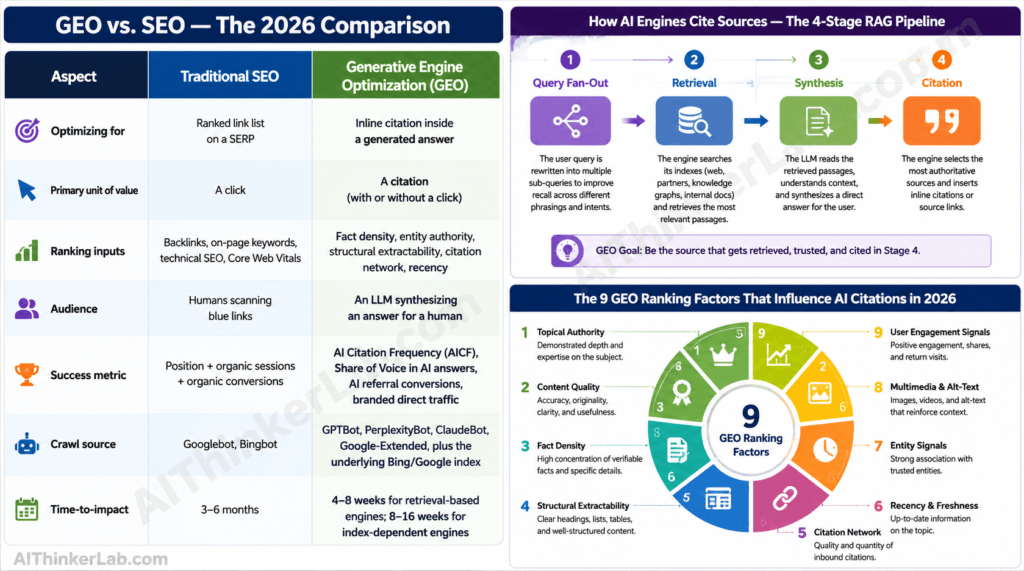
| Optimizing for | Ranked link list on a SERP | Inline citation inside a generated answer |
| Primary unit of value | A click | A citation (with or without a click) |
| Ranking inputs | Backlinks, on-page keywords, technical SEO, Core Web Vitals | Fact density, entity authority, structural extractability, citation network, recency |
| Audience | Humans scanning blue links | An LLM synthesizing an answer for a human |
| Success metric | Position + organic sessions + organic conversions | AI Citation Frequency (AICF), Share of Voice in AI answers, AI referral conversions, branded direct traffic |
| Crawl source | Googlebot, Bingbot | GPTBot, PerplexityBot, ClaudeBot, Google-Extended, plus the underlying Bing/Google index |
| Time-to-impact | 3–6 months | 4–8 weeks for retrieval-based engines like ChatGPT Search and Perplexity; months for engines that depend on training-data inclusion |
GEO does not replace SEO. Mersel AI’s 2026 framework notes that “80% of GEO is good, fundamental SEO” (a quote from Jeremy Moser, CEO of uSERP), supported by two telling overlaps: 87% of ChatGPT citations match Bing’s top-10 results, and 93.67% of Google AI Overview citations link to at least one top-10 organic result (Mersel AI 2026). GEO is the additional layer you build on top of an already-healthy SEO foundation.
How AI Engines Actually Pick Sources (The RAG Pipeline)
To optimize for AI citations, you have to understand the four-stage retrieval-augmented generation (RAG) pipeline most modern AI search products use — including Perplexity, ChatGPT Search, Google AI Overviews, and Google AI Mode:
- Query Fan-Out. The model decomposes the user’s prompt into several sub-queries. A single question like “best CRM for a 10-person agency under $50/seat” becomes 4–8 internal searches around pricing, agency use cases, scale, integrations, and reviews.
- Information Retrieval. Each sub-query hits an index (Bing for ChatGPT, Google for AI Overviews and AI Mode, a proprietary vector store for Perplexity). The system pulls candidate passages — not whole pages — that look semantically aligned with each sub-query.
- Synthesis. The LLM reconciles overlapping facts across candidate passages and drafts a single coherent answer.
- Citation Attribution. Sources that contributed specific facts to the draft get an inline citation. Sources that contributed nothing extractable — or whose claims were contradicted by stronger sources — get dropped.
This changes what you optimize. AI engines do not cite pages — they cite passages. The practical job of GEO is to make every paragraph independently extractable: a self-contained, fact-rich answer that still makes sense when an engine lifts it out of context.
That is why structural choices (short paragraphs, lead-with-the-answer, FAQ schema, tables) outrank stylistic ones (clever intros, narrative storytelling) in citation studies.
The 9 GEO Ranking Factors That Actually Move Citations in 2026
The original Princeton/Georgia Tech study tested nine optimization methods on GEO-bench. The three that significantly outperformed every other technique — across both their internal test rig and Perplexity.ai — were:
- Statistics Addition: Inject specific numbers (percentages, counts, dollar amounts, dates). Result in the paper: up to +40% visibility.
- Quotation Addition: Include direct, attributable quotes from credible third parties. Citation magnet for AI models trained to recognize attribution.
- Cite Sources: Add inline references to your own claims. The paper measured a +115.1% relative visibility lift for sites ranked 5th in SERPs that added source citations (Aggarwal et al., 2024). The headline numbers most often quoted — +41% Position-Adjusted Word Count and +28% Subjective Impression — are the average improvements across all queries. The same fetch-then-generate mechanic that AI answer engines use is exactly what powers RAG — seeing how retrieval works under the hood makes the optimization side click.
Layered on top of those core academic findings, two years of public citation studies (Authoritas, Zyppy, BrightEdge, Lantern, SE Ranking, Conductor, Seer Interactive) have surfaced six more practical factors. Together, here is what to engineer for:
- Fact Density (Statistics per 100 words). Princeton’s data shows higher fact density correlates with up to +40% AI visibility. Practical target: at least 1 verifiable statistic, named entity, or specific date every 100 words for informational content.
- Direct-Answer Lead in the First 30% of the Page. Zyppy’s 2025 analysis of thousands of ChatGPT citations found 44.2% of all LLM citations come from the first 30% of text (the intro and first major section). Bury your answer in paragraph 4 and the engine never reaches it.
- Structured Extractability. Pages with FAQ schema and inline citations are weighted approximately 40% higher in ChatGPT source selection than pages without these elements; pages with three or more schema types have a 13% higher LLM citation probability (Authoritas 2025; 2026 State of AI Search).
- Entity Authority over Backlinks. SE Ranking (Nov 2025) found sites with >32,000 referring domains are 3.5× more likely to be cited by ChatGPT than sites with <200 — but BrightEdge found 89% of AI citations now come from pages ranked beyond position 100 in traditional Google results. The takeaway: domain-level entity strength matters more than the ranking of any single URL.
- Bing Index Presence. ChatGPT Search retrieves live results primarily through Bing’s index — 87% of ChatGPT cited pages correspond to Bing’s top results. If your sitemap is not in Bing Webmaster Tools, you are invisible to the largest AI engine on Earth.
- Content Freshness. AI engines weight recency heavily on time-sensitive queries. Digital Agency Network’s 2026 research found content published in 2024 without updates consistently loses ground to a 2026 article on the same topic. A quarterly refresh cycle with a visible “last updated” date is now table stakes.
- Cross-Platform Citation Network. Yext’s study of 6.8 million AI citations found 86% come from brand-managed sources — 44% from first-party websites and 42% from business listings, reviews, and structured directories. Reddit, Wikipedia, YouTube, and Quora mentions also feed entity recognition.
- Conversational Query Match. Format follows intent: “best” queries get listicles and comparison tables; “how to” queries get step-by-step guides; “what is” queries get definition-led explainers. Mismatch the format and your citation probability drops regardless of content quality.
- Crawl Access for AI Bots. Check
robots.txt. If you have blocked GPTBot, PerplexityBot, ClaudeBot, or Google-Extended, you are actively opting out of AI visibility. Most sites do this by accident via a default WordPress security plugin setting.
Platform-Specific GEO Strategies (Because One Size Does Not Fit All)
A central finding from Semrush’s 2026 research is that only 11% of domains are cited by both ChatGPT and Perplexity AI — each platform has its own crawl priorities, indices, and content-type preferences. Optimizing once and assuming universal coverage is the single most common GEO mistake. Here is the platform-by-platform playbook.
ChatGPT Search & ChatGPT (~60–73% of AI search market share)
- Index source: Bing. Submit to Bing Webmaster Tools — it takes 15 minutes and directly raises citation probability.
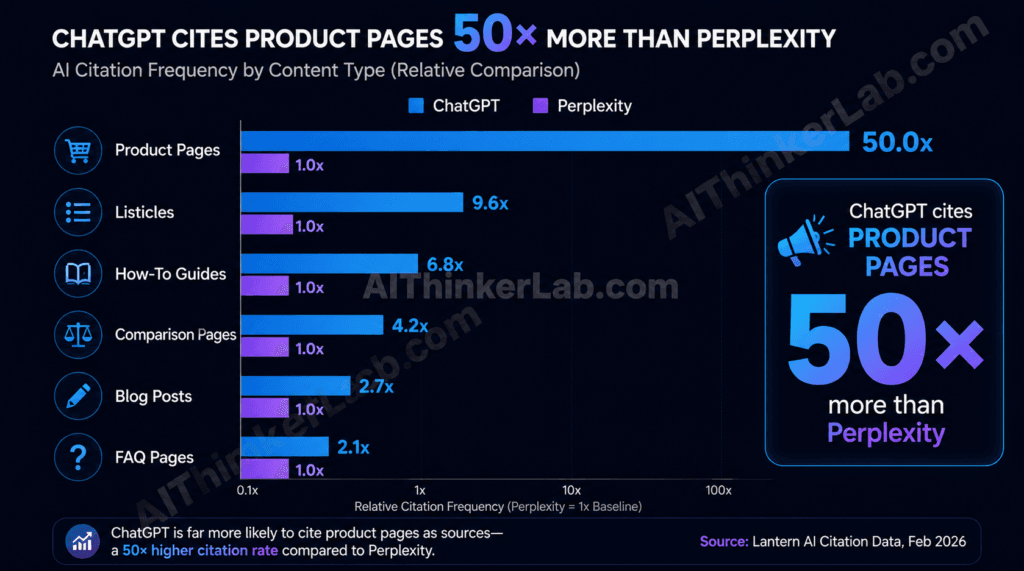
- Content type preference: Surprisingly, product pages (Lantern Feb 2026 found ChatGPT cites product pages at 20.1%, vs. Perplexity’s 0.4%). If you are a SaaS or e-commerce brand, optimize pricing pages, comparison pages, and feature pages — not just blog posts.
- Authority floor: Sites with >32,000 referring domains are 3.5× more likely to be cited (SE Ranking 2025). There is a real “trust cliff” here.
- Time-to-citation: 4–8 weeks from publish for retrieval-based answers; months to years if you are trying to influence the parametric memory of base models.
- Volume reality: ChatGPT drives 87.4% of all AI referral traffic to websites (Conductor 2026), so this is the platform where “winning a citation” translates most cleanly into actual sessions.
Perplexity AI (~5.8% market share, but disproportionately high B2B value)
- Index source: Proprietary vector index over a curated web crawl.
- Content type preference: Long-form, well-cited explainers; comparison and alternatives content; data-rich blog posts. Listicles thrive here.
- CTR strength: Perplexity displays clickable inline citations prominently, producing an 18–22% click-through rate on cited sources (BrightEdge), the highest of any AI engine.
- Per-citation ROI: Authority Tech’s 2026 study found Perplexity converts at ~11× the rate of traditional organic search — making it the highest-ROI platform per citation earned despite its small overall share.
Google AI Overviews & Google AI Mode
- Index source: Google’s own index. Strong traditional SEO is the prerequisite — 93.67% of AI Overview citations link to at least one top-10 organic result (Mersel AI 2026), even though the top-10/AIO citation overlap has dropped to 17–38%.
- Content type preference: Concise, structured answers — featured-snippet-style. The same content patterns that won featured snippets in 2020 win AI Overview citations in 2026.
- CTR risk: When an AI Overview triggers, organic CTR drops 34.5–61% depending on the study and query class. But cited brands earn 35% more organic clicks and 91% more paid clicks than uncited competitors (Seer Interactive 2025). Citation is now the only defensible position on those queries.
- Schema priority: FAQPage, HowTo, Article, and Product schema. Google explicitly uses structured data as a citation-selection signal for AI Mode.
Google Gemini (~15–21% market share, fastest growth)
- Volume trajectory: Gemini’s referral traffic to external websites grew 388% year-over-year in late 2025 vs. ChatGPT’s 52% (Lantern Feb 2026). It is the fastest-growing AI search referrer.
- Distribution edge: 77.9% of Gemini interactions occur on mobile, mainly via the Android ecosystem. Mobile UX, page speed, and AMP-friendly structure matter more here than anywhere else.
Claude (~4.1–4.5% market share, highest conversion per session)
- Citation behavior: Claude is the most conservative citer of the major engines — it tends not to surface inline source links by default in chat. Brand mentions and entity authority matter more than referral expectations here.
- Conversion strength: Despite low referral volume, Claude visitors convert at up to 16.8% (The Digital Bloom, Feb 2026) — the highest of any AI engine in commercial datasets. The audience is small, technical, and high-intent.
How to Measure GEO Success Without Going Mad
You cannot manage what you cannot measure, and the standard SEO dashboard is now structurally inadequate for GEO. The four metrics that have converged across agency research in 2026 are:
- AI Citation Frequency (AICF). How often your brand or domain is cited across ChatGPT, Perplexity, Gemini, AI Overviews, and Claude for a defined prompt set. Tools like Otterly.AI, Profound, AI Clicks, and Brandlight now automate this — but you can prototype the same audit by running 25–50 of your highest-priority queries weekly and logging citations in a spreadsheet.
- Share of Voice in AI Answers. Of all sources cited for your target queries, what percentage are you vs. each named competitor? This is the AI-era equivalent of organic SERP share.
- AI Referral Traffic in GA4. Create a custom channel grouping that classifies sessions from
chatgpt.com,chat.openai.com,openai.com,perplexity.ai,gemini.google.com,bard.google.com,claude.ai,copilot.microsoft.com, andyou.comas a distinct “AI Referral” channel. Track sessions, conversion rate, pages/session, and revenue separately. - Branded Direct + Branded Search Lift. A significant share of AI-influenced sessions show up later as direct traffic or branded search — what the industry now calls the “dark funnel.” Look at month-over-month branded search volume (in Search Console) and direct traffic alongside your AICF score; they should rise together.
Two warnings worth printing on the wall:
Warning 1 — Do not equate “organic sessions” with “marketing performance” anymore. ALM Corp’s 2026 analysis found organic click share down 11–23 percentage points across every vertical measured, while text-ad share rose 7–13 points. Stable rankings with declining CTR are not failure; they are the new normal.
Warning 2 — Different platforms reward different content. Lantern’s February 2026 citation data shows a 50× difference between ChatGPT and Perplexity in how often they cite product pages. A single unified GEO playbook is a fiction.
The 7-Step GEO Action Plan for Monday Morning
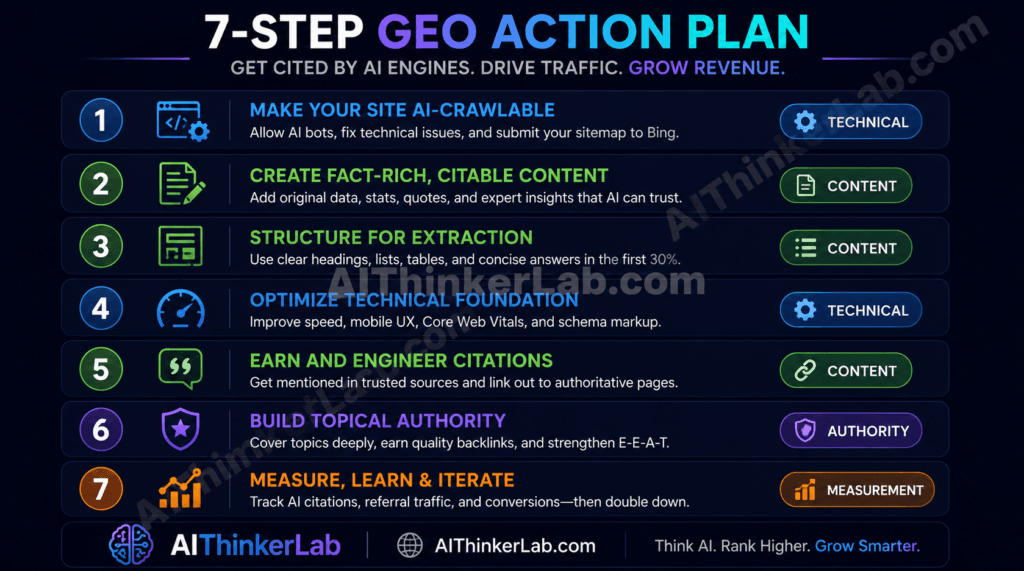
Here is the exact sequence I run for a new client audit. None of it requires special tooling beyond Search Console, Bing Webmaster Tools, GA4, and a ChatGPT/Perplexity account.
Step 1 — Submit to Bing Webmaster Tools and Verify GPTBot Access
ChatGPT Search runs on Bing’s index, and 87% of ChatGPT citations correspond to Bing top results. If you are not in Bing, you are not in ChatGPT. Then open robots.txt and confirm GPTBot, PerplexityBot, ClaudeBot, Google-Extended, and OAI-SearchBot are not disallowed.
Step 2 — Audit Your Top 20 Pages for Fact Density
For each page, count the verifiable facts (numbers, named entities, specific dates, attributed quotes) per 100 words. If you are below one fact per 100 words on informational content, you have a citation problem. Princeton’s data: adding statistics produced the single largest visibility lift in the GEO study.
Step 3 — Rewrite the First 100 Words of Every Priority Page
44.2% of LLM citations come from the first 30% of a page. Replace flowery intros with a direct, self-contained answer in the first 60 words, then expand. The “TL;DR box” at the top of this article is exactly the pattern.
Step 4 — Add Schema and Structural Extractability
Article, FAQPage, HowTo, and — for SaaS/e-commerce — Product and Review schema. Pages with three or more schema types have a 13% higher LLM citation probability (2026 State of AI Search). Use H2/H3 hierarchy honestly. Comparison content gets a table; step-based content gets a numbered list; definition content gets a definition-led paragraph.
Step 5 — Build an Original-Data Asset Every Quarter
The single most defensible GEO move is publishing data nobody else has. A 200-person survey, a proprietary benchmark, or a public methodology with hard numbers gives the AI an exclusive citation it has no choice but to attribute. Enrich Labs 2026 found that comparison content and original-research reports are the two single highest-citation content types in B2B.
Step 6 — Build the Citation Network Beyond Your Domain
Yext’s 6.8M-citation study showed 86% of AI citations come from brand-managed sources, with 44% from first-party websites and 42% from business listings, reviews, and directories. Audit your presence on Wikipedia, Wikidata, G2, Capterra, Crunchbase, Reddit, Quora, and your major industry-specific directories. Consistency of NAP and entity description across these sources directly feeds entity authority.
Step 7 — Set Up Weekly AI Citation Tracking
Pick 25–50 priority prompts (the conversational long-tail your buyers actually use). Run them weekly across ChatGPT, Perplexity, Gemini, and Google AI Overviews. Log who is cited and where. Within 8–12 weeks you will see the patterns of which content types and structural choices move your AICF — and you will have your own internal dataset, which is the most defensible GEO asset of all.
The Honest Uncomfortable Truth About GEO
The shift to Generative Engine Optimization is not a tactical adjustment, and pretending otherwise is the reason most teams will lose ground in 2026. Three things are true at the same time:
- Your informational traffic will shrink. Mersel AI’s 2026 forecast cites Gartner’s projection that organic search traffic to websites will decline 50%+ by 2028 as generative AI search scales. HubSpot has already reported a 70–80% organic decline; Business Insider, 55%. If you sell against an informational keyword strategy, you should plan for that revenue line to compress.
- A creator-economy view of the same collapse — what’s banned, what works for AI content creators in 2026 and, for the capability side of the same question, the AI advantages that hold up for creators versus the myths that don’t.
- Your highest-quality traffic will grow. AI search visitors convert at 4.4–23× the rate of standard organic. Ahrefs found AI traffic generated 12.1% of signups while accounting for only 0.5% of total visitors — a 24:1 conversion ratio. The pie is shrinking and concentrating at the same time.
- The first-mover window is still open, narrowly. Conductor’s 2026 data shows only 14% of marketers actually measure AI search performance, even though 43% claim to be “optimizing for it.” The agencies and brands that operationalize GEO in 2026 will own the citation share — and citation share, like domain authority before it, compounds. The brands AI cites today are the brands AI cites in 2027.
Don’t fight the engine. Feed it. Better facts, cleaner structure, more original data — the same craft, judged on tougher criteria.
Related Reading on AIThinkerLab
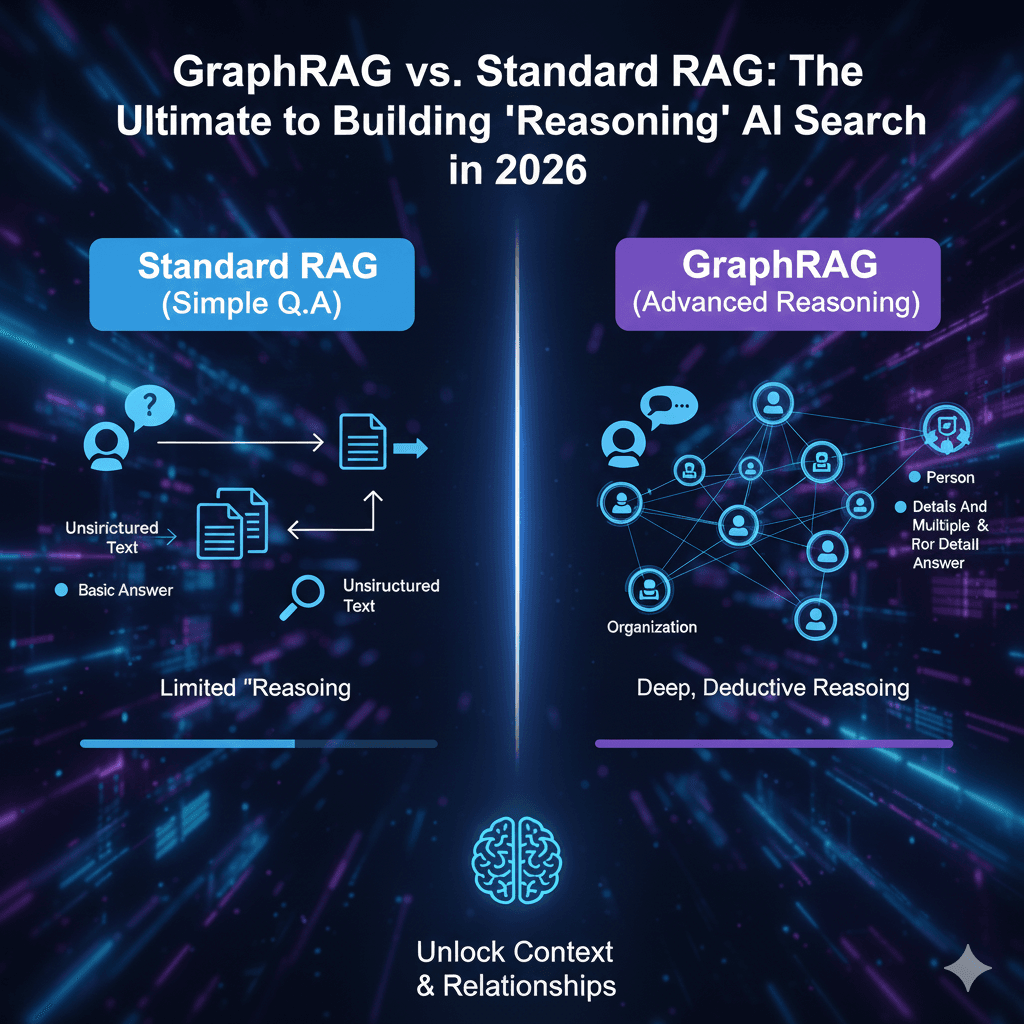
- GraphRAG vs. RAG — Building Reasoning AI Search in 2026
- AI for Creators: 11 Real Advantages, 3 Myths — which AI capabilities save creators real hours, and which marketed promises quietly underdeliver.
References
- Aggarwal, P., Murahari, V., Rajpurohit, T., Kalyan, A., Narasimhan, K., & Deshpande, A. (2024). GEO: Generative Engine Optimization. Proceedings of the 30th ACM SIGKDD Conference on Knowledge Discovery and Data Mining (KDD ’24). Read the paper.
- Seer Interactive (Sept 2025). Google AI Overviews CTR Impact Study (3,119 informational queries across 42 organizations). Source.
- Conductor (2026). AI Search Referral Benchmark Report.
- Lantern (Feb 2026). AI Citation Data Report: ChatGPT vs. Perplexity Content-Type Preferences.
- SE Ranking (Nov 2025). Referring Domains and ChatGPT Citation Probability Analysis.
- BrightEdge (2026). AI Citations Beyond the Top 100 Organic Results.
- Yext (2025). State of AI Citations: Analysis of 6.8 Million Citations.
- Authoritas / Zyppy (2025). Positional Bias in LLM Citations.
- Ahrefs (Dec 2025). AI Overviews Impact on Position-1 CTR.
- Mersel AI (2026). Why Organic Traffic Is Declining in 2026.
- ALM Corp (Feb 2026). Organic vs. Paid Share Across Verticals Post-AI Overviews.
- The Digital Bloom (Feb 2026). Gen AI Website Traffic Share Report.
- Similarweb + Graphite (Mar 2026). AI Chatbot Market Share 2026.
- HubSpot (2025). State of Marketing Report: AI and the Future of Search. Source.
- SparkToro (2024). Zero-Click Search Study.
Frequently Asked Questions About Generative Engine Optimization
Last updated: May 2026. This article is part of AIThinkerLab’s ongoing Generative Engine Optimization research series. If you spot a stat that needs updating or have first-party data to share for the next refresh, drop us a note via the Contact page.
Pingback: AEO vs Traditional SEO: Build for AI Search Day One
Pingback: GEO・LLMOの違いを比較表で整理|AIO・AEOとの使い分けと対策5選 - AI検索パートナーズ|技術に強みを持つLLMOコンサルティング
Pingback: What Is GEO? How to Get Cited by ChatGPT & Google AI (2026 Guide) — DGMI Blog
Pingback: GEO・LLMOの違いを比較表で整理|AIO・AEOとの使い分けと対策5選 - AI検索パートナーズ| AI検索対策/LLMO/AIO/GEO/AEOの実行支援
Pingback: Content Writing in the AI Era: SEO & GEO Guide 2026
Pingback: From SEO to GEO: How to Make Your Medical Content Visible to AI
the examples helped a lot, especially the second one
I love how your posts are both informative and entertaining You have a talent for making even the most mundane topics interesting
I was pretty pleased to uncover this web site.
I wanted to thank you for ones time for this wonderful read!!
I definitely appreciated every part of it and i also
have you book-marked to check out new stuff in your site.
I love how this blog celebrates diversity and inclusivity It’s a reminder that we are all unique and should embrace our differences