TL;DR – Four major AI assistants compete in 2026: Google Gemini 3.0 (best for Google Workspace users, 2M+ token context window, deep Drive/Docs/Gmail integration), ChatGPT GPT-5.2 (best general-purpose default, strongest persistent memory and voice mode, $20/month), Grok 3 (only AI with real-time access to X/Twitter, included with X Premium $8–22/month, lower content moderation), and DeepSeek V3/R1 (best price-to-performance for developers, open-weight, ~10% of OpenAI API cost — but data stored on servers in China, which creates real compliance considerations for regulated industries). Two other models matter for specific use cases: Claude Opus 4.6 for enterprise/legal/compliance work where hallucinations are unacceptable, and Meta AI (Llama 4) for self-hosted, privacy-constrained deployments with a 10M-token context window.
In 2024, “which AI should I use?” had one answer: ChatGPT Plus. In 2026 that answer is wrong for most people. ChatGPT’s share of the AI assistant market dropped from roughly 85% to around 65% over 2024–2026 — not because ChatGPT got worse, but because Gemini, Grok, and DeepSeek each carved out a real moat the other models can’t match.
Gemini is now the right answer if your work lives in Google Workspace. Grok is the right answer if you need to know what the internet is saying about something right now. DeepSeek is the right answer if you’re a developer paying API bills and want frontier-tier reasoning at roughly 10% of what OpenAI charges. ChatGPT is still the best general-purpose default — but “default” is doing different work in 2026 than it was two years ago.
This guide is a strategy piece, not a benchmark. The goal is to help you decide which of these four subscriptions is actually worth paying for given how you work — and which combinations make sense for people who route different tasks to different models. Two newer entrants — Claude (Anthropic) and Meta AI (Llama 4) — also matter for specific use cases and are covered in their own section below. For head-to-head benchmark scores, see the 2026 Grok vs ChatGPT vs Gemini testing piece — this article focuses on positioning and choice, not raw numbers.
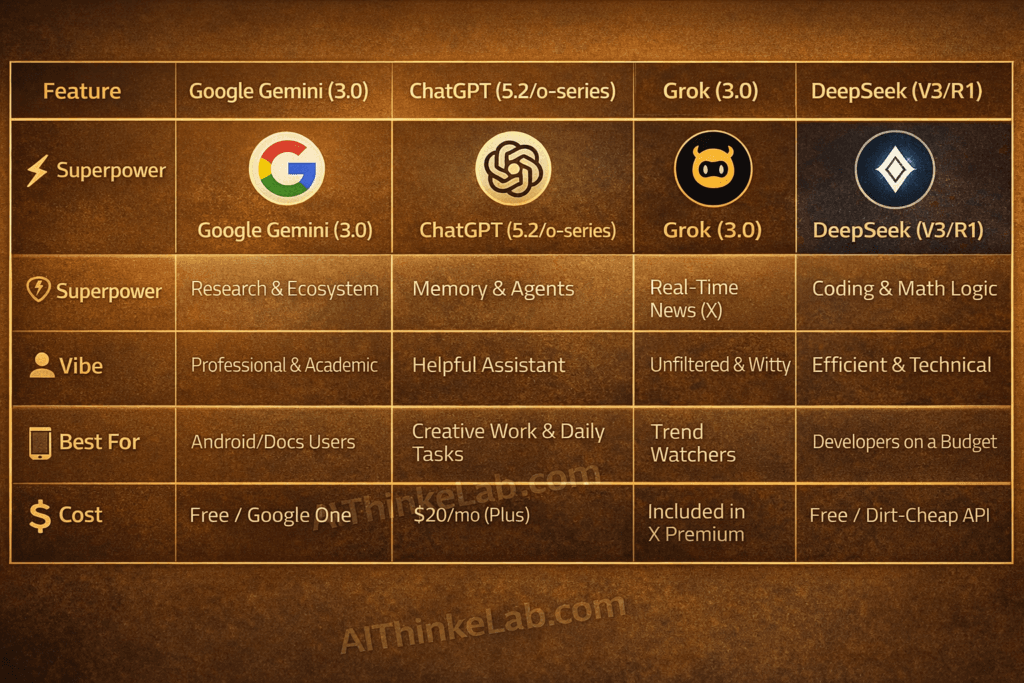
At a Glance: The “Cheat Sheet” Table
If you are in a rush and just need to know which subscription to cancel or keep, here is the high-level breakdown of the 2026 ecosystem.
| Feature | Google Gemini (3.0) | ChatGPT (5.2/o-series) | Grok (3.0) | DeepSeek (V3/R1) | Claude (Opus 4.6) | Meta AI (Llama 4) |
|---|---|---|---|---|---|---|
| Superpower | Research & Ecosystem | Memory & Agents | Real-Time News (X) | Coding & Math Logic | Safe, long-context reasoning + agentic coding | Open-weight freedom + 10M token context |
| Vibe | Professional & Academic | Helpful Assistant | Unfiltered & Witty | Efficient & Technical | Careful, precise, enterprise-grade | Open, flexible, privacy-first |
| Best For | Android/Docs Users | Creative Work & Daily Tasks | Trend Watchers | Developers on a Budget | Legal teams, compliance, enterprise developers | Privacy-first orgs, API cost cutters, devs |
| Cost | Free / Google One | $20/mo (Plus) | Included in X Premium | Free / Dirt-Cheap API | Free / $20 Pro / $5 per MTok (API) | Free / Self-hostable (near-zero running cost) |
What about Claude and Meta AI?
The Google Gemini vs ChatGPT vs Grok vs DeepSeek conversation dominates headlines — but two fast-rising challengers are changing the math in 2026: Anthropic’s Claude and Meta AI (powered by Llama 4). Neither fits neatly into the four-way battle above, but both are relevant to anyone making a serious AI decision this year.
Claude (Anthropic) — The Enterprise Expert
Claude Opus 4.6 is Anthropic’s flagship model in 2026. Built by a team of former OpenAI researchers with AI safety as a founding principle, Claude is the AI that enterprises trust when being wrong has consequences.
Three things Claude does better than the other four:
- Longest reliable document analysis: Claude’s 1-million-token context window is on par with Gemini 3.0 — but unlike Gemini, it doesn’t require Google Workspace integration. Claude can process an entire legal contract, annual report, or software codebase in a single session without losing coherence across chapters.
- Lowest hallucination rate: Independent evaluations consistently rate Claude as the most factually reliable frontier model. For high-stakes work — legal briefs, medical summaries, financial analysis — this is the metric that matters most.
- Agentic coding: Claude Code is the first AI coding assistant that autonomously reads your codebase, writes and edits files, runs tests, and commits to git — without you writing a single line of scaffolding. Developer surveys in early 2026 show Claude Code preferred over competing tools 59% of the time in real-world sessions.
Claude 2026 pricing:
- Free: claude.ai (daily limits apply)
- Pro: $20/month
- Max: $100–$200/month (unlimited Opus + Claude Code)
- API: Claude Opus 4.6 at $5 input / $25 output per million tokens
Best for: Lawyers, compliance officers, researchers, enterprise developers, and anyone whose work cannot afford a hallucinated fact. If ChatGPT is the “helpful assistant” and DeepSeek is the “budget genius,” Claude is the careful expert — slower to speculate, right more often when accuracy is non-negotiable.
Limitation: Claude does not generate images and has no native real-time web access in its standard tier (available via tools). It is also stricter than Grok about controversial content, which some users find limiting.
Meta AI (Llama 4) — The Open-Source Wild Card
Meta AI is not just one model — it’s an entire strategy. In 2026, Meta AI runs on Llama 4 Maverick, a 400-billion-parameter model with a 10-million-token context window — ten times larger than any competitor, including Gemini 3.0. It also supports native text and image processing and is available for free on WhatsApp, Instagram, Facebook, and Messenger.
The one thing Meta AI does that no other AI on this list can:
Meta AI is open-weight — meaning companies can download the model itself and run it on their own servers. No monthly subscription, no per-token fees, no data leaving the building. For organizations handling sensitive data or spending over $5,000/month on AI API costs, this single fact changes the entire economic calculation.
Three reasons Meta AI/Llama 4 matters in 2026:
- Zero API cost when self-hosted: Teams running Llama 4 Maverick on their own infrastructure pay nothing for token usage. Hardware costs are the only expense.
- 10M-token context window: The largest context window of any model available today. Llama 4 Maverick can process entire codebases, multi-year research archives, or years of email threads in a single prompt.
- Native multimodality: Llama 4 was designed from the ground up to process text and images together — not as an add-on. This enables document intelligence workflows (parsing charts, diagrams, and PDFs in one session) that other models handle less smoothly.
Meta AI 2026 pricing:
- Consumer use: Free at meta.ai, WhatsApp, Instagram, Facebook, Messenger
- Self-hosted (Llama 4 weights): $0 (hardware and cloud compute costs only)
- API via cloud partners (AWS Bedrock, Cloudflare): Standard cloud compute rates
Best for: Privacy-first enterprises (GDPR/HIPAA environments), teams with large AI API budgets looking to cut costs, developers who want full model control, and organizations needing the largest possible context window. With 650 million+ downloads, Llama is also the most widely deployed open model family in history.
Limitation: Meta AI does not have persistent memory across conversations on consumer platforms. The open-weight advantage requires technical infrastructure to realize — it is not plug-and-play for non-developers. Raw reasoning benchmarks still favor GPT-5.2 and Gemini 3.0 Pro at the very top end.
Deep Dive: The Four “Personalities”
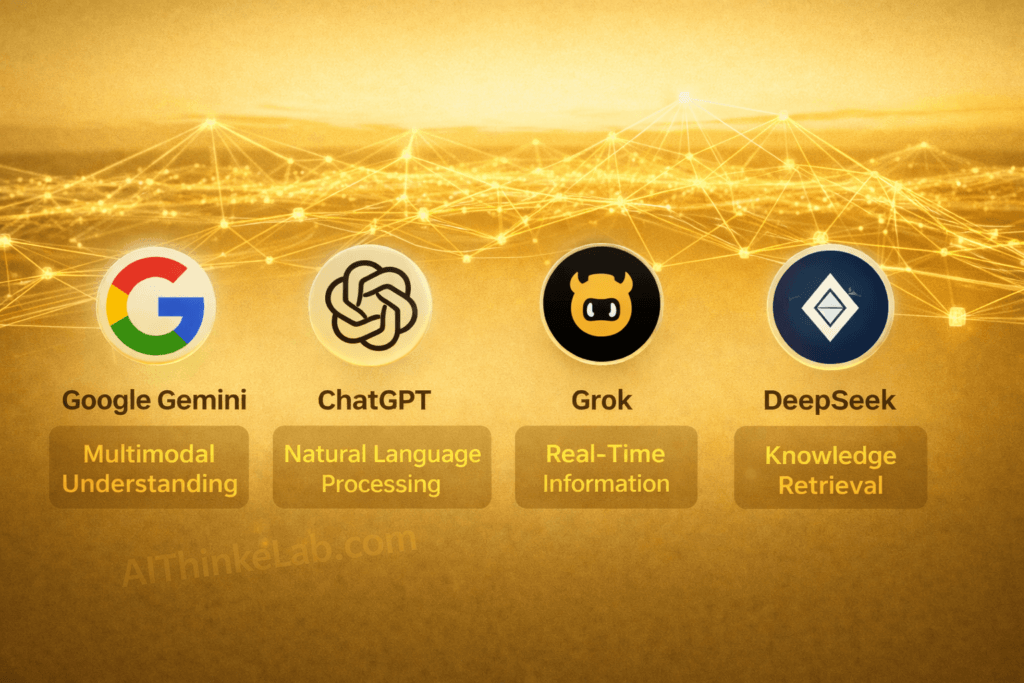
Benchmarks tell you how smart a model is; “personality” tells you how useful it will be. After roughly six months of switching between these four models for daily work — writing, coding, research, and general assistant tasks — here is what each one actually feels like in real use.
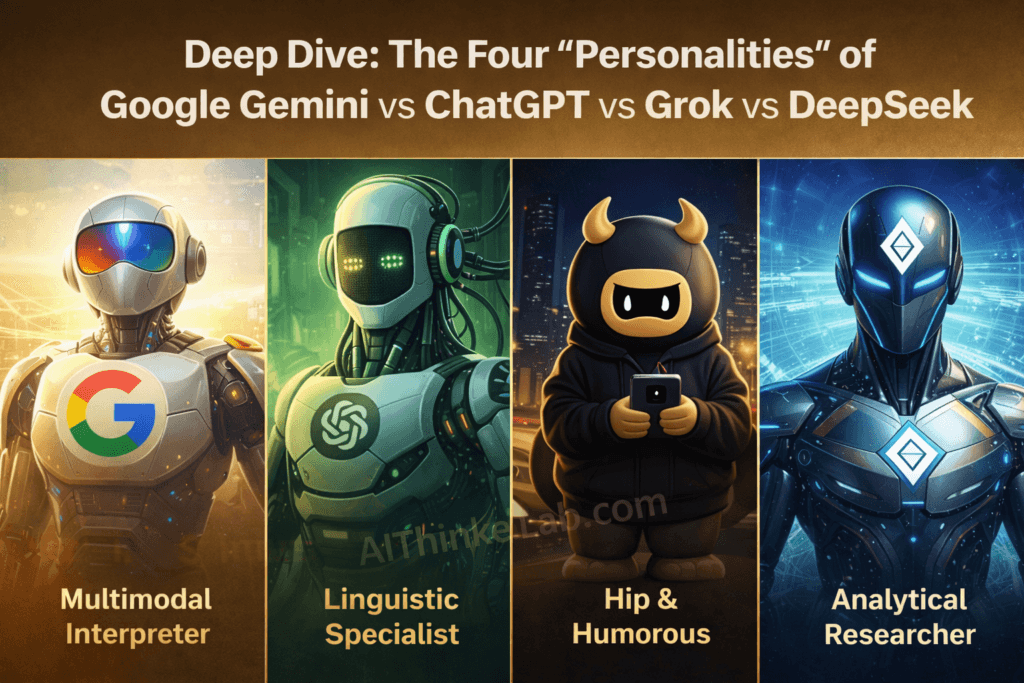
A. Google Gemini (The “Smart Colleague”)
The User: Students, Researchers, Heavy Google Workspace users.
If your life lives in tabs—Google Docs, Sheets, Gmail, and Chrome—Gemini 3.0 is barely a “tool” anymore; it’s an infrastructure layer.
What Gemini Does That No One Else Can
In my experience, Gemini’s greatest strength isn’t its raw IQ (though 3.0 is formidable); it is context. It reads your Drive, checks your Calendar, and drafts replies in Gmail without you ever leaving the tab. I recently had it plan a meeting agenda based on three different email threads and a PDF report in my Drive. It took 10 seconds. You simply cannot do that with ChatGPT without messy file uploads.
2026 Update
The new 2M+ token context window is a game-changer. You can upload entire textbooks or massive codebases, and Gemini doesn’t just summarize them—it “understands” the specific connections across chapters. In the recent “Humanity’s Last Exam” benchmarks, Gemini 3 dominated the hard sciences, making it the go-to for academic rigor.
Weakness:
It can still feel “stiff.” The safety filters in 3.0 are aggressive. If you ask for anything slightly edgy or controversial, Gemini often pivots to a pre-canned “I cannot assist with that” response faster than the others.
B. ChatGPT (The “Personal Assistant”)
The User: Writers, Creative Professionals, General Users.
OpenAI knows they can’t beat DeepSeek on price or Google on ecosystem, so they have pivoted to “Experience.”
Why ChatGPT Still Feels Like the Default
ChatGPT (running GPT-5.2 and o-series) knows me. It remembers my preferences across conversations—like “Don’t use bullet points for emails” or “I have a peanut allergy” when suggesting recipes. This accumulated context makes it feel less like a search engine and more like a partner. Furthermore, the Voice Mode remains the gold standard. It captures intonation and interruption better than Gemini, making it the only AI I talk to while driving.
Beyond general chat and reasoning, these models now power autonomous coding agents — ChatGPT’s ecosystem includes OpenAI Codex while Anthropic offers Claude Code. Our OpenAI Codex vs Claude Code comparison reveals which AI coding agent actually wins on benchmarks, pricing, and real-world code quality.
2026 Update
The focus this year is the o-series (reasoning) models. These aren’t just chatbots; they are agents. You can ask it to “Plan a 3-week trip to Japan,” and it will actually reason through travel logistics, rail pass costs, and weather patterns step-by-step, rather than just hallucinating a generic itinerary.
Weakness:
It is getting expensive. To access the top-tier features (like unlimited o-series reasoning or advanced voice), the $20/month subscription feels like a baseline requirement, whereas others offer more for free.
C. Grok (The “Live Wire”)
The User: News junkies, Stock traders, Social Media managers.
Grok is the anti-corporate AI. If Gemini is a library, Grok is a newsroom floor.
Grok’s Real Moat: A Direct Pipe to X
This is Grok’s massive moat. While Gemini and ChatGPT rely on search indexes (which can take hours or days to update fully), Grok has a direct pipe to X (formerly Twitter). It knows a meme is trending or a political scandal is breaking seconds after it happens. I use Grok exclusively when I need to know why something is happening “right now.”
2026 Update
Grok 3 has surprised everyone with its visual reasoning and “unfiltered” creative writing. It’s willing to be snarky, funny, or edgy in ways that OpenAI’s RLHF (Reinforcement Learning from Human Feedback) training explicitly forbids.
Weakness:
It can be an echo chamber. Because it pulls heavily from X, its “facts” are sometimes just prevalent opinions. The tone can also be erratic—sometimes you want a straight answer, not a witty comeback.
D. DeepSeek (The “Budget Genius”)
The User: Developers, Startups, Data Analysts.
DeepSeek is the “people’s champion” of 2026. Coming out of China, it completely upended the economics of intelligence.
DeepSeek’s Numbers: GPT-Level Logic at 10% the Cost
DeepSeek offers GPT-4/5 level logic for pennies. I know entire startups that have migrated their backend from OpenAI to DeepSeek’s API and cut their monthly bill by 90%. It is lean, mean, and incredibly logical.
2026 Update
DeepSeek-R1 (Reasoning) is currently the developer favorite for debugging. When I feed it a broken code block, it doesn’t just fix it; it explains why the fix works with a level of technical depth that often beats ChatGPT. It’s optimized for pure logic, math, and code.
Weakness:
It lacks the polish. There is no fancy voice app, no calendar integration, and no image generation ecosystem. It is strictly a text/code engine for people who want work done.
What Can Grok Do That ChatGPT and Gemini Cannot?
For the most recent Grok 4-specific benchmarks against GPT-5.5 and Gemini 3.1 Pro, see the hands-on testing article — those numbers update faster than this strategy guide does.
Here are the four things Grok does that its direct rivals simply cannot replicate:
1. Live X (Twitter) Data Access — Grok’s Unmatched Moat
Grok reads X posts, trending topics, and raw social conversation in real time — seconds after content is published, not hours. ChatGPT and Gemini rely on web search indexes that update on a delay. When a stock moves unexpectedly, a CEO posts something controversial, or a meme drives a buying trend, Grok knows before any other AI does.
Practical test: Ask Grok “Why is [company] trending right now?” — it pulls the exact X thread driving the conversation. Ask ChatGPT the same question and it either says “I don’t have access to real-time data” or references an article from yesterday.
This matters most for: stock traders, social media managers, PR professionals, journalists, and anyone who needs to know why something is happening in the world right now, not what happened yesterday.
2. Fewer Content Restrictions Than Any Other Major AI
Grok engages with satirical, edgy, and politically sensitive content at a level that OpenAI’s RLHF safety training and Google’s content policies explicitly prevent. For users who find mainstream AI assistants frustratingly evasive or over-moderated, Grok’s willingness to be blunt, snarky, or contrarian is a genuine differentiator.
Important caveat: Lower guardrails cut both ways. Grok more readily engages with controversial content — but also occasionally presents X platform opinion as verified fact. Cross-check anything Grok reports from a social source before treating it as authoritative.
3. Real-Time Social Sentiment Analysis
Because Grok indexes the raw X feed rather than curated news, it can analyze how people are actually talking about a topic right now — not just what official sources say. This makes it uniquely powerful for:
- Market research: Tracking real consumer sentiment on a product launch before review sites have published anything.
- Crisis communications: Seeing how fast a PR crisis is spreading and what narrative is forming — before the formal coverage follows.
- Political and cultural monitoring: Understanding the grassroots conversation around a topic, not just the polished editorial take.
Neither ChatGPT nor Gemini offer equivalent real-time social intelligence, regardless of which search add-on they use.
4. Bundled Cost Advantage for X Premium Subscribers
Grok is included with X Premium ($8–$22/month) — meaning existing X subscribers access a frontier-tier AI at zero additional cost. ChatGPT Plus costs $20/month separately. Gemini Advanced costs $19.99/month separately. For users who already pay for X, Grok has no marginal cost.
What Grok Cannot Do That ChatGPT and Gemini Can
Being honest about Grok’s limitations is just as important as highlighting its strengths:
| Capability | Grok 3 | ChatGPT (GPT-5.2) | Gemini 3.0 |
|---|---|---|---|
| Persistent memory | ❌ None | ✅ Full | ✅ Limited |
| Document analysis | ⚠️ Limited | ✅ Strong | ✅ Best-in-class (2M tokens) |
| Image generation | ⚠️ Limited | ✅ DALL-E 4 | ✅ Imagen 3 |
| Coding benchmarks | ⚠️ Average | ✅ Strong | ✅ Strong |
| Real-time X data | ✅ Unique | ❌ None | ❌ None |
| Google Workspace link | ❌ None | ❌ None | ✅ Native |
Bottom line: Use Grok for real-time social intelligence and unfiltered responses. Use ChatGPT for memory-dependent tasks, creative work, and voice interaction. Use Gemini when your workflow lives inside Google’s ecosystem. The strongest strategy in 2026 is not picking one — it’s knowing when to reach for each.
Is DeepSeek Safe to Use and Where Does It Store My Data?
DeepSeek is technically impressive, but its default data storage practices create real compliance risks for organizations in regulated industries.
This is not a theoretical concern — it is a data residency question with specific, verifiable answers.
Where DeepSeek Stores Your Data
DeepSeek AI is a Chinese company headquartered in Hangzhou, China. Its privacy policy states that user data — including prompts, conversation history, and uploaded files — may be processed and stored on servers in the People’s Republic of China.
This has concrete implications:
- EU / GDPR users: Data transferred to Chinese servers falls outside the standard frameworks of GDPR data protection. EU users relying on DeepSeek’s consumer interface may have limited legal recourse under European privacy law.
- US federal and government-adjacent organizations: Several US agencies have issued guidance restricting DeepSeek on government devices. Contractors working with US federal clients should verify explicitly whether DeepSeek is permissible under their contracts before deployment.
- HIPAA (healthcare) and financial data: Any protected health information (PHI) or regulated financial data sent via DeepSeek’s consumer API is subject to Chinese data law, not US HIPAA or SOC 2 frameworks. This is a categorical compliance risk, not a gray area.
Is DeepSeek Safe for Personal Use?
For general personal use — coding assistance, writing help, research summarization — the practical risk is comparable to using any other foreign-operated AI service. The data residency concern is most acute for sensitive professional or regulated data, not everyday queries.
DeepSeek’s consumer chat product has also been flagged in independent cybersecurity audits for vulnerabilities in its web interface — separate from any concerns about the model weights themselves. For personal users, keeping standard operational security practices (not sharing passwords, financial data, or identifying information) is sufficient mitigation.
The Three Safe Ways to Use DeepSeek in 2026
If you want DeepSeek’s capability without the data residency risk, three options maintain the model’s performance advantage:
Option 1 — Self-host the open-weight version DeepSeek has released open-weight versions of its models. Running these on your own infrastructure means no data ever leaves your network. This is the option chosen by privacy-first enterprises and organizations with HIPAA or GDPR constraints.
Option 2 — Access DeepSeek via a Western cloud provider AWS, Microsoft Azure, and Google Cloud now offer DeepSeek models through their own managed APIs. In these configurations, data is processed and stored under US or EU data residency agreements — governed by those providers’ compliance frameworks, not DeepSeek’s. This is the recommended path for organizations that want DeepSeek’s cost advantage with Western data guarantees.
Option 3 — Use Claude Haiku 4.5 as a Western alternative For teams that specifically want a low-cost reasoning model without Chinese data residency, Claude Haiku 4.5 at $1 per million input tokens is the closest price-competitive Western alternative. It does not match DeepSeek R1 on pure math reasoning, but it handles the majority of production use cases at comparable cost.
DeepSeek Safety: Summary Table
| User Type | Risk Level | Recommended Action |
|---|---|---|
| Personal / casual use | Low | Standard use is fine; avoid sharing sensitive data |
| EU-based organization | Medium | Use via Western cloud provider (AWS/Azure/GCP) |
| US federal contractor | High | Verify contract terms; likely prohibited |
| Healthcare (HIPAA data) | High | Self-hosted open-weight only, or use Claude/OpenAI |
| Finance (regulated data) | High | Self-hosted open-weight only, or use Claude/OpenAI |
| Developer (non-sensitive data) | Low | Direct API or self-hosted; excellent cost/performance |
Verdict: DeepSeek V3 and R1 are among the most capable and cost-effective AI models in 2026. The safety question is not about the model’s intelligence — it is about where your data goes. Know the answer before you deploy at scale.
The “Privacy & Trust” Factor
We can’t talk about AI in 2026 without talking about data.
- Closed Gardens (OpenAI & Google): By default, your interactions with ChatGPT and Gemini can be used to train future models (unless you are on an Enterprise plan or opt-out). You are paying for convenience with your data.
- Open Weights (DeepSeek): DeepSeek has released “Open Weights” versions of their models. This means tech-savvy users or companies can run DeepSeek locally on their own servers. If you are working with highly sensitive HIPAA or financial data, running a local instance of DeepSeek is the only way to guarantee total privacy.
Which is Best in 2026 — Google Gemini, ChatGPT, Grok, or DeepSeek?
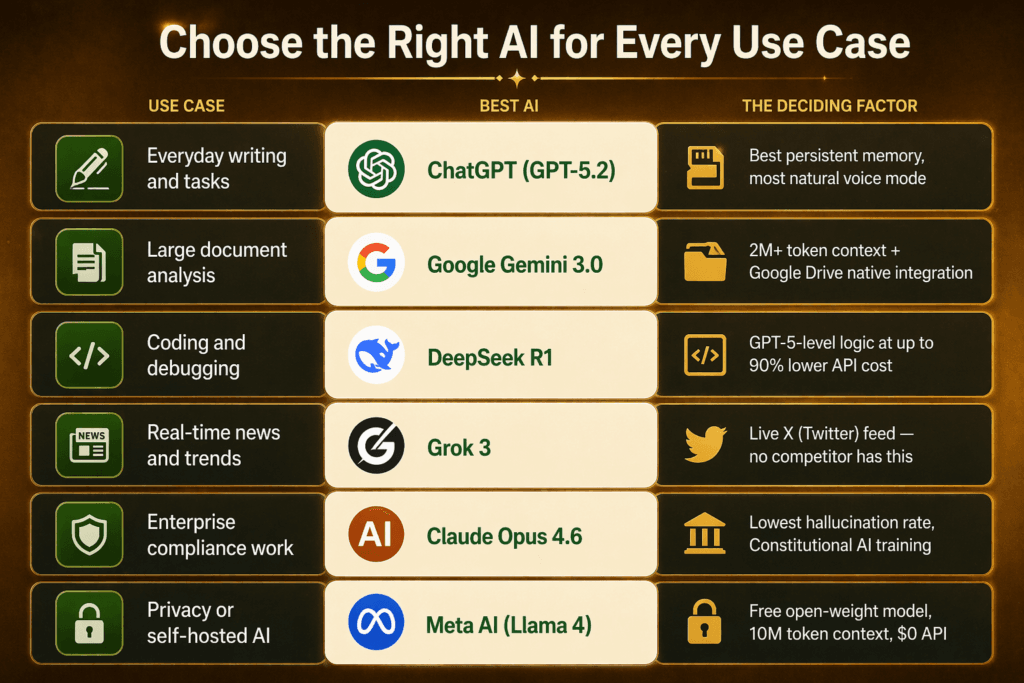
ChatGPT (GPT-5.2) is the best overall AI in 2026 for most users. But “best” is a proxy question for “best for what?” — and the answer changes completely depending on your workflow.
Here is the clearest breakdown available, based on real-world testing across all six major AI platforms:
Best AI by Use Case in 2026
| Use Case | Best AI | The Deciding Factor |
|---|---|---|
| Everyday writing and tasks | ChatGPT (GPT-5.2) | Best persistent memory, most natural voice mode |
| Large document analysis | Google Gemini 3.0 | 2M+ token context + Google Drive native integration |
| Coding and debugging | DeepSeek R1 | GPT-5-level logic at up to 90% lower API cost |
| Real-time news and trends | Grok 3 | Live X (Twitter) feed — no competitor has this |
| Enterprise compliance work | Claude Opus 4.6 | Lowest hallucination rate, Constitutional AI training |
| Privacy or self-hosted AI | Meta AI (Llama 4) | Free open-weight model, 10M token context, $0 API |
For the most current 3-way comparison covering the latest models — Grok 4.3, GPT-5.5, and Gemini 3.1 Pro — see our dedicated 2026 head-to-head analysis with full benchmarks and pricing tables.
The Honest 2026 Ranking for General Users
If you had to choose a single AI subscription today, here is where each platform stands:
- 🥇 ChatGPT (GPT-5.2/o-series) — Best overall. Memory, voice, agents, and the widest feature range for everyday users. The $20/month subscription is justified for general-purpose use, creative work, and autonomous task completion.
- 🥈 Google Gemini 3.0 — Best for Google Workspace users, students, and researchers. The 2M+ token context window is the largest of any closed commercial model. If you live in Google Docs, the integration advantage is decisive.
- 🥉 DeepSeek V3/R1 — Best value. Matches ChatGPT and Gemini on most benchmarks at a fraction of the cost. The go-to choice for developers and startups building AI-powered products at scale.
- Claude Opus 4.6 — Best for enterprise, legal, and high-stakes analysis. The right choice when being wrong has consequences and budget allows for a premium reliability tier.
- Grok 3 — Best for real-time information. Essential for social media professionals, traders, and journalists. Weaker than the others as a standalone general-purpose AI.
- Meta AI (Llama 4) — Best for self-hosted or privacy-constrained deployments. If data residency or zero API cost is your primary constraint, this changes everything.
Why There Is No Universal “Best AI” in 2026
The AI market fragmented in 2025–2026 precisely because no single model dominates every dimension. OpenAI leads on user experience. Google leads on ecosystem integration. DeepSeek leads on price-to-performance. Claude leads on reliability. Grok leads on real-time data. Meta leads on open-weight freedom.
Power users in 2026 do not pick one AI — they route tasks to the right model for each job. A developer might use DeepSeek for code, Claude for document review, and Grok to track what the tech community is saying about a new framework — all in the same afternoon.
If you are still using only one AI for everything, this guide is your signal to rethink that approach.
Next steps and further reading
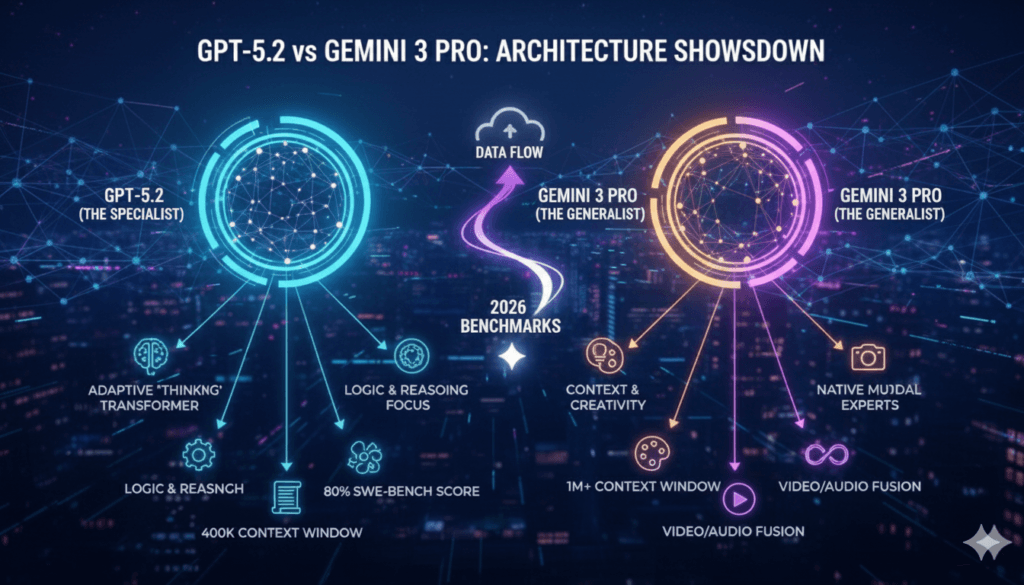
Still undecided? If you want to see the raw numbers behind these recommendations, check out our detailed technical breakdown of GPT-5.2 vs Gemini 3 Pro benchmarks to see exactly how they scored in our lab tests.
Mastering these models shouldn’t take hours of trial and error. To help you get results instantly, I’ve compiled the 2026 AI Prompt Library—a plug-and-play PDF featuring the exact syntax I use for deep research and complex coding. [Download your free copy here] and stop wasting tokens on generic responses
Anthropic is also pushing the frontier of AI reasoning — our analysis of Claude Opus 4.6 vs Opus 4.5 benchmarks and pricing explores how their newest models compete with Gemini and ChatGPT.
Recent independent research is also testing model safety — discover what happened in the Heretic AI Abliteration benchmark challenging GPT-4 safety alignment.
While large models dominate headlines, many companies are shifting toward efficiency — learn how small language models can reduce AI costs by up to 90%.
Google is also improving model efficiency with new architectures like Sequential Attention — a breakthrough in AI model efficiency.
Teams building on agent frameworks in 2026 should read our MiniMax M2.7 vs GPT-4 and Claude breakdown before finalizing their model selection — it covers independent benchmark data, a verbosity-adjusted cost framework, and the agent-native vs. agent-capable distinction that most model reviews skip entirely.
References:
1. Google Gemini (Google)
In 2026, Gemini is deeply integrated into the Google ecosystem, with Gemini 3 Pro and Gemini 3 Flash serving as the core models.
- Official Website: gemini.google.comThe main interface for chatting with Gemini and accessing Google Workspace integrations.
- Developer Documentation: ai.google.devAccess the Gemini API, SDKs, and the latest release notes for model snapshots like Gemini 3.
- Google Workspace for Education: edu.google.com/ai/gemini Specific resources for using Gemini in educational institutions.
2. ChatGPT (OpenAI)
OpenAI continues to lead the “Personal Assistant” market with GPT-5.2 and the advanced o-series (o3/o5) reasoning models.
- Official Website: chatgpt.comThe home for ChatGPT Plus, Enterprise, and the recently launched ChatGPT Health features.
- Developer Platform: platform.openai.comDocumentation for the API, including the new “Responses API” and agentic model capabilities.
- OpenAI API Documentation: platform.openai.com/docs Technical guides on strict output, function calling, and GPT-5 model snapshots.
3. Grok (xAI)
Grok 3.0 has established itself as the premier tool for real-time information via its native integration with the X social platform.
- Official Website: grok.comThe consumer-facing portal for Grok, though most users access it directly via x.com.
- Developer Documentation: docs.x.aiAPI references for Grok-3 and Grok-4-fast, including the specialized
x_searchandweb_searchtools. - xAI Overview: x.ai Company announcements and research papers regarding xAI’s latest model releases.
4. DeepSeek (DeepSeek AI)
DeepSeek-V3.2 and the R1 reasoning models are currently the top choice for developers due to their aggressive pricing and high logic scores.
- Official Website: deepseek.comThe primary chat interface for DeepSeek’s flagship models.
- API Documentation: api-docs.deepseek.comTechnical documentation for their OpenAI-compatible API, including pricing and model details.
- GitHub (Open Weights): github.com/deepseek-ai Where they release open-weights models and research papers (essential for your “Privacy & Trust” section).