The Honest Verdict
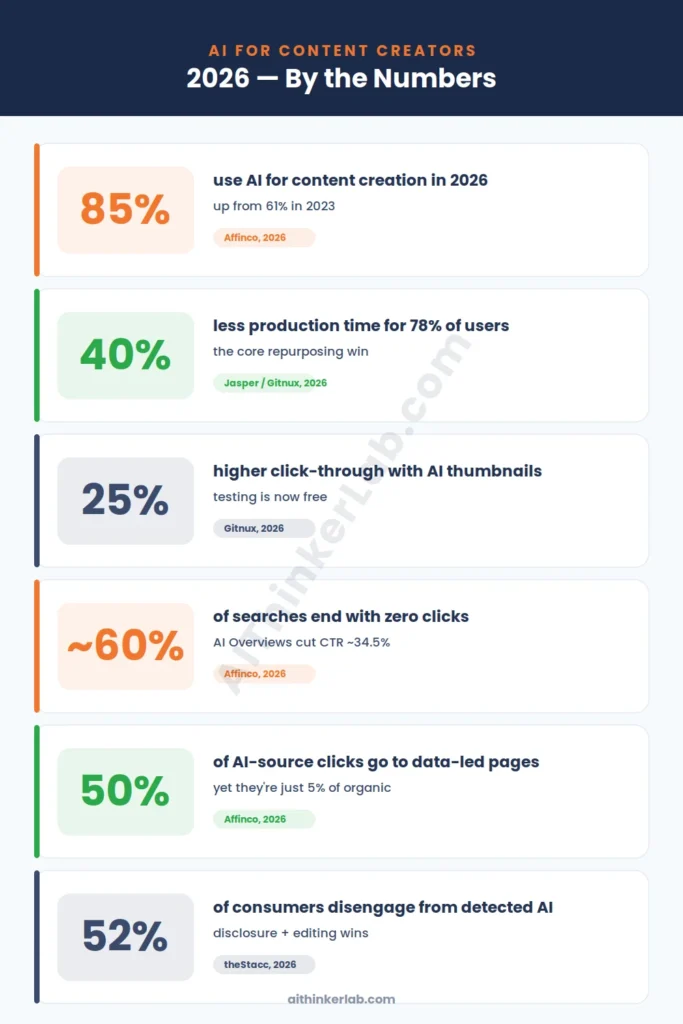
- AI adoption among creators is now the default, not the edge: 85% of marketers use AI for content in 2026, up from 61% in 2023, per an Affinco compilation of industry data.
- The biggest real wins are unglamorous: repurposing, multilingual dubbing, SEO research, captions, and B-roll — tasks that eat hours, not the creative core.
- Three of the loudest promises underdeliver: AI does not replace your editor, does not write viral hooks, and does not “know” your brand voice.
- The editing tax is real: well-edited AI content performs 12% better in AI-search citations, while unedited AI content performs 34% worse, according to Presenc AI (2026).
- Audiences punish lazy AI: 52% of consumers reduce engagement when they recognize content as AI-generated (theStacc, 2026).
- Original data is your citation moat: stat-led pages drive 50% of clicks from AI sources while making up just 5% of organic clicks (Affinco, 2026) — AI can’t manufacture that for you.
What AI Actually Does for Creators in 2026
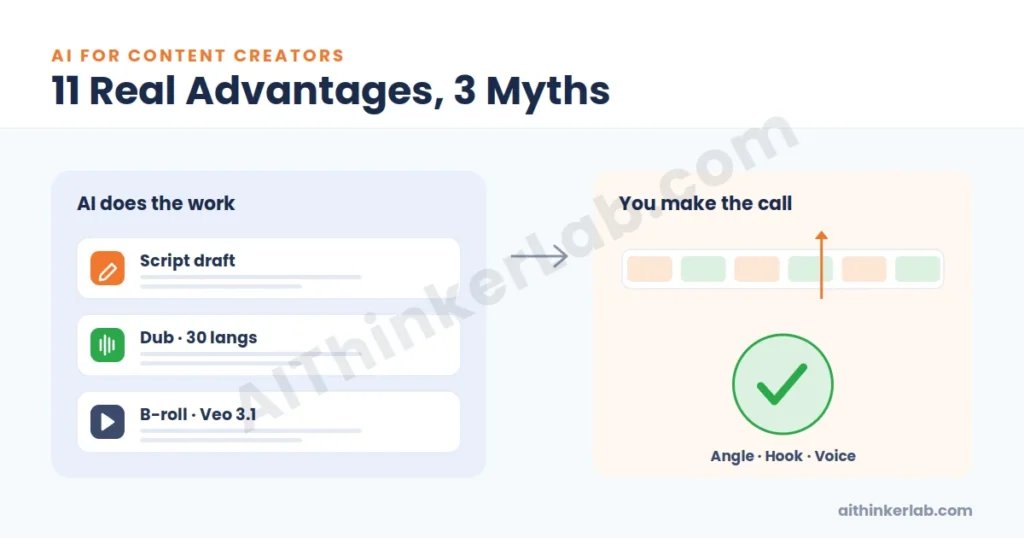
AI for content creators in 2026 is a leverage tool for production tasks — drafting, repurposing, translating, researching, and generating B-roll — not a replacement for editorial judgment, taste, or original reporting. That single distinction explains almost every “AI win” and “AI fail” you’ll read below. The tools are genuinely capable: Anthropic’s Claude Opus 4.8 (released May 28, 2026) and OpenAI’s GPT-5.5 (April 2026) write cleaner first drafts than most humans produce cold, and Google’s Veo 3.1 generates usable B-roll from a sentence. What they don’t do is decide what’s worth saying.
Adoption already settled the “is anyone really using this” question. 85% of marketers report using AI for content creation in 2026, up from 61% in 2023, per an Affinco data compilation, and 97% say they plan to use it this year (Typeface, 2026). The more useful frame now isn’t whether to use AI — it’s where it pays and where it quietly costs you.
So here’s the rule that runs through this entire piece: AI multiplies the work you already know how to judge, and degrades the work you can’t judge. Hand it a task you could check in thirty seconds — caption cleanup, a thumbnail variant, a rough translation — and it saves you real time. Hand it the thing that makes your content yours — the angle, the hook, the voice — and it regresses you toward the average. Keep that line in mind, because the 11 advantages live on one side of it and the 3 myths on the other.
Worth disambiguating one thing up front, because the whole AI-content conversation runs on a muddled distinction: there’s a world of difference between AI-assisted content (drafted by a model, then shaped and grounded by a human) and pure AI content (generated and shipped unedited). They don’t perform the same. According to Presenc AI (2026), well-edited AI-assisted content performs 12% better in AI-search citations, while unedited AI content performs 34% worse. The market has already sorted itself accordingly — an Ahrefs study of roughly 900,000 pages found that 74.2% of new web pages now contain AI-generated content, but only 2.5% are pure AI (via theStacc, 2025). The default isn’t “AI or human.” It’s “AI plus a human who knows what they’re doing,” and every advantage below assumes that second half.
This guide is about where AI earns its keep. The flip side — the content patterns that got 16 YouTube channels terminated in January 2026 and the EU AI Act disclosure deadline landing that August — is covered in the companion piece on what still monetizes and what’s now banned for AI creators.
The 11 Advantages That Hold Up
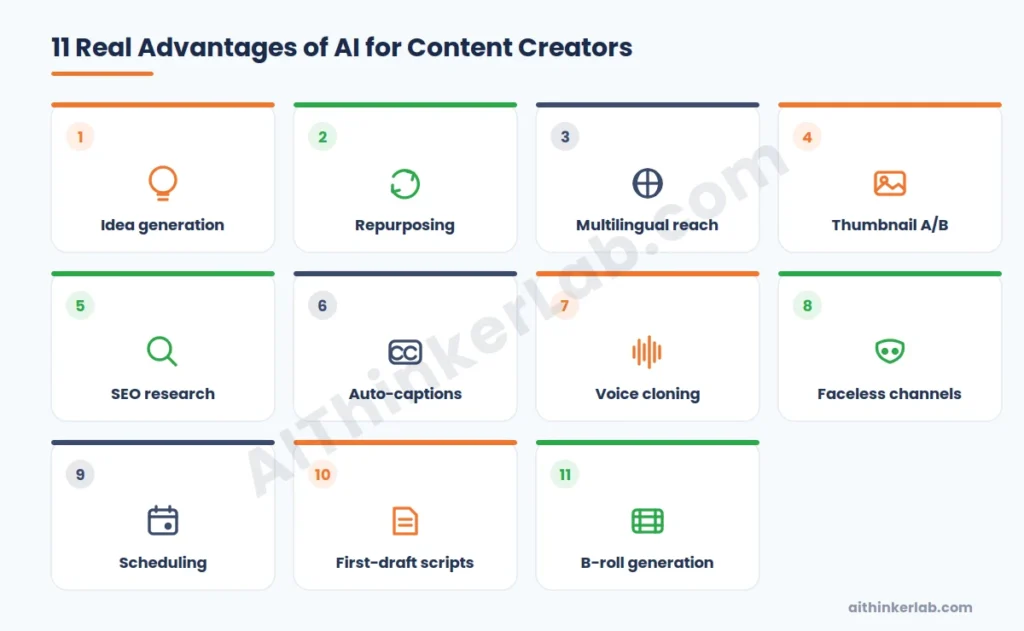
These eleven made the list because the payoff is documented, repeatable, and checkable in your own workflow — not because a vendor said so. A few come with hard limits, and I’ve flagged those plainly. The test for “real” was simple: does it save measurable time or unlock something you literally couldn’t do solo, without asking the audience to accept worse work?
Advantage 1 — Idea generation at scale
AI is a legitimate idea engine because it’s good at recombination, not because it’s creative. Feed Claude Opus 4.8 or GPT-5.5 your last 20 video titles and your three best-performing topics, and it’ll return 50 adjacent angles in a minute — most mediocre, a handful genuinely worth making. The value isn’t the list; it’s the filtering speed. You go from blank page to a shortlist of five you’d actually shoot.
The reason this works is worth understanding, because it tells you exactly where it stops working. A model is a recombination machine: it remixes patterns it has seen into permutations you haven’t bothered to write down. That’s perfect for “what are 30 angles on this topic I’m missing,” and useless for “what’s the one angle nobody has done.” Treat it as a brainstorm partner who never runs dry and never gets attached to a bad idea — then bring your own taste to the cut. The creators who get the most out of this don’t ask AI for the idea; they ask for the long tail of obvious ones so they can spot the gap.
Advantage 2 — Repurposing long-form into short-form
Repurposing is the single highest-ROI AI task for most creators, and it’s where the time savings are real. A 40-minute podcast or long video becomes a newsletter, five Reels scripts, and a thread in one pass. Jasper’s study of 1,000 marketers found AI cut content-creation time by 40% for 78% of users (via Gitnux, 2026). In practical terms, a creator who used to spend a full day slicing one piece across platforms can claw back roughly 5–7 hours a week — the bulk of it from repurposing and reformatting rather than original creation. That’s not a vanity number; it’s a second video a week.
Advantage 3 — Multilingual reach without a dubbing studio
AI dubbing now lets a solo creator publish in dozens of languages while keeping their own voice — a capability that didn’t exist affordably two years ago. ElevenLabs dubs video into roughly 29–32 languages while preserving the original speaker’s timbre and pacing (ElevenLabs, 2026). The proof point most people cite: actor Matthew McConaughey released a Spanish-language version of his Lyrics of Livin’ newsletter in his own cloned voice without speaking Spanish (per techcoffeehouse, 2026). For a creator, that’s access to entire audiences — Hindi, Spanish, Arabic — that a recording budget previously gated.
Advantage 4 — Thumbnail A/B testing at zero cost
AI removes the cost barrier to thumbnail iteration, which is where a lot of CTR is won or lost. Generating ten thumbnail variants used to mean a designer and a turnaround; now it’s a prompt and a few minutes. The upside is documented: YouTube creators using AI-assisted thumbnails saw about 25% higher click-through rates, per Gitnux (2026). The caveat — and it matters — is that AI generates plausible thumbnails, not winning ones. You still need to test against your own audience; the tool just makes testing free.
Advantage 5 — SEO and AEO research that used to take hours
AI compresses keyword and competitor research from an afternoon into minutes, and that’s a defensible, real win. Tools like Ahrefs and Semrush already layer AI over their data, and a general model can cluster topics, draft intent maps, and surface gaps fast. But here’s the so-what that most creators miss: search itself is changing under you. Around 60% of Google searches now end without a click, and AI Overviews cut click-through by roughly 34.5% (Affinco, 2026). The flip side is the opportunity — stat-led, original-data pages account for 50% of clicks coming from AI sources while making up just 5% of organic clicks (Affinco, 2026). AI can do the research; it can’t manufacture the original data that actually earns the citation. (Note: the current term is Google AI Mode, not the deprecated SGE / AI Overviews framing.) That gap is the entire premise of the data-backed playbook for getting cited by ChatGPT, Perplexity, and Google AI Overviews — fact density and original data, not volume, are what move AI citations.
Advantage 6 — Auto-captions and accessibility
Auto-captioning is a quiet, unambiguous win — accuracy is high enough that editing captions is now faster than writing them. Beyond accessibility (which matters on its own), captions lift watch time on muted autoplay feeds, and they feed the transcript that powers your repurposing. There’s almost no downside here and no taste required, which is exactly why it’s safe to automate fully.
Advantage 7 — Voice cloning for consistent narration (real but limited)
Voice cloning genuinely works for consistent narration — but it comes with real limits and rising scrutiny, so treat it as conditional. A voice clone reproduces your own consented voice from text (distinct from a voice changer, which swaps to a different persona). It’s a lifesaver when you’re sick, traveling, or maintaining a brand voice across languages. The limits: emotional range still flattens on long reads, and the regulatory ground is shifting — the AI Fraud Accountability Act of 2026 is currently before the US Senate, and platforms now require explicit consent for professional clones. Use it for utility narration; don’t expect it to carry an emotionally demanding monologue.
Advantage 8 — Faceless content channels (real but saturated)
Faceless channels are a real, viable model — and also the most crowded corner of the creator economy, which is the honest caveat. AI voiceover plus AI B-roll makes a no-camera channel buildable in a weekend, and people do earn from history, documentary, and lore niches. But the same low barrier that lets you in let everyone in. The contrarian read: “faceless” is now a production method, not a strategy. Without a sharp niche and a real point of view, you’re one of ten thousand identical channels, and AI can’t fix undifferentiation.
Advantage 9 — Cross-platform scheduling and analytics
AI-assisted scheduling and analytics are a solid operational win that frees you from tab-juggling. Modern tools auto-reformat a post per platform, recommend timing, and summarize what’s working in plain language. It won’t make a flat post perform — but it removes the logistical drag that eats the back half of every creator’s week, and that reclaimed time compounds.
Advantage 10 — First-draft scripts
AI first drafts are real time-savers if you treat them as scaffolding, not finished work. Claude Opus 4.8 and GPT-5.5 will hand you a structured, on-topic script in seconds — intro, beats, outro. It gets you past the blank page, which is most of the friction. The trap is shipping the draft: AI scripts are competent and generic, and competent-generic is invisible. The draft is the floor, not the ceiling.
Advantage 11 — B-roll generation (real, growing fast)
AI B-roll has crossed from gimmick to genuinely useful, and it’s improving faster than any other tool in this list. Google Veo 3.1 — widely rated the best all-round AI video generator in 2026 and available free inside Google Flow (50 daily credits) — produces clean, short cinematic clips with native audio, while Runway Gen-4 remains the marketer’s pick for brand-consistent output. Notably, OpenAI’s Sora, the headline video model of 2024–25, is being discontinued later in 2026, and the gap has been filled by Veo, Runway, Kling, and Seedance — often at lower cost. For a creator, this means establishing shots and filler footage that used to require stock subscriptions or a shoot are now a prompt away.
The 3 Myths That Cost You Time and Trust
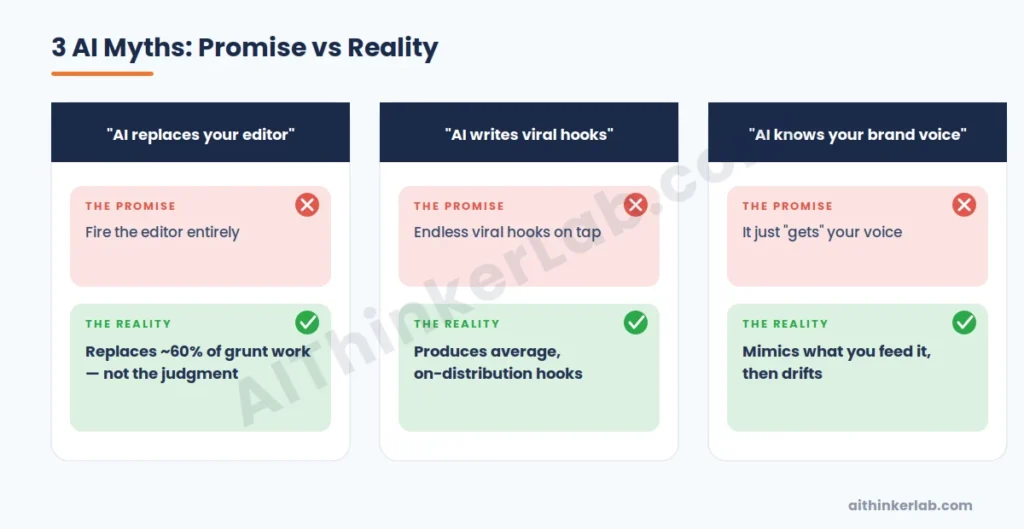
Now the other side of the line. These three aren’t “AI is useless” takes — they’re specific, oversold promises that lead creators to over-trust the tool and underinvest in the work that actually differentiates them. Each one has a real kernel; each one gets stretched into something it can’t deliver.
Myth 1 — “AI Replaces Your Editor”
AI does not replace your editor — it replaces roughly 60% of an editor’s grunt work, which is a different and smaller claim. AI handles the rote layer well: rough cuts, silence and filler-word removal, caption sync, B-roll suggestions, color and audio cleanup. What it can’t do is the editorial judgment that makes editing editing — pacing for tension, knowing which joke to cut, sensing when a section drags, protecting the through-line. The so-what: if you fire your editor and keep the AI, your output gets faster and flatter at the same time. The right move is the opposite — let AI eat the grunt work so your editor (or you) spends time only on judgment calls.
Myth 2 — “AI Generates Viral Hooks”
AI does not generate viral hooks; it generates statistically average ones, and average is the enemy of viral. This is structural, not a prompting problem. A model predicts the most likely next words, so by design it converges on the center of the distribution — the hook that sounds like every hook. Virality lives in the tails: the surprising angle, the specific detail, the slightly-wrong-on-purpose phrasing a model is trained to smooth out.
Here’s the test that proves it. Ask any 2026 model for “10 viral hooks about productivity” and you’ll get clean, grammatical, utterly forgettable lines — “Stop wasting time and start getting things done.” Technically a hook. Functionally wallpaper. The version that actually stops a scroll is the one with a specific number, an uncomfortable admission, or a claim that sounds slightly too bold — exactly the kind of edge a model sands off in the name of being helpful and safe. So AI is a fine hook brainstormer — give me 20 options to react to — and a terrible hook author. The version that pops is almost always the one you twisted after seeing the safe ones.
Myth 3 — “AI Knows Your Brand Voice”
AI does not know your brand voice — it mimics whatever you feed it, and the mimicry degrades the moment you stop steering. Paste in 20 of your posts and yes, it’ll approximate your cadence for a paragraph or two before regressing toward generic-confident-LinkedIn. “Brand voice” isn’t a style you can hand off; it’s a thousand small judgment calls about what you would and wouldn’t say. And the audience can tell: 52% of consumers reduce engagement when they identify content as AI-generated (theStacc, 2026). The lesson isn’t “never use AI for voice” — it’s that voice is the last thing to automate, not the first.
How to Build an AI Creator Stack (Without the Hype)
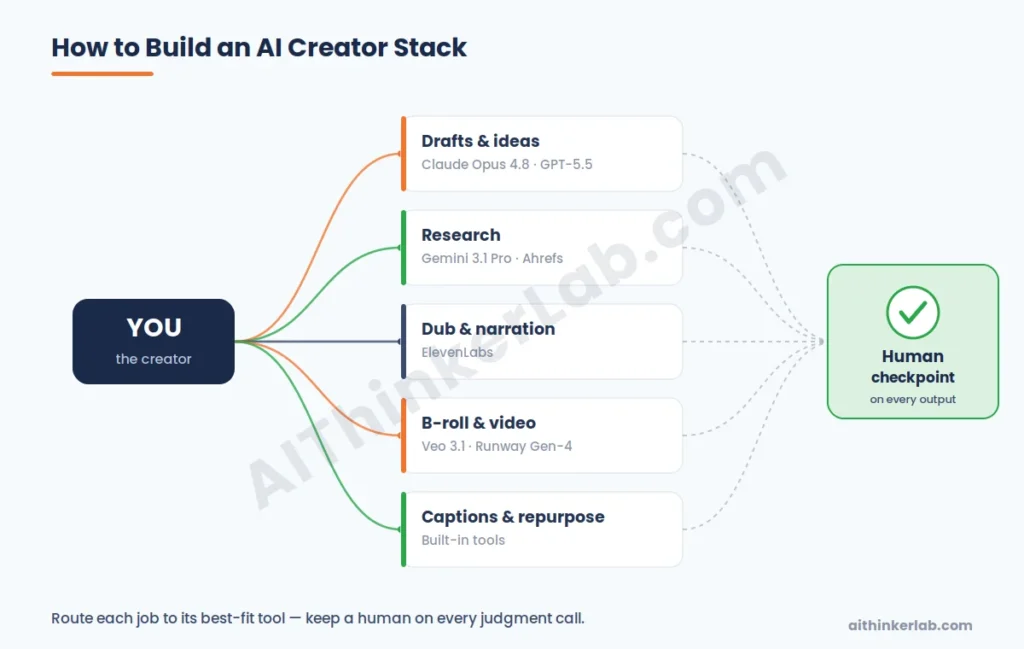
The winning 2026 setup routes each job to the tool that’s actually best at it, then puts a human on every judgment call. There’s no single best model — Claude Opus 4.8 leads for writing and long agentic work, GPT-5.5 is strongest for everyday drafting, Gemini 3.1 Pro leads on research and reasoning, and Veo 3.1 leads on video — so model-agnostic routing beats loyalty to one app.
| Job | Best-fit tool (June 2026) | Human still owns |
|---|---|---|
| First-draft scripts & ideas | Claude Opus 4.8 / GPT-5.5 | Angle, hook, final cut |
| Research & topic clustering | Gemini 3.1 Pro, Ahrefs | The original data/insight |
| Dubbing & narration | ElevenLabs | Emotional delivery, consent |
| B-roll & short clips | Veo 3.1 (via Google Flow), Runway Gen-4 | Story, sequencing |
| Captions & repurposing | Built-in / Descript-style tools | What’s worth repurposing |
The so-what for your week: automate the checkable layer ruthlessly, and spend the reclaimed 5–7 hours on the three things AI provably can’t do — your angle, your hook, and your voice. That’s not a compromise with AI; it’s the entire point of it.
One practical warning on the routing approach: don’t hardcode your workflow to a single tool. The release cadence in 2026 has been relentless — Claude Opus 4.8 landed May 28, Google shipped Gemini 3.5 Flash and the Gemini Spark agent at I/O on May 19, and GPT-5.5 arrived in April — and the “best” model for any one job changes every few weeks. The creators who stay efficient treat their stack as swappable: a draft tool, a research tool, a voice tool, a video tool, each chosen for the job and replaced when something better ships. Loyalty to one app is how you end up paying for yesterday’s frontier. The constant isn’t the tool; it’s the human checkpoint sitting on every output before it goes live. Knowing what’s allowed is half the equation; here’s how AI content creators actually earn in 2026 once you’re compliant.
The Bottom Line
Strip away the noise and AI for content creators comes down to one rule: it multiplies judgment you already have and degrades judgment you don’t. The eleven advantages — from repurposing to Veo 3.1 B-roll — all live on the side of leverage, freeing hours you can pour back into the work that’s actually yours. The three myths all share the same failure: they ask AI to supply the taste, the hook, and the voice that are the whole reason an audience chose you over the algorithm’s average. Use it to do more of what you’re good at, faster — and keep your hands firmly on the part no model can fake. The creators who win the next year won’t be the ones who automate the most; they’ll be the ones who automate the right things and protect the rest.
Sources / References
- GetGenie – A SEO/AEO optimized content creation toole with different varieties. — https://getgenie.ai?rui=3782
- Affinco / Zoomyourtraffic — AI Content Creation Statistics 2026: Adoption & Market Data — https://affinco.com/ai-content-creation-statistics/ (accessed June 2026)
- Presenc AI — AI Content Creation Statistics 2026 — https://presenc.ai/research/ai-content-creation-statistics (accessed June 2026)
- theStacc — AI Content Statistics 2026: 50 Facts and Figures — https://thestacc.com/blog/ai-content-statistics/ (accessed June 2026)
- Gitnux — AI in the Content Industry Statistics 2026 (Jasper, Descript, YouTube data) — https://gitnux.org/ai-in-the-content-industry-statistics/ (accessed June 2026)
- ElevenLabs — official product & pricing pages — https://elevenlabs.io/pricing (accessed June 2026)
- Tech Coffee House — ElevenLabs Review 2026 (ARR, Fortune 500, McConaughey/Caine, AI Fraud Accountability Act) — https://techcoffeehouse.com/2026/06/01/elevenlabs-review-2026-what-it-does-who-its-for-and-what-you-should-know/ (accessed June 2026)
- Google Flow / Veo 3.1 — review & product overview — https://aivideopicks.com/posts/google-flow-review-2026.html (accessed June 2026)
- ChatCut — 6 Best AI Video Generators in 2026 (Sora discontinuation, Veo/Runway/Kling/Seedance) — https://chatcut.io/blog/best-ai-video-generator-2026 (accessed June 2026)
- Vellum — LLM Leaderboard 2026 (model versions, Claude Opus 4.8, GPT-5.5, Gemini 3.1) — https://www.vellum.ai/llm-leaderboard (accessed June 2026)