
Key Takeaways
- YouTube terminated 16 major AI channels in January 2026, erasing 4.7 billion lifetime views, 35 million subscribers, and roughly $10 million in annual ad revenue — under existing inauthentic-content rules, not a new AI ban.
- The EU AI Act’s Article 50 becomes enforceable on August 2, 2026, with penalties up to €35 million or 7% of global revenue for undisclosed AI-generated content distributed in the EU.
- Consumer enthusiasm for AI-generated creator content fell from 60% in 2023 to 26% in 2025 (Billion Dollar Boy), even as 87% of creators report using AI tools more.
- Sora 2’s web and app are gone as of April 26, 2026, and the Sora API shuts down September 24, 2026 — Google Veo 3.1, Runway Gen-4.5, and Kling 3.0 now lead the field.
- The bigger threat is Google AI Mode, not platform enforcement — Chartbeat reports a 33% year-over-year decline in Google referral traffic across 2,500+ publisher sites, and the I/O 2026 overhaul deepens it.
Introduction
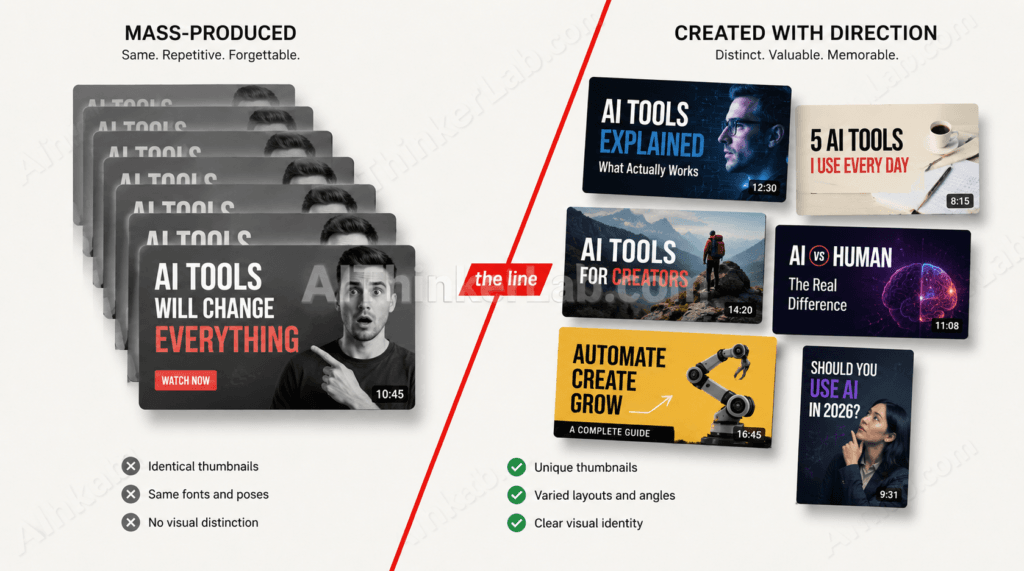
In a single enforcement wave in January 2026, YouTube terminated 16 channels that collectively held 4.7 billion lifetime views, 35 million subscribers, and around $10 million in annual ad revenue. None of them were banned for using AI. They were banned for being mass-produced. That distinction is the entire story of AI for content creators in 2026 — and most of the advice circulating online is still aimed at the wrong threat.
This guide does three things competing roundups don’t. It names the five specific content patterns that actually get channels killed in 2026 (it’s a short list, and “uses AI” is not on it). It walks through the August 2 EU AI Act deadline that most non-European creators don’t realize applies to them. And it argues — with the traffic data — that the AI threat creators should be pricing into their workflow is not platform enforcement. It’s the disappearance of organic search traffic.
The 2026 Reality Check: What Actually Changed for Creators
AI for content creators in 2026 is governed by three forces working in parallel — YouTube’s inauthentic-content enforcement, the EU AI Act’s transparency deadline, and Google AI Mode’s compression of organic search traffic. Any creator strategy that addresses only one of the three is fighting the wrong war.
Force one is platform enforcement. YouTube renamed its “repetitious content” policy to “inauthentic content” on July 15, 2025, broadening it from spam detection to any channel built on formulaic, mass-produced uploads. The wording matters: “content that looks like it’s made with a template with little to no variation across videos, or content that’s easily replicable at scale.” The word “AI” appears nowhere in the rule. That is deliberate.
Force two is regulation. The EU AI Act’s Article 50 transparency obligations come into effect August 2, 2026, and they apply to anyone distributing AI-generated content reachable by EU users — not only to companies based in Europe. The European Commission’s draft Code of Practice, with a final version expected in June 2026, will set the technical standards.
Force three is the demand-side collapse. Zero-click searches now account for 60% of queries and Chartbeat reports global Google search traffic declined 33% year-over-year across 2,500+ publisher sites. At Google I/O 2026, the company unveiled an AI Mode-driven Search redesign that builds custom answer interfaces on the fly and embeds information agents that monitor topics for users over time. Every one of those features reduces the click that used to fund creator work.
So what: any AI tactic that ignores any of the three forces is incomplete. A creator who optimizes for monetization safety but ignores GEO is building a fortress with no food supply.
What’s Banned: The Five Patterns That Get AI Content Killed in 2026
AI itself is not banned on any major platform in 2026. Five specific content patterns are — mass-produced template videos, undisclosed deepfakes of real people, scraped-article-to-AI-voiceover pipelines, AI music dump channels with no human curation, and AI content misrepresented as human-made on platforms that prohibit it. Every major enforcement action this year mapped to one of those five.
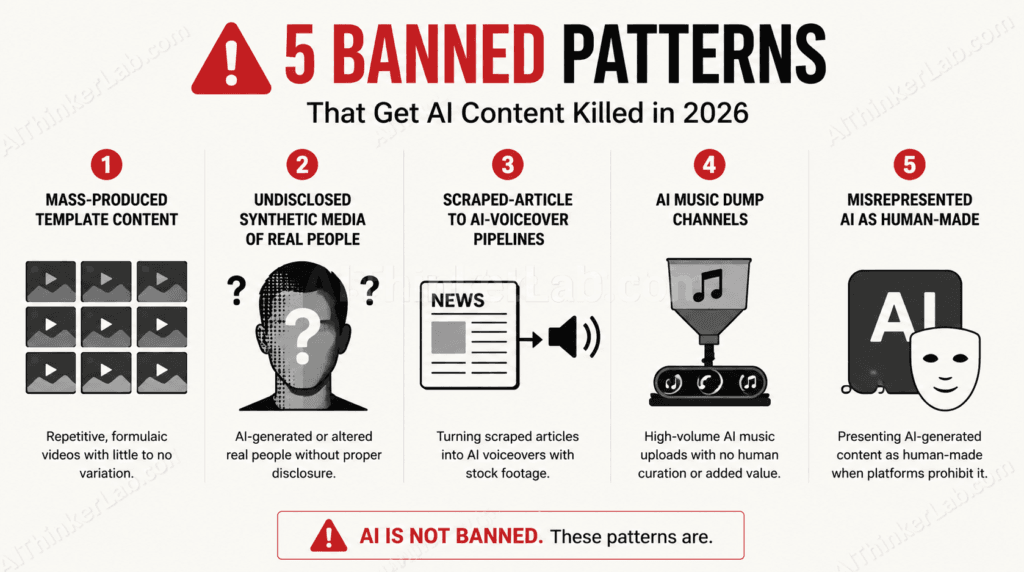
Pattern 1: Mass-produced template content. This is the bullseye of YouTube’s inauthentic-content policy. The January 2026 enforcement wave targeted channels where AI was doing all the creative work and the creator was simply pressing publish. A channel uploading 20 videos a day with identical structure — quotes over looped background footage, scraped article over text-to-speech, slideshow plus generic narration — fails the test whether the underlying technology is AI or a human reading from a script.
Pattern 2: Undisclosed synthetic media of real people. YouTube’s altered-content disclosure rule, separate from monetization eligibility, requires creators to label content that contains realistic AI-generated portrayals of real people. Hiding it can pull the video and, in repeat cases, the channel. Under the EU AI Act, this becomes a legal obligation in August 2026, not just a platform rule.
Pattern 3: Scraped-article-to-AI-voiceover pipelines. Taking a news article, feeding it to an AI voiceover, dropping in stock footage, and uploading the output has no transformative value. YouTube reviewers are explicitly trained to identify the pattern. Meta launched a parallel “unoriginal content” crackdown days after YouTube’s policy rename in 2025, suggesting platform-wide consensus.
Pattern 4: AI music dump channels. Pure Suno or Udio output paired with stock loops and uploaded at high cadence fails the same template-and-replicability test. Music channels that survive add original visuals, written commentary, consistent branding, and limited upload frequency. YouTube in 2026 is a lead generation channel for beat licensing, not a standalone income source for this category.
Pattern 5: Misrepresented authorship. Submitting AI-generated work to outlets that prohibit it — image stock sites, certain literary magazines, university coursework — triggers a different enforcement layer. C2PA Content Credentials make this increasingly hard to hide; credentials are embedded by default in photos taken on Google Pixel 10 devices, all images generated by Adobe Firefly, all images and videos from OpenAI DALL-E 3 and Sora, images from Bing Image Creator, and a growing share of other tools.
So what: enforcement does not target the tool. It targets the pattern. A human-narrated 20-uploads-a-day stock-footage channel dies the same way an AI one does.
What Works: The Creator AI Stack That’s Still Monetizing
The AI workflow surviving 2026 enforcement runs on three rules — AI executes, the human directs; every upload carries format variation; and the creative judgment remains visibly human. Channels that follow those rules are still monetizing at scale, including faceless and AI-heavy ones. The pattern in every demonetized case has been the inverse: AI doing the directing, with the creator pressing publish.
Direction means a human chooses the topic, the angle, the structure, and the editorial stance — before the AI touches anything. Claude Opus 4.7, GPT-5.5, and Gemini 3.1 Pro all shipped in April 2026 with substantially better instruction-following than their predecessors. That capability is wasted if creators use them as topic generators rather than draft engines. The creators winning in 2026 walk in with a thesis, use the model to pressure-test it, write a structured outline themselves, then use the model to fill in scaffolded sections. The output gets rewritten in voice afterward.
Format variation is the most under-discussed rule. “Content that looks like it’s made with a template with little to no variation across videos” is YouTube’s own wording for the inauthentic test. A channel that varies thumbnail style, intro structure, video length, on-camera presence, and pacing across uploads passes the test. A channel with a single template — even a well-produced one — does not.
Eighty-seven percent of creators say they used AI tools more in 2025, and 73% of marketers report that AI-assisted content outperforms human-only work. Those figures hide a sorting effect: AI-assisted work wins when humans direct it; AI-generated work loses when humans rubber-stamp it. The line between the two is editorial labor, not tool selection.
So what: if you cannot describe the editorial choice you made on a given upload in one sentence, the platform’s reviewers cannot either — and that is the same test.
The Best AI Tools for Content Creators in 2026 (Honest Comparison)
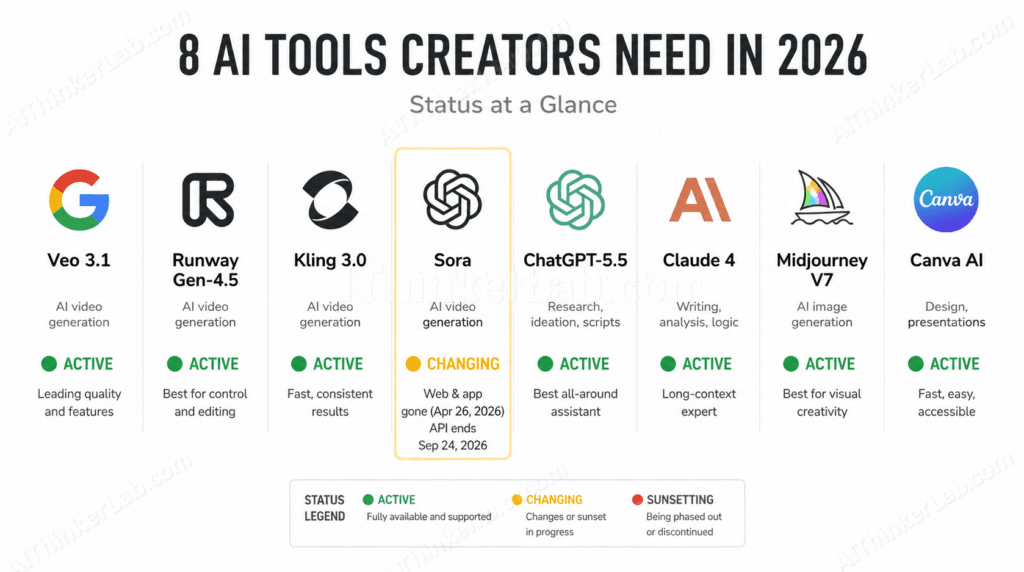
The tool landscape shifted significantly in April 2026. OpenAI announced that the Sora web and app experiences are being discontinued on April 26, 2026, and the Sora API will be discontinued on September 24, 2026 — making it a poor foundation for new workflows despite still being recommended in most older roundups. Google Veo 3.1 took the cinematic top slot; Runway Gen-4.5 leads on control; Kling 3.0 leads on price-to-quality.
| Tool | Best for | Strength | Limitation | Status |
|---|---|---|---|---|
| Google Veo 3.1 | High-end video, ads, YouTube cinematic | Native audio, 4K/60fps, character consistency | Mandatory SynthID watermark | Active |
| Runway Gen-4.5 | Filmmakers, controlled shots | Camera control, character continuity across clips | Premium pricing | Active |
| Kling 3.0 | High-volume social, value pick | Strong motion, lower cost per iteration | Less mature ecosystem | Active |
| Sora 2 / Sora 2 Pro | Narrative polish (legacy projects only) | Photoreal output, physics realism | Web/app deprecated April 26, 2026; API shuts Sept 24 | Sunsetting |
| Claude Opus 4.7 | Long-form writing, scripts, editing | Editorial voice, instruction-following | $5/$25 per 1M tokens (input/output) | Active |
| GPT-5.5 | Agentic workflows, research pipelines | Tool orchestration, autonomous tasks | $5/$30 per 1M tokens | Active |
| Gemini 3.1 Pro | Volume work, multimodal | 60% cheaper than Opus on input, 2M context window | Weaker at editorial nuance | Active |
| ElevenLabs | Voiceover, multilingual dubbing | Voice cloning quality, language coverage | Synthetic-media disclosure obligations apply | Active |
| Adobe Firefly | Image generation, brand-safe work | C2PA credentials embedded by default | Fewer stylistic options than Midjourney | Active |
The tool-stack question that actually matters is not which model is “best” — it is which combination keeps human direction visible. A creator using Claude Opus 4.7 for scripts, Runway Gen-4.5 for B-roll, ElevenLabs for voiceover, and a human editor for final cut is making AI-assisted work. A creator running a single prompt-to-publish pipeline is making AI slop. Before committing to any of these tools, separate the capabilities that genuinely save time from the ones that are oversold — a companion breakdown covers the 11 AI advantages that hold up for creators and the 3 myths that don’t.
The Disclosure Stack: YouTube, the EU AI Act, and C2PA in Plain English
The EU AI Act’s Article 50 transparency obligations become enforceable on August 2, 2026, under Regulation (EU) 2024/1689, with penalties reaching €35 million or 7% of global revenue for non-compliance. Providers of generative AI systems producing text, images, audio, or video must mark outputs in a machine-readable format and ensure they are detectable as artificially generated or manipulated. Deployers using AI to create deepfakes must disclose that the content has been artificially generated or manipulated. The Act applies wherever the content is distributed to EU users — not where the creator is based.
YouTube’s altered-content disclosure is a separate, narrower rule. It requires a label when content contains realistic AI-generated portrayals of real people, real places, or real events. Disclosure does not grant monetization eligibility to templated content — toggling the box does not protect a mass-produced channel from the inauthentic-content rule. The two policies operate independently.
C2PA Content Credentials are the technical layer underneath both. The Coalition for Content Provenance and Authenticity has over 6,000 members and affiliates as of January 2026, with specification v2.3 released the same month. The EU AI Act Article 50 enforcement begins August 2026, requiring machine-readable disclosure on AI-generated content. California SB 942 took effect January 2026. Major tools — Adobe Firefly, DALL-E 3, Google Pixel 10, Bing Image Creator — now sign output by default. Most platforms still strip the metadata during transcoding, which is why the EU Code of Practice recommends a multi-layer approach combining C2PA, imperceptible watermarks like Google’s SynthID, and content fingerprinting.
The practical compliance posture for a non-EU creator who reaches EU audiences: use tools that embed C2PA or SynthID by default, keep AI-generated content visibly labeled in the description and on-screen where the EU Code recommends, and document a human-review step for any AI-generated text published as informational content. That documentation is what triggers the editorial-responsibility carve-out under Article 50.
So what: in three months, undisclosed deepfakes are not just a brand risk — they are a regulatory liability with a price tag attached.
AI Slop vs AI-Assisted: How Platforms Actually Tell the Difference
Platforms in 2026 do not detect AI. They detect patterns. The operational test YouTube reviewers use, taken verbatim from the help center: template plus low variation plus replicability at scale equals inauthentic, regardless of whether AI was used.
That single sentence explains every confusing enforcement decision of the last year. “A human reading fifty Bible verses over stock footage fails the same test as an AI voice doing the same thing”, and a faceless channel pairing AI music with original visuals, written commentary, and varied formats passes the test even though every visible element was generated. The test is structural, not technological.
The Kapwing AI Slop Report, published in late 2025, found that 21% of YouTube recommendations served to new users are now AI-generated. Unlike previous eras of “spam” content, which were often easy to filter via metadata or low resolution, 2026-era slop is high-definition and visually stimulating. That is what forced platforms to shift from technology-based detection to behavior-based detection, and it is what makes the pattern-based test impossible to game by upgrading models.
The AI Impact Summit 2026 produced a line worth keeping. Creator Prakhar Gupta argued that “mistakes will become proof of truth. If you do not make mistakes, people will suspect it is artificial intelligence.” The audience-side signal is converging with the platform-side signal — both reward visible human imperfection, both penalize templated perfection.
So what: optimizing AI workflows for fewer artifacts and tighter consistency is, in 2026, an algorithmic and audience liability. The polish that used to signal quality now signals slop.
The Traffic Collapse Nobody Is Pricing Into Their AI Strategy
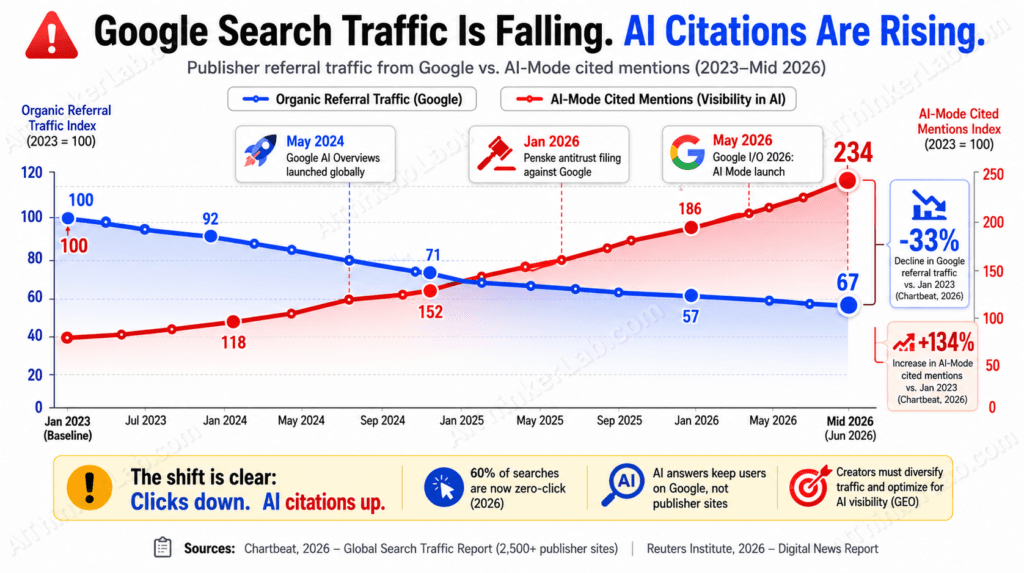
Most creators are optimizing for the wrong AI threat. Platform enforcement removes thousands of channels a year. Google AI Mode is quietly removing the demand-side traffic that funds the entire creator economy. The first is a survivable risk; the second is a business-model risk, and almost no AI-for-creators content addresses it.
The data is unambiguous. HubSpot estimates it lost 70 to 80 per cent of its organic traffic. Chegg, the education platform, reported a 49 per cent decline. DMG Media documented drops as steep as 89 per cent for some queries. NPR called it an “extinction-level event” for online news publishers. The Penske Media Corporation antitrust filing in January 2026 — challenging Google’s use of publisher content to train and serve AI Mode — quoted internal executives saying users “are reading the overview and stopping there. We see it.” Reuters Institute reports media executives expect a 43% average decline in search referrals over the next three years.
For a creator whose pipeline runs blog → newsletter → product, the implication is sharper than it looks. AI Mode does not just compress click-through rate. It absorbs the educational top-of-funnel content that used to attract the search visitor who eventually subscribed. Once Google synthesizes the answer, the click that started the funnel is gone, and so is the subscriber it would have produced. A controlled citation experiment on what actually moves AI visibility
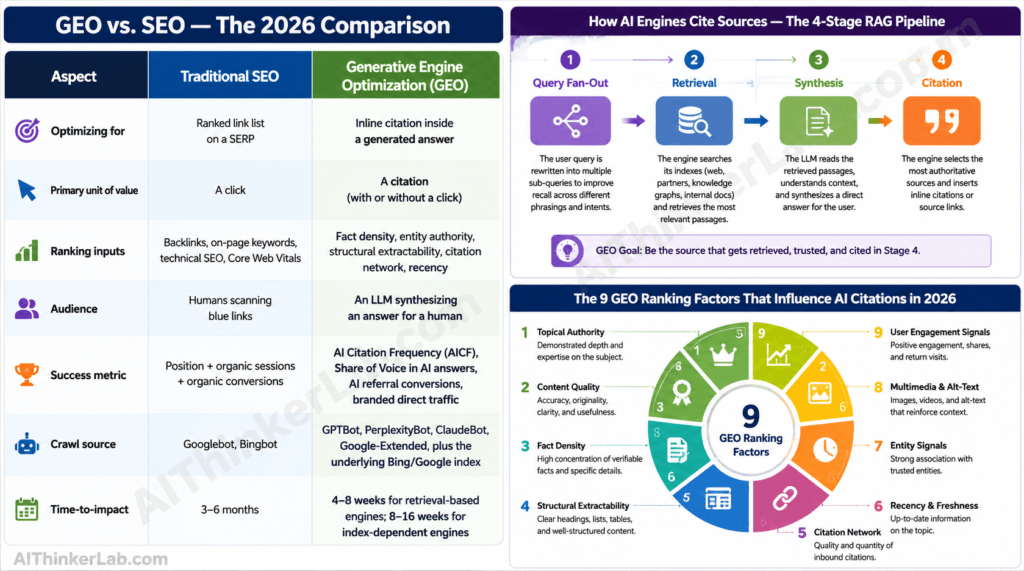
The pivot is generative engine optimization — structuring content so it gets cited inside AI Mode, ChatGPT search, Perplexity, and Claude answers. The data-backed Generative Engine Optimization playbook. The mechanics matter: named entities with versions, statistics with inline source attribution, self-contained paragraphs that survive extraction, and answer-first openers under every heading. The piece you are reading is built on those rules; the editorial choices in it are not stylistic, they are infrastructural.
So what: an AI strategy that maximizes production efficiency but ignores GEO is solving a 2023 problem with 2024 tools while the 2026 problem eats the audience that funds it.
Building a Defensible Creator Workflow (the 4-Layer Stack)
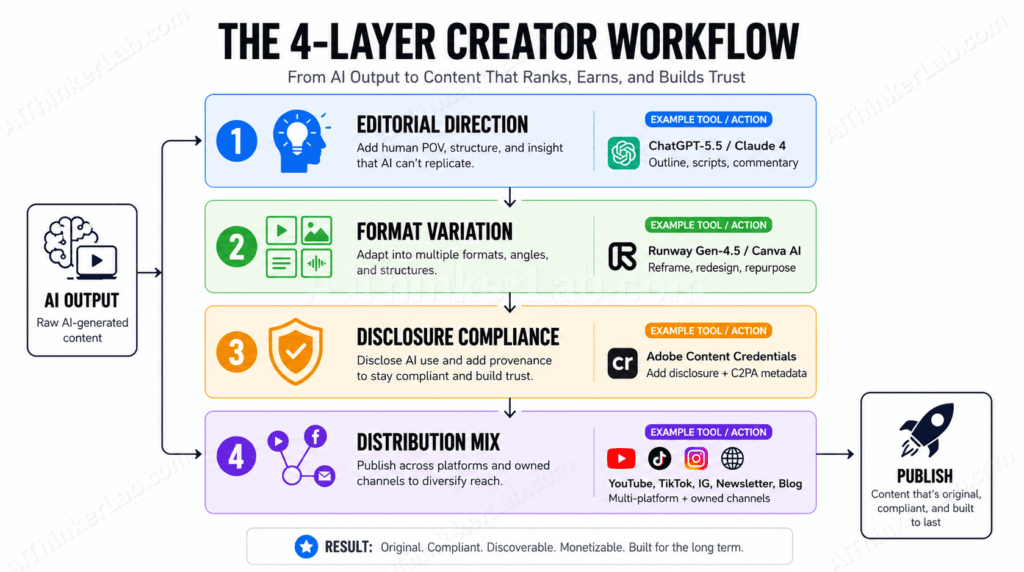
A creator workflow that survives 2026 has four visible layers of human judgment between the AI output and the publish button. The layers are not optional, and they are not interchangeable.
Layer 1: Editorial direction. A human picks the topic, the angle, the audience, and the stance before any AI is invoked. This is the single highest-leverage layer and the one most often skipped. Creators who let the model suggest topics are letting the model define the channel.
Layer 2: Format variation. Across the last ten uploads, vary thumbnail composition, intro structure, video length, pacing, and on-camera elements. YouTube’s inauthentic-content test runs at the channel level — one video’s pattern can pull monetization from every video on the channel. Format variation is the most efficient defense.
Layer 3: Disclosure compliance. Use tools that embed C2PA credentials by default (Adobe Firefly, DALL-E 3, Veo, Pixel 10 captures). Toggle YouTube’s altered-content disclosure when the content qualifies. For EU-reaching content after August 2, 2026, keep documentation of human editorial review for any AI-generated text published as informational content — that documentation is the Article 50 editorial-responsibility carve-out.
Layer 4: Distribution mix. Reduce dependence on a single referral source. With zero-click searches now accounting for 60 per cent of queries, channels built entirely on Google referral traffic carry concentrated platform risk. Newsletter, podcast, direct-app, and community distribution are no longer optional diversification — they are the only audience layer Google AI Mode cannot intercept.
The 4-layer stack is a defense in depth. A channel passing all four is hard to demonetize, hard to penalize under EU rules, and hard to displace from search synthesis. A channel passing only the first three is a regulatory bet on Google’s good behavior, which the Penske and Chegg filings suggest is not a bet the industry is winning.
The Honest Tradeoffs: When AI Hurts Your Channel More Than It Helps
AI usage cuts both ways. Eighty-seven percent of creators report using AI tools more in 2025, and 73% of marketers say AI-assisted content outperforms human-only work — but consumer enthusiasm for AI-generated creator content fell from 60% in 2023 to 26% in 2025. The production-side wins are real. The audience-side trust collapse is also real, and pretending otherwise is the fastest way to misread the market.
The trust signal sorts by genre. Educational explainer content with AI-assisted research and human delivery is performing as well or better than pre-AI baselines. Persona-driven commentary, vlog, and personality channels show the steepest audience pushback when AI is detected — those audiences are paying for a specific human voice, and any sign the voice is synthesized triggers churn. Tutorial and review categories sit in the middle: the audience tolerates AI assistance for production but punishes AI generation of the actual demonstration or judgment.
The contrarian read on the 60%→26% drop is that audience pushback is itself a competitive moat. Thirty-eight percent of consumers say AI can improve content quality, and 41% credit it with increasing representation and diversity in creator media — meaning roughly a third of the audience still values AI work, and the rest will pay a premium for signals of human authorship. Creators who lean into visible human imperfection — first-take voiceover, on-camera mistakes, dated reference points only a human would catch — are pricing themselves into the higher-trust half of the market on purpose.
So what: the question is not whether to use AI in 2026. The question is whether your audience can name a human reason to keep watching once they know AI is in the workflow.
What the next twelve months actually look like
The creators surviving 2026 are not the ones who used the most AI or the least. They are the ones whose audience can name a human reason to keep watching — an editorial stance, a recognizable voice, a craft signal that survives the model upgrade cycle. Every regulatory change, platform enforcement wave, and search redesign in this article runs in the same direction: away from rewarding throughput, toward rewarding signed human judgment.
Through the second half of 2026, the August 2 EU AI Act deadline will produce a wave of compliance-led tool changes, and the C2PA ecosystem will get its first real-world stress test under regulation. Google AI Mode’s traffic compression will continue, and the creators who treated GEO as optional will discover their funnels were depending on a layer of Google’s behavior that has already ended. The opportunity is in the inverse of every trend in this piece — visible authorship, format variation, distribution outside Google’s reach, and AI used as a directed tool rather than a content engine. That stack still wins. It just looks less efficient than the one that lost.
Sources
- OutlierKit Resources — YouTube AI slop crackdown coverage.
- YouTube Help — Channel monetization policies (inauthentic content).
- Tubefilter — January 2026 AI channel terminations (reporting).
- European Commission — EU AI Act / Regulation (EU) 2024/1689, Article 50.
- Coalition for Content Provenance and Authenticity — Specification v2.3, member directory.
- Chartbeat — 2026 publisher referral traffic data (cited in TheNextWeb coverage).
- Reuters Institute for the Study of Journalism — Digital News Report 2026.
- Search Engine Journal — AI Overviews / AI Mode publisher impact coverage.
- Billion Dollar Boy — Creator economy survey (via eMarketer).
Richard F Ruiz scanning online networks laws downloading discrimination on self docaments6
Really important guide on the ‘banned’ aspect. Transparency and ethics are key. At Pixapi, we focus on providing a reliable developer platform that respects these boundaries while offering high-end visual AI features.
This is an incredibly nuanced take on the current state of AI in content creation. The distinction between ‘AI-assisted’ and ‘AI-generated slop’ is something every creator needs to understand to stay compliant and relevant. As mentioned in the article, having a robust 4-layer stack is key. For developers and creators building these stacks, Pixapi is a great resource—it offers a visual AI API that helps integrate high-quality image and video features while maintaining that necessary layer of human editorial control. Thanks for the deep dive into the EU AI Act and GEO!
I really appreciate your insights on AI for content creators in 2026. It’s crucial to stay informed about the right tools. I’m curious how these AI tools can be used to create engaging health content.