TL;DR — Key Takeaways
- Ranked by traffic dependency, not revenue ceiling: digital products (TDS 3/10) and productized audits (TDS 2/10) out-earn ads for sites under ~50K monthly pageviews.
- Display ads got harder to even access in 2026: Ezoic now requires 250,000 monthly users for new publishers (announced February 19, 2026), leaving AdSense — at roughly $5–15 RPM for tech niches with Tier-1 traffic — as the realistic entry option, and only as a bonus layer.
- Users clicked a traditional result in just 8% of Google visits when an AI summary appeared, versus 15% without one, according to Pew Research Center (2025) — the core reason pageview-based revenue keeps shrinking.
- AI citation now pays real money: Perplexity’s Comet Plus shares 80% of pooled subscription revenue with publishers across visits, citations, and agent actions, from an initial $42.5 million pool (Perplexity, 2025–2026).
- Recurring SaaS affiliate programs (20–40% recurring commissions) beat Amazon’s roughly 1–4.5% category rates for AI-tool content at small-site click volumes.
- The 90-day sequence for a small AI site: ship one digital product, add one productized audit, layer two recurring affiliates, and only then switch ads on.
Here’s a number worth sitting with: when Google shows an AI summary, people click a regular result on roughly 8% of visits. Without the summary, it’s about 15% — nearly double — according to Pew Research Center (2025). Half your clicks, gone before you’ve written a word. That’s the environment every AI content monetization strategy has to survive in as of July 2026, and it’s why this guide ranks seven strategies by how much traffic they need, not how much money they could make. To be clear about scope: monetizing AI content here means earning from publishing about AI or with AI assistance — blogs, YouTube, newsletters — not selling models, and definitely not spinning up AI-generated spam sites (those get rejected from every ad network anyway). If you’re pre-launch, start with how to start an AI blog, then come back.
Why the Old AI Content Monetization Playbook Broke
The standard advice hasn’t changed in a decade: get traffic, slap on AdSense, add affiliate links, maybe sell a course someday. Every step assumes pageviews keep arriving. They don’t — at least not the way they used to.
Four data points, one conclusion. Gartner projected traditional search volume would drop 25% by 2026 as users shift to AI assistants (Gartner, 2024). Pew’s 2025 browsing-data study found AI summaries cutting result clicks nearly in half — and links inside those summaries got clicked on just 1% of visits (Pew Research Center, 2025). Google AdSense itself moved from per-click to per-impression payouts back in November 2023, a quiet admission that clicks were becoming too scarce to price. And in February 2026, Ezoic — the ad platform that spent a decade courting small publishers — raised its minimum to 250,000 monthly users and retreated upmarket (Ezoic, 2026). No single one of those sources says it outright, so I will: the pageview is a depreciating asset, and the ad industry itself is now pricing that in.
Does that mean content is dead? No. Something stranger happened. Content now has two audiences — humans who visit, and AI engines that read, synthesize, and cite. The Princeton-led GEO study found citation-optimized content earns up to 40% more visibility inside generative engines (Aggarwal et al., 2023). And as of January 2026, at least one engine pays for that visibility in cash — more on Perplexity’s Comet Plus below.
So the question changed. It’s no longer “how do I get more pageviews to monetize?” It’s “which revenue streams still work when pageviews are scarce — and which ones convert AI citations into money?” Rank strategies by RPM and you’re ranking for a world that’s gone.
What Is the Traffic-Dependency Ladder?
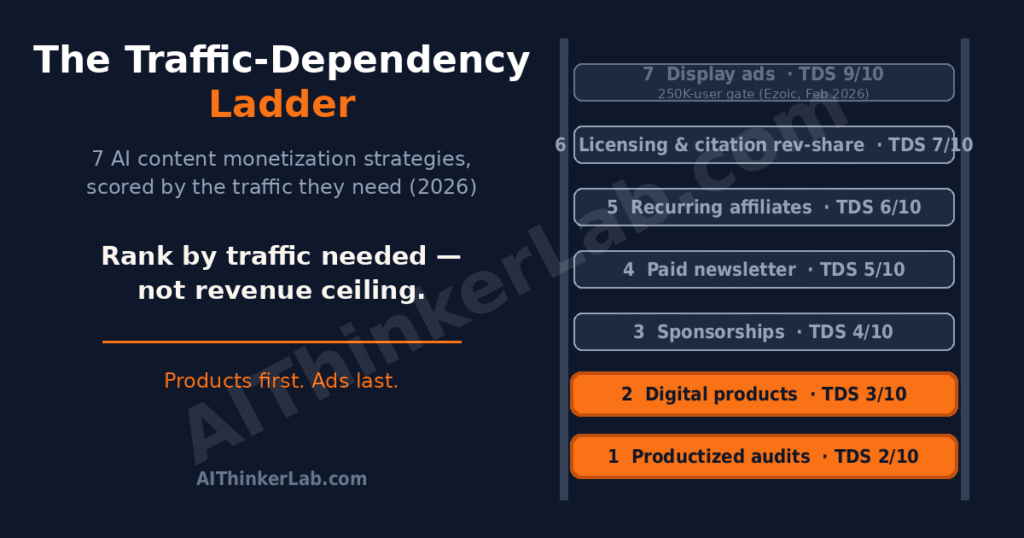
The Traffic-Dependency Ladder is a framework for ranking AI content monetization strategies by how much traffic each one requires to produce meaningful income. Every strategy gets a Traffic-Dependency Score (TDS) from 1 (works with almost no traffic) to 10 (useless without mass traffic). Small sites should climb from the bottom: products first, display ads last.
That’s the whole idea — and it inverts most advice you’ve read. Here’s how the seven strategies score in mid-2026:
| # | Strategy | TDS | Startup cost | Time to first ₹/$ | Realistic ceiling (solo) | 2026 outlook |
|---|---|---|---|---|---|---|
| 1 | Digital products (kits, templates, workflows) | 3/10 | $0–50 | 2–6 weeks | $500–5,000/mo | Strong — decoupled from traffic |
| 2 | Productized services & audits | 2/10 | $0 | 1–2 weeks | $1,000–8,000/mo | Strong — trust-driven |
| 3 | Recurring affiliate programs | 6/10 | $0 | 1–3 months | $300–3,000/mo | Good — if comparison pages get AI-cited |
| 4 | Paid newsletter / membership | 5/10 | $0–25/mo | 2–4 months | $500–4,000/mo | Good — owned audience |
| 5 | Sponsorships & brand deals | 4/10 | $0 | 1–3 months | $200–2,000/mo | Steady — niche beats scale |
| 6 | Display ads (AdSense; Ezoic now gated) | 9/10 | $0 | 3–6 months | ~$5–15 RPM (tech niche, Tier-1 traffic) | Weak below 50K pv/mo; access shrinking |
| 7 | Content licensing & AI citation rev-share | 7/10 | $0 | 3–6 months | Early, unpredictable | Emerging fast — Comet Plus is live |
Read the table bottom-up if you run a small site. The strategies that need the least traffic are the ones almost nobody leads with — and that’s the gap this piece exists to close. (For the citation-side playbook that feeds several of these rungs, the generative engine optimization guide pairs with this article.)
Strategy 1: Digital Products — Kits, Templates, and Workflows (TDS 3/10)
Digital products convert expertise into inventory. For AI content creators in 2026 the formats that sell are working artifacts, not information: docker-compose stacks, n8n workflow bundles, audit scorecards, prompt systems, JSON-LD schema packs. A PDF explains; a kit does. Buyers pay for the hours you save them, and a 2,000-pageview site with the right 50 buyers out-earns a 100,000-pageview site running ads.
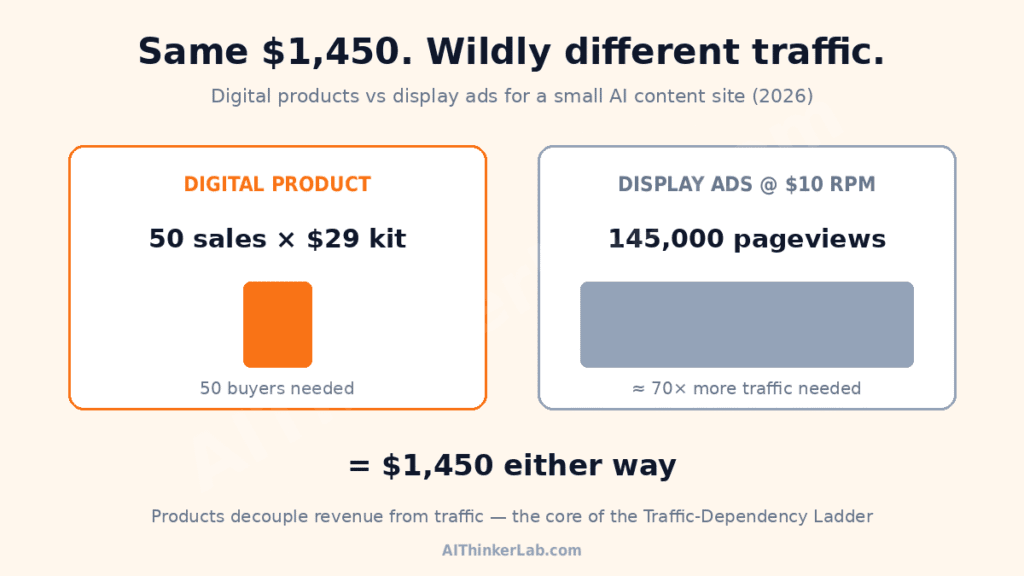
The math is the argument. Fifty sales of a $29 kit is $1,450. To match that with display ads at a healthy $10 RPM, you’d need 145,000 pageviews — seventy times more traffic for the same money.
Platform fees decide your margin, so pick deliberately. Gumroad charges 10% + $0.50 on direct sales and became a full Merchant of Record in January 2025, handling global sales tax for you — but sales through its Discover marketplace carry a flat 30% fee, and Gumroad keeps its fees even when you refund a customer (Gumroad pricing docs, accessed July 2026). Lemon Squeezy, now Stripe-owned, takes 5% + $0.50 plus 1.5% on international transactions, also as merchant of record (Lemon Squeezy fee docs, accessed July 2026). Self-hosting with WooCommerce plus Razorpay (~2% domestic) and PayPal for international buyers keeps the most margin but makes you handle invoices, GST, and refunds. I run the self-hosted route on AIThinkerLab for exactly one reason — margin control on low-priced products — and it cost me a weekend of gateway-routing code to get there. I’m running this exact 90-day sequence on AIThinkerLab right now — product shipped, audit offer next — and I’ll publish the product-vs-ads revenue split here once the window closes. If the Ladder is wrong, this is where you’ll read it first.
Failure modes, honestly: refund requests spike if the product page overpromises (keep a changelog visible — it builds trust); India-based sellers need GST clarity before international sales scale; and a product nobody asked for won’t sell no matter the funnel. Build the thing your own articles keep almost-teaching. Then sell the finished version. The way my guide on running AI models locally and offline became the Local AI Kit.
Strategy 2: Productized Services and Audits (TDS 2/10)
A productized service is consulting with the ambiguity removed: fixed scope, fixed price, fixed deliverable. “AI-citation audit of your site — 47-point scorecard, prioritized fixes, delivered in 5 business days, $149.” No discovery calls. No custom proposals. The buyer knows exactly what arrives, and you know exactly what you owe them.
This is the lowest-traffic strategy on the Ladder because one good client can equal a month of ad revenue, and clients arrive through trust, not volume. A single well-ranked article — or one AI citation in a ChatGPT answer where a business owner asked “why isn’t my site showing up in AI search?” — can land a $149 audit. Try doing that with a display ad impression worth a fraction of a cent.
The catch is boundaries. Scope creep kills productized services quietly: the $149 audit becomes three “quick follow-up questions,” then a call, then unpaid consulting. Write the boundary into the offer itself (“one revision round included; implementation quoted separately”) and honor it even when it feels rude. Especially then.
Where do you find the first buyers? Your own content. An audit offer converts best when it sits at the bottom of the exact article that demonstrates the skill — a GEO teardown article linking to a GEO audit service. The article is the proof; the service is the product. That pairing is also why this strategy compounds with everything else on the Ladder rather than competing with it.
Which Affiliate Programs Still Convert When AI Answers the Query? (Strategy 3, TDS 6/10)
Recurring SaaS affiliate programs still convert in 2026; low-percentage physical-product programs mostly don’t. AI answer engines compress the research phase — a user asks ChatGPT “best AI writing tool,” gets a synthesized answer, and never opens ten review tabs. The affiliate pages that survive are the ones AI engines cite as the source of the comparison, and the programs that pay enough per referral to matter at lower click volume.
The economics split sharply. Amazon Associates pays roughly 1–4.5% depending on category, per its published commission schedule — fine at massive scale, pointless at boutique traffic. SaaS programs on networks like PartnerStack and Impact.com routinely pay 20–40% recurring for as long as the referred customer stays subscribed. One customer on a $49/month tool at 30% recurring is ~$176/year. You don’t need a thousand clicks; you need thirty of the right ones.
Two execution rules matter more than program choice. First, build comparison and alternatives pages (“X vs Y”, “X alternatives for [use case]”) — table-led, criteria explicit — because structured, citation-rich formats gain up to 40% more generative-engine visibility (Aggarwal et al., 2023), and Perplexity’s own economics now reward being the cited comparison (more below). Second, disclose properly and prominently; both FTC rules and AdSense policy require it, and a hidden disclosure is a rejection risk you don’t need while an ad-network application is pending.
And a filter most guides skip: only promote tools you’d defend in a comment section. Burned trust doesn’t renew. Recurring commissions do.
Strategy 4: Paid Newsletters and Memberships (TDS 5/10)
A paid newsletter converts your most engaged 1–3% of readers into predictable monthly revenue — and it’s the only strategy on this list that no algorithm change can take from you. The list is yours. Google can reroute search; OpenAI can re-rank citations; your subscribers still get the email.
Fee math decides the platform. Substack takes 10% of paid revenue (Substack pricing) — zero cost until you earn, expensive once you do. At 100 subscribers paying $5/month, Substack’s cut is $50/month; self-hosted Ghost on a $6–25/month VPS keeps that margin but makes you the sysadmin. Under ~200 paid subscribers, Substack’s simplicity usually wins. Past 500, Ghost’s flat cost wins the arithmetic. Switch when the fee line crosses the hosting line — not before, because migrations cost subscribers.
What actually gets people to pay in the AI niche? Not news — AI news is free everywhere and stale in six hours. What converts is applied material: the working n8n workflow behind the case study, the exact prompt system, the config files, a monthly teardown of what you tested and what broke. The free tier proves you know things; the paid tier hands over the artifacts.
One honest constraint: a paid tier before ~1,000 engaged free readers usually stalls. This is a mid-Ladder strategy (TDS 5/10) precisely because it needs an audience — smaller than ads need, larger than products need. Sequence it accordingly.
Strategy 5: Sponsorships and Brand Deals (TDS 4/10)
Sponsors in 2026 buy audiences ads can’t reach — and niche depth beats raw scale in that purchase. An AI-tools newsletter with 2,000 developer readers can charge more per reader than a general-tech list with 20,000, because the sponsor (an AI SaaS, a GPU cloud, a dev-tools company) knows exactly who’s on the other end. Specificity is the product.
Realistic anchors, not fantasy: small niche newsletters commonly land $50–300 per sponsored slot in the first year; dedicated posts or reviews price higher; bundles (newsletter + blog placement + Instagram mention) price highest because they hit the same buyer three ways. Your rate card should exist before the first inquiry — sponsors negotiate down from your number, so make sure there is one.
Two guardrails. Editorially: label sponsored content clearly (FTC in the US, ASCI guidelines in India) and keep review conclusions non-negotiable — one puff-piece review costs more reader trust than any sponsor pays. Practically: sponsorships are lumpy income. They fill gaps between product launches beautifully; they anchor a business badly.
The quiet advantage for AI-niche creators right now — AI companies have marketing budgets and very few trusted independent voices to spend them on. Supply and demand favors you. For a while.
Can You Still Make Money With Display Ads on an AI Content Site? (Strategy 6, TDS 9/10)
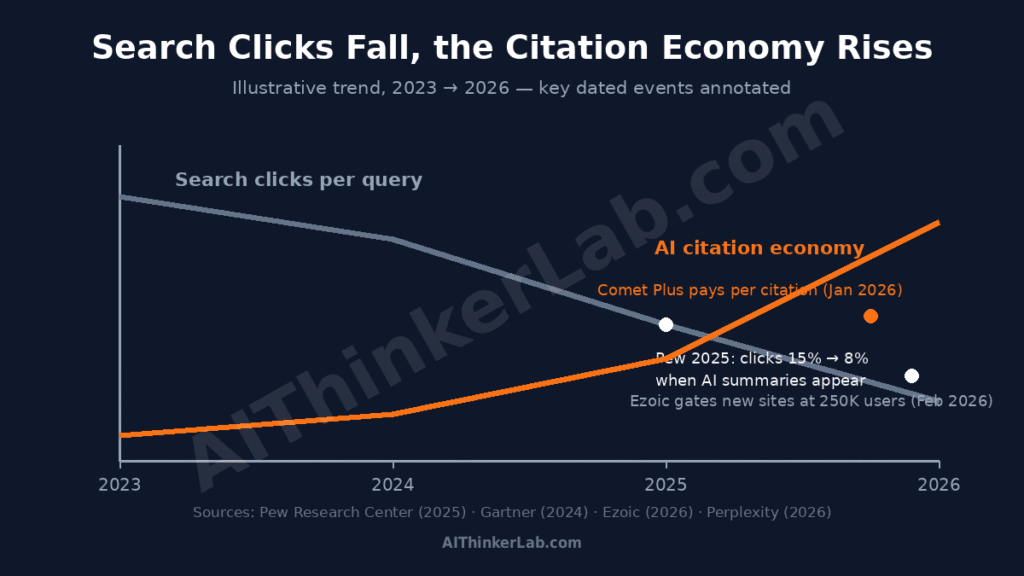
Display ads still pay on AI content sites in 2026, but access is shrinking and the money needs scale: Ezoic now requires 250,000 monthly users for new publishers (announced February 19, 2026), premium networks like Raptive and Mediavine gate at tens of thousands of sessions, and Google AdSense — the realistic entry point — returns roughly $5–15 per 1,000 pageviews for tech-niche sites with Tier-1 traffic, and far less for developing-market audiences (2026 publisher benchmarks).
That paragraph is the honest answer most monetization guides bury. Here’s the fuller picture. AdSense pays per impression, not per click, with about an 80% revenue share for content sites — so earnings track raw traffic almost linearly. A 2,000-pageview site in the AI/tech niche is looking at maybe $10–30 a month, and meaningfully less if most visitors come from lower-CPC regions; benchmark roundups put typical Indian-traffic RPMs around $1.2–3.5 (Mozedia, 2026). And the door that used to be open for small sites just closed: Ezoic’s February 2026 policy grandfathers existing accounts but sends new sub-250K publishers to an Incubator program that accepts twenty sites a month (Ezoic, 2026). Twenty. A month. Globally.
Now stack that against the trendline from earlier — search clicks halving under AI summaries (Pew, 2025), search volume itself projected down 25% (Gartner, 2024). You’d be scaling a revenue stream whose raw material is shrinking, on platforms that increasingly don’t want small inventory anyway. Ads aren’t dead; they’re last. That’s the contrarian core of this whole piece — and as of this year it’s not even contrarian to the ad industry, which is voting with its eligibility rules.
So what should a small site actually do? Get AdSense approved (approval itself validates content quality against Google’s policies and unlocks options later), then treat ad revenue as a coffee budget while products and services carry the business. Revisit the priority only past ~50K pageviews — and even then, watch what AI search does to your traffic curve quarter by quarter. Ads are a dividend on attention. In 2026, attention is the scarce input.
Do AI Companies Pay to License Blog Content? (Strategy 7, TDS 7/10)
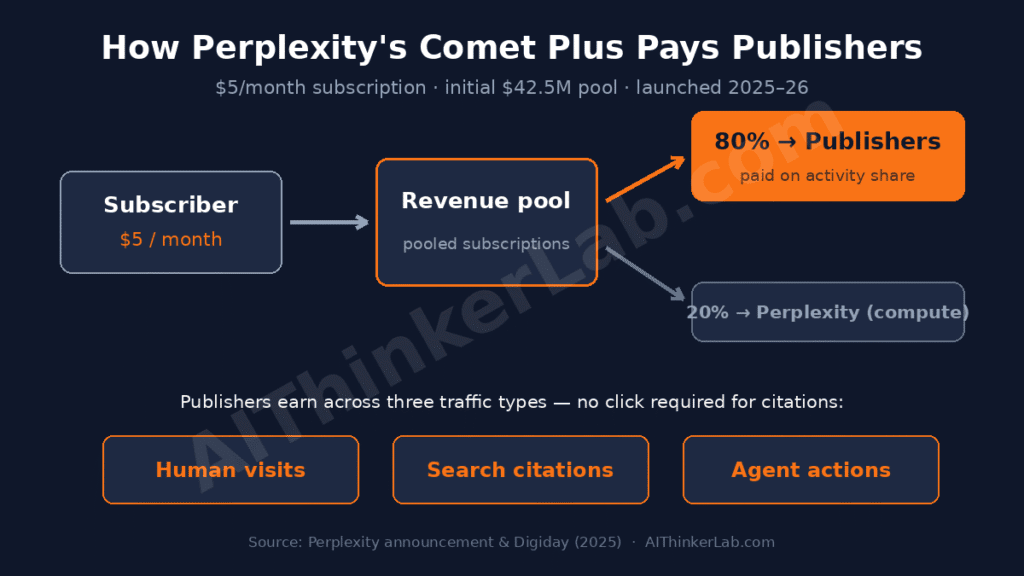
AI companies pay for content at two very different scales in 2026. At the top: licensing deals like News Corp’s reported $250M+ five-year agreement with OpenAI (WSJ, 2024). For everyone else: Perplexity’s Comet Plus, a $5-per-month subscription launched formally in January 2026, which pools subscriber revenue and pays 80% to participating publishers — keeping 20% for compute — across three traffic types: human visits, search citations, and agent actions (Perplexity, 2025–2026).
The citation piece is the genuinely new economics. Under every previous model, an AI answer that cited your page without a click paid you nothing; under Comet Plus, the citation itself contributes to your payout share, click or no click. Reporting put enrollment above 2,400 publishers by Q1 2026, with analyst estimates around $8–15 per 1,000 citations — estimates, not Perplexity-confirmed terms, so treat the numbers as directional. And the model has runway: Perplexity raised roughly $200 million at a near-$20 billion valuation in June 2026, largely to scale its Comet browser (the same ecosystem as the Perplexity sidebar I tested for 30 days). strategy that Comet Plus rides on (The Information via Yahoo Finance, June 2026). Small publishers can request to join by emailing publishers@perplexity.ai.
The realistic solo play, then, has two parts. Enroll where enrollment is open — the cost is an email. And do the GEO work that makes citations happen at all: quotable declarative sentences, attributed statistics, self-contained answer blocks, clean structure. Content built to be cited is content pre-qualified for whatever citation-payment model wins, whether that ends up being Perplexity’s, or a Google/OpenAI response to it.
There’s a defensive angle too. Your robots.txt and llms.txt already decide which AI crawlers (GPTBot, ClaudeBot, PerplexityBot) can read your site. Blocking them all “on principle” removes you from the citation economy entirely; allowing everything with no strategy gives your work away unpriced. The middle path most small publishers land on: allow crawling, optimize for citation, and keep your highest-value material — the paid kits, the member content — off the open web where it can’t be absorbed for free.
Watch this strategy quarterly. It has the widest gap on the Ladder between what it pays today and what it might pay in eighteen months.
The 90-Day Stack for a Solo Creator
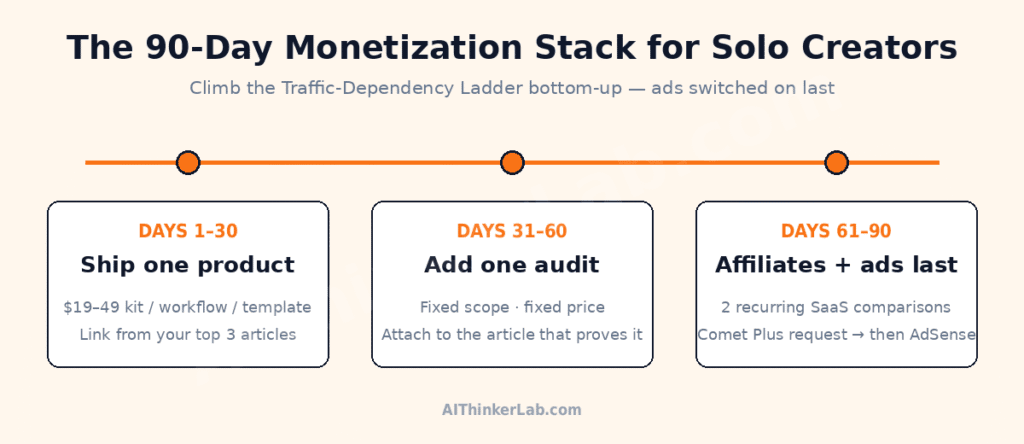
Strategies don’t work in isolation — they sequence. Here’s the order the Traffic-Dependency Ladder implies for a small AI content site, compressed into ninety days.
Days 1–30: ship one product. Take the thing your articles keep almost-teaching and finish it — a workflow bundle, a scorecard, a config kit. Price it $19–49. Put it behind Gumroad or Lemon Squeezy if you want zero setup and tax handled for you (10% + $0.50 vs 5% + $0.50 + 1.5% international — run your own mix), or WooCommerce + Razorpay/PayPal if you want maximum margin and don’t mind the bookkeeping. One product page, linked from your three most relevant articles. Done beats perfect; v1.1 is allowed to exist.
Days 31–60: add one productized audit. Fixed scope, fixed price, delivered on a template you refine with each client. Attach it to the article that best demonstrates the skill. Two clients a month at $149 already outearns a small site’s annual ad revenue.
Days 61–90: layer two recurring affiliates, request Comet Plus enrollment, then switch ads on. Pick two SaaS tools you genuinely use, build one honest comparison page each (table up top, criteria explicit — the format AI engines lift). Send the Perplexity publisher email; it costs nothing. Then enable AdSense and let it earn whatever it earns without optimizing another minute for it.
I’m running this exact 90-day sequence on AIThinkerLab right now — product shipped, audit offer next — and I’ll publish the product-vs-ads revenue split here once the window closes. If the Ladder is wrong, this is where you’ll read it first.
The pattern beneath the plan: each layer feeds the next. Articles prove skill → skill sells audits → audits inform products → products fund the newsletter that sponsors eventually pay to reach. Traffic helps every layer. It’s required by none of the first three. That’s the point.
Where the Money Actually Is
Strip everything above to one sentence: in 2026, revenue follows trust, and traffic is just one increasingly unreliable way to build it. The creators earning real money from AI content aren’t the ones with the biggest Analytics graphs — they’re the ones whose expertise got packaged into something a reader could buy, hire, or subscribe to before the traffic question even mattered. This year made the shift visible on both ends: the ad industry raised its drawbridge for small sites in February, and an AI engine started paying for click-less citations in January.
My recommendation is the Ladder, bottom-up: one product in thirty days, one audit offer in sixty, two honest affiliate pages and a Comet Plus enrollment request in ninety, ads switched on last and ignored. Re-score your mix each quarter — especially strategy 7, the rung whose value could jump most between this update and the next one.
The pageview era rewarded whoever published most. Whatever this era ends up being called, the early evidence says it rewards whoever’s worth citing.
Sources
- 2026 AdSense RPM benchmarks — Adstimate publisher benchmark dataset; Mozedia RPM guide (Feb 2026)
- Pew Research Center — “Google users are less likely to click on links when an AI summary appears in the results” (July 22, 2025): https://www.pewresearch.org/short-reads/2025/07/22/google-users-are-less-likely-to-click-on-links-when-an-ai-summary-appears-in-the-results/
- Gartner — “Gartner Predicts Search Engine Volume Will Drop 25% by 2026” (Feb 19, 2024): https://www.gartner.com/en/newsroom/press-releases/2024-02-19-gartner-predicts-search-engine-volume-will-drop-25-percent-by-2026-due-to-ai-chatbots-and-other-virtual-agents
- Aggarwal et al. — “GEO: Generative Engine Optimization,” arXiv:2311.09735 (2023): https://arxiv.org/abs/2311.09735
- Ezoic — “Ezoic Raises Bar to 250K” press release, Feb 19, 2026 (via Yahoo Finance/PR Newswire) and Ezoic support: “Getting Started: Ezoic’s Requirements” (accessed July 2026): https://support.ezoic.com/kb/article/getting-started-ezoics-requirements
- Perplexity — Comet Plus announcement (Aug 2025) and Digiday interview with Jessica Chan, head of publisher partnerships (Aug 2025): https://digiday.com/media/how-perplexity-new-revenue-model-works-according-to-its-head-of-publisher-partnerships/
- Yahoo Finance / The Information — Perplexity ~$200M raise at ~$20B valuation (June 5, 2026)
- Gumroad — pricing and fee help docs (accessed July 2026): https://gumroad.com/help/article/66-gumroads-fees
- Lemon Squeezy — pricing and fee docs (accessed July 2026): https://docs.lemonsqueezy.com/help/getting-started/fees
- Google AdSense blog — per-impression payment update (Nov 2023)
- Wall Street Journal — News Corp–OpenAI licensing deal (May 2024)