TL;DR / Key Take Away
- GLM-5.3 launched August 14, 2026 on the same ~744B-parameter mixture-of-experts base as GLM-5.2, with every capability gain coming from post-training alone — no new pretraining run.
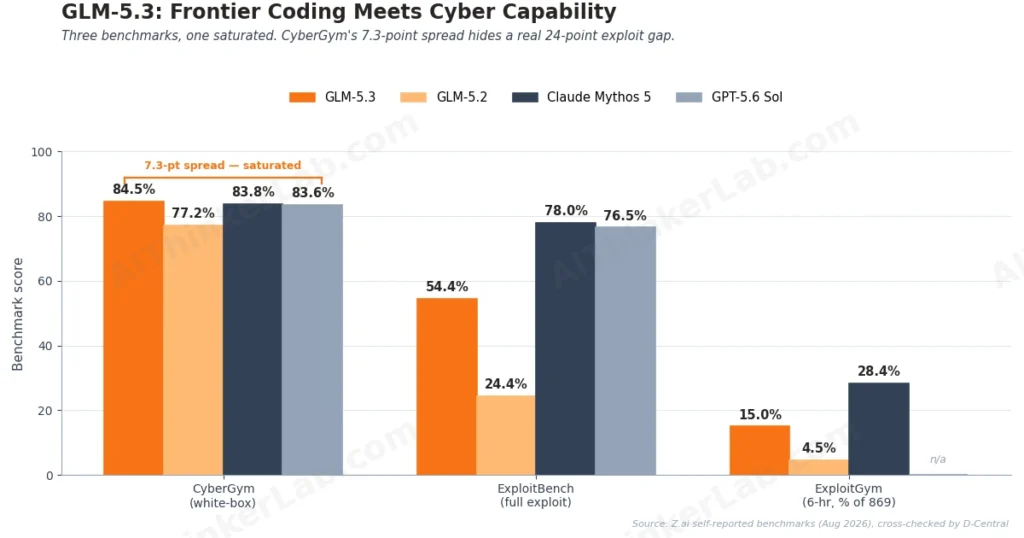
- On CyberGym (white-box configuration), GLM-5.3 scored 84.5%, technically ahead of Claude Mythos 5 (83.8%) and GPT-5.6 Sol (83.6%) — but five frontier models land within 7.3 points of each other, which is a saturation signal, not a real capability gap.
- On ExploitBench, the benchmark that measures carrying a bug to a working exploit, GLM-5.3 jumped from GLM-5.2’s 24.4% to 54.4% — a genuine 2.2x gain — while still trailing Claude Mythos 5 (78.0%) by 24 points.
- The weights are not yet public. Z.ai delayed release by roughly two weeks and tied the delay explicitly to safety evaluation, after the model developed exploitation reasoning faster than the post-training run intended to produce.
- Coding benchmarks moved in the same direction as exploitation benchmarks — Terminal-Bench 3.0 went from 4.6 to 28.3, DeepSWE v1.1 from 46.2 to 66.9 — which is the actual evidence that “frontier coding” and “cyber capability” are one training signal, not two separate features.
Frontier Coding Just Got a Second Job
August 14, 2026, 10:47 AM. Z.ai’s launch post for GLM-5.3 carries a tagline that would have sounded like marketing overreach a year ago: “Built to Code. Ready for Cyber Defense.” Sixty seconds after reading it, the obvious question isn’t whether the model can code — GLM-5.2 already proved that open-weight coding could compete with closed frontier labs. The question is what “ready for cyber defense” actually means when the same post-training run that improved code generation also, apparently, taught the model to chain together a working exploit.
Frontier coding, in the sense this piece uses it, means the current generation of post-training techniques — reinforcement learning on executable, verifiable environments — applied to make a model better at real software engineering tasks: fixing bugs, navigating unfamiliar codebases, running terminal commands, completing long-horizon agentic work. That’s a narrower and more useful definition than “cutting-edge AI,” and it matters here because GLM-5.3 didn’t get a new architecture or a bigger pretraining run to earn its cyber claims. Same 744-billion-parameter mixture-of-experts base as GLM-5.2. Same roughly 40 billion active parameters per token. All of it from post-training. This piece pulls apart what that actually bought Zhipu AI, why the top-line 84.5% cyber score is close to meaningless on its own, and where the real 2.2x jump is hiding in a chart most coverage never got to. What happens when the same coding gains carry into cybersecurity capability.
What Is Frontier Coding, and Why Does GLM-5.3 Call Itself That?
GLM-5.3’s coding claim rests on a cluster of benchmarks that measure agentic software work rather than isolated code generation, and the deltas are large enough that Z.ai front-loaded them in the launch materials. On the company’s own Z.ai Code Bench, running inside Claude Code 2.1.207, GLM-5.3 scored 34.5% at Max reasoning effort against GLM-5.2’s 23.4% — an 11.1-point absolute gain, 47.4% relative, according to Kingy AI’s reporting on the release (2026). On Terminal-Bench 3.0, a test of whether a model can operate a real shell to complete multi-step tasks, the jump was from 4.6 to 28.3. DeepSWE v1.1 moved from 46.2 to 66.9. AutomationBench roughly doubled, from 26.2 to 48.2.
Here’s the thing nobody flagged loudly enough: every one of those numbers is vendor-reported. No independent lab has re-run GLM-5.3 under a single shared harness yet, and the independent DeepSWE leaderboard hadn’t added the model at time of writing, per Kingy AI (2026). That doesn’t make the numbers false. It means treat them as Z.ai’s best case until someone else reproduces them — the same caveat that applied to GLM-5.2’s launch claims, which mostly held up under later scrutiny (D-Central, 2026). GLM-5.2 itself, for context, had already beaten GPT-5.5 on SWE-bench Pro (62.1 vs 58.6) and landed within about a point of Claude Opus 4.8 on FrontierSWE, per Technology.org’s July 2026 benchmark review — so GLM-5.3’s starting line wasn’t a weak one.
What Are GLM-5.3’s Actual Cyber Capabilities?
GLM-5.3 was trained with data and environments specifically built for finding software vulnerabilities, according to the-decoder’s coverage of the release (2026), a deliberate response to the gap Chinese open-weight labs have historically had against US frontier models in cybersecurity. Z.ai published results across three distinct benchmarks that measure three different points in a vulnerability’s life: finding it, proving it, and weaponizing it. Reading only one of the three — which is what most coverage did — produces a badly wrong picture.
| Benchmark | What it measures | GLM-5.3 | GLM-5.2 | Claude Mythos 5 | GPT-5.6 Sol |
|---|---|---|---|---|---|
| CyberGym (white-box) | Reproduce a known bug given the patch diff | 84.5% | 77.2% | 83.8% | 83.6% |
| ExploitBench | Carry a bug to a working exploit (41 V8 CVEs) | 54.4% | 24.4% | 78.0% | 76.5% |
| ExploitGym (6-hr budget) | Raw count of 869 containerized exploit tasks solved | 130 (15.0%) | 39 (4.5%) | 247 (28.4%) | not published |
Table data: Z.ai self-reported benchmarks, cross-checked and reproduced by D-Central’s independent analysis (August 2026).
GLM-5.3 leads the open-weight field on all three by a wide margin over its own predecessor. It does not lead the overall field on two of the three — and the one it does technically lead is, on inspection, the least useful chart in the entire announcement.
Is GLM-5.3’s CyberGym Score Real?
Most guides on this release will tell you the 84.5% CyberGym score means GLM-5.3 out-hacks Claude and GPT-class models. That’s not quite what the number says. CyberGym, built by UC Berkeley’s Responsible AI Development Initiative, tests whether an agent can generate a proof-of-concept input that reproduces a real, historical vulnerability, drawn from 1,507 bugs across 188 open-source projects sourced through Google’s OSS-Fuzz campaign, according to the benchmark’s original paper (arXiv 2506.02548, 2026). What almost nobody reports is that CyberGym runs at four different information levels, and the gap between them is enormous — the original paper’s primary task, Level 1 (codebase plus a text bug description, no crash trace, no patch), tops out around a 20–22% success rate even for the best model-and-scaffold combinations. A case where a vendor delayed release rather than risk premature exposure.
Z.ai’s 84.5% is a Level 3, white-box score — the model gets the ground-truth crash trace and the patch diff and the post-patch codebase. That’s not a fourfold leap past the published literature ceiling. It’s a different exam, closer to “confirm this specific known answer” than “find the needle.” And the tell that the exam has stopped discriminating between models is in the spread: five frontier systems finish within 7.3 points of each other at that configuration. A benchmark that can’t separate GLM-5.3, Claude Mythos 5, GPT-5.6 Sol, and Kimi K3 by more than seven points has saturated for that setting. Winning it is real. It’s also close to uninformative about which model is actually more dangerous or more useful in practice — a distinction D-Central’s technical analysis first surfaced clearly (2026), and one worth repeating because almost every other outlet covering the launch missed it.
Can GLM-5.3 Actually Exploit Vulnerabilities, Not Just Find Them?
This is where the honest story lives, and it’s a better story than the headline number, not a worse one. ExploitBench — built by Carnegie Mellon’s Seunghyun Lee and Professor David Brumley in collaboration with Bugcrowd — scores whether a model can carry a vulnerability all the way to a working exploit against 41 patched V8 CVEs, using a 16-flag ladder with a deterministic oracle for each flag. GLM-5.3 scored 54.4% here, against GLM-5.2’s 24.4%. That’s a genuine 2.2x improvement, and it came from post-training on a base model that hadn’t changed at all.
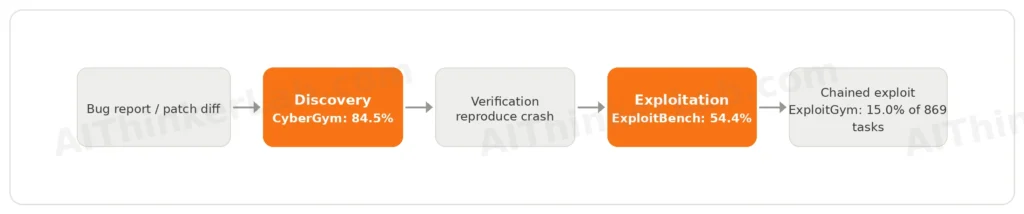
Two independent findings corroborate that this jump is real rather than a friendly self-reported number. First, the UK AI Security Institute and the US Center for AI Standards and Innovation ran a joint evaluation on July 23, 2026 and independently measured Kimi K3 at 32% and GLM-5.2 at 24% on a comparable exploitation task — numbers that land almost exactly on Z.ai’s own figures, according to D-Central’s reporting (2026). Second, on ExploitGym — the breadth benchmark from UC Berkeley RDI and the Max Planck Institute for Security and Privacy, spanning 869 containerized tasks across userspace, V8, and Linux kernel targets — GLM-5.3 solved 130 of 869 within a six-hour budget, versus GLM-5.2’s 39. That’s roughly 3.5x its predecessor, and about 53% of Claude Mythos 5’s 247. The gap to the closed frontier didn’t close. It roughly halved in about five weeks of post-training work, which is a meaningfully different and more precise claim than “GLM-5.3 beat Claude on cyber.”
The Capability Transfer Ladder
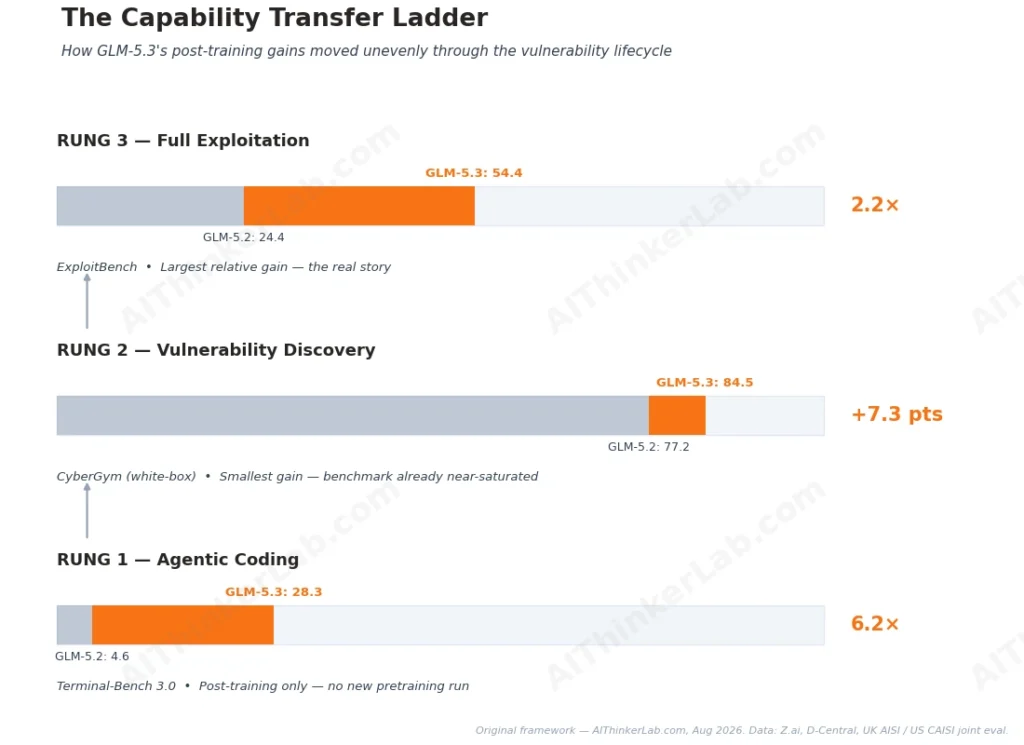
Here’s the framework nobody else has laid out, because it requires placing GLM-5.3’s coding benchmarks next to its cyber benchmarks in the same chart, and every source I found treats them as two separate announcements. Call it the Capability Transfer Ladder: three rungs, each measuring how far post-training-only gains reach into a harder task.
Rung one — raw agentic coding. Terminal-Bench 3.0 moved 6.2x (4.6 → 28.3). DeepSWE v1.1 moved 1.45x (46.2 → 66.9). This is the model getting better at operating a shell and fixing real code.
Rung two — vulnerability discovery. CyberGym moved from 77.2% to 84.5%, a 7.3-point gain — modest in absolute terms because the benchmark had already saturated for GLM-5.2 in this configuration.
Rung three — full exploitation. ExploitBench moved 2.2x (24.4% → 54.4%). ExploitGym moved roughly 3.5x (39 → 130 of 869, 6-hour budget).
Read top to bottom, the pattern is not “coding got a bit better and cyber tagged along.” It’s the opposite: the hardest, most agentic tasks — full exploit chains, not single-bug discovery — improved the most. That’s consistent with Z.ai’s own account, reported by D-Central (2026), that the model began reasoning across multiple stages of exploitation and producing coherent plans for complete exploitation chains, an outcome the company says it did not fully anticipate when it added vulnerability-discovery environments to the post-training mix. I’d go a step further than that framing, though: this isn’t really two capabilities that happened to move together. Frontier coding, defined as long-horizon agentic reasoning over real codebases, and cyber exploitation are the same underlying skill — planning across dependent steps in a system you don’t fully control — measured on two different task distributions. Most coverage of this launch treats “coding model” and “cyber model” as separate marketing claims stapled onto one release. The benchmark data says they’re the same claim.
Why the Weights Are Still Not Public
GLM-5.3 shipped to GLM Coding Plan subscribers and through ZCode, Claude Code, and OpenCode integrations on day one. The weights did not. Z.ai says they’ll publish in roughly two weeks and ties the delay explicitly to safety evaluation and hardening — a departure from GLM-5.2’s pattern, where MIT-licensed weights hit Hugging Face within days of the coding-plan soft launch, per D-Central’s tracking (2026). Z.ai hasn’t stated a license for GLM-5.3 yet; GLM-5.2’s MIT license is a precedent, not a commitment.
That delay is worth sitting with rather than skimming past. It means the company that built the exploitation environments is, by its own account, pausing before letting anyone download a model whose offensive capability grew faster than the training run was designed to produce. It’s a small but real echo of the capability-threshold logic in frameworks like Anthropic’s Responsible Scaling Policy (version 3.0, effective February 24, 2026), which defines specific thresholds — including for cyber operations — that trigger stricter security and deployment safeguards before a model reaches the public, rather than after. Whether GLM-5.3’s two-week window constitutes an equivalent bar is a fair thing to be skeptical about; Zhipu hasn’t published an evaluation framework as detailed as Anthropic’s. But the shape of the decision — gate access, not just capability — is the same shape, and it’s happening at a Chinese open-weight lab for the first time at this scale.
To Z.ai’s credit on a separate front: the company also runs a public coordinated-disclosure ledger at cvd.z.ai. Since GLM-5.2, models working with security teams in China have surfaced 2,436 vulnerabilities across 269 open-source projects — 1,097 rated critical or high, 53 already carrying public CVEs, 2,383 still under embargo. The oldest confirmed defect traces back to 1981, with a mean 26.6-year gap between a bug’s introduction and its discovery. That latency figure is arguably the most important number in the entire release: it’s a direct measurement of how much undiscovered vulnerability is sitting, right now, in software the internet already depends on.
Should You Trust Vendor-Reported AI Cyber Benchmarks?
Cautiously, and only alongside independent corroboration — which is the right general posture for this whole category, not a GLM-5.3-specific complaint. The International AI Safety Report 2026 notes that AI systems have measurably improved at autonomous vulnerability discovery across multiple benchmarks over the past year, and that developers are increasingly reporting attackers — including nation-state-linked actors — using models to support real cyber-offense operations. The report also flags a structural evidence gap: cyber evaluations are still an emerging field, and scores can be inflated if a model was inadvertently trained on benchmark data.
None of that is a reason to treat this release as an operational threat briefing, and it isn’t one here. The useful reader takeaway is narrower and more practical: verify vendor cyber benchmarks against at least one independent source before repeating the headline number, check which configuration (information level, time budget, harness) produced the score, and remember that a model getting better at finding plausible vulnerabilities without a matching increase in verification capacity just moves the bottleneck — a point D-Central makes sharply in the context of open-source maintainers already drowning in unverified reports (2026). This piece is a capability and benchmark breakdown, not a how-to; nothing here describes how to reproduce an exploit, and that’s deliberate.
The Real Takeaway
GLM-5.3 is a genuine result, not a marketing number dressed up as one — a 2.2x jump on real exploitation capability, from post-training alone, on a model that was already competitive on coding, is worth taking seriously whichever lab produced it. But the specific claim worth remembering isn’t “GLM-5.3 beats Claude at cybersecurity.” It’s narrower: open-weight models closed roughly half the exploitation gap to the closed frontier in about five weeks, the headline benchmark everyone’s repeating is the one that discriminates least between models, and the company that built it delayed public access because the capability outran its own expectations. If you’re evaluating this model for anything security-adjacent, read the ExploitBench and ExploitGym numbers before the CyberGym one — and check back once the weights and an independent harness actually exist.
Sources
- Technology.org, “GLM-5.2 Coding: How Good Is It, Really? (2026 Benchmarks)” (Jul 2026) — https://www.technology.org/2026/07/02/glm-5-2-coding-how-good-is-it-really-2026-benchmarks/
- the-decoder, “Zhipu AI releases GLM-5.3, claims it’s the strongest open-weights coding model” (Aug 14, 2026) — https://the-decoder.com/zhipu-ai-releases-glm-5-3-claims-its-the-strongest-open-weights-coding-model/
- D-Central, “GLM-5.3 Cybersecurity Benchmarks: What the 84.5 Score Hides” (Aug 14, 2026) — https://d-central.tech/glm-5-3-cybersecurity-benchmarks/
- ChinaTechNews.com, “Chinese AI Giant Zhipu Unveils GLM-5.3, Edging Past Western Rivals in Cybersecurity Benchmarks” (Aug 17, 2026) — https://www.chinatechnews.com/2026/08/17/127491-chinese-ai-giant-zhipu-unveils-glm-5-3-edging-past-western-rivals-in-cybersecurity-benchmarks
- CyberGym original paper, “Evaluating AI Agents’ Real-World Cybersecurity Capabilities at Scale” — https://arxiv.org/abs/2506.02548
- Kingy AI, “GLM-5.3 Just Launched: Specs, Benchmarks, API & How to Use It” (Aug 2026) — https://kingy.ai/blog/glm-5-3-specs-benchmarks-api-how-to-use/
- Emergent, “GLM 5.3 Benchmarks: What the Numbers Show & What They Don’t” (Aug 2026) — https://emergent.sh/learn/glm-5-3-benchmarks
- International AI Safety Report 2026 — https://arxiv.org/pdf/2602.21012
- Anthropic, Responsible Scaling Policy v3.0 (effective Feb 24, 2026) — https://www.anthropic.com/responsible-scaling-policy/rsp-v3-0