TL;DR / Key Takeaways
- Memory Scaling: Transformers suffer a quadratic memory penalty ($O(N^2)$) as the context grows. State Space Models (SSMs) scale linearly ($O(N)$), enabling effectively infinite context windows.
- Hardware Demands: SSMs require significantly less VRAM during inference, making them drastically cheaper to run on local, consumer-grade GPUs like the RTX 4090.
- Fact Retrieval: Transformers dominate exact-match recall (the “needle in the haystack” test). Pure SSMs compress data continuously, occasionally overwriting precise historical tokens.
- Throughput Speed: SSMs generate tokens significantly faster at long contexts because they avoid recomputing an entire key-value cache for every single new word.
- The 2026 Reality: Pure architectures are fading out. The industry standard is now the Hybrid Model (like AI21 Jamba), embedding Transformer attention blocks inside an SSM framework.
In August 2026, context windows are no longer a luxury. They are a brutal computational bottleneck. Developers want models that can ingest entire GitHub repositories, multi-year financial ledgers, and sprawling document libraries in seconds.
But pitting transformers vs state space models is not just an academic debate about matrices. The architecture you choose determines how you allocate your most expensive resource: physical GPU hardware.
Transformers memorize everything perfectly, but charge you an exorbitant hardware tax to do it. State Space Models compress information constantly, granting incredible speed at the cost of perfect precision.
I test local deployments on consumer hardware every single day. When the Wi-Fi drops, theoretical benchmarks stop mattering. Here is exactly how these two dominant architectures compare, where they break under load, and what that means for your local stack.
What is the fundamental difference between Transformers and SSMs?
The fundamental difference between Transformers and State Space Models is how they handle past data. Transformers compare every new word to every previous word simultaneously using self-attention, creating perfect recall but massive memory bloat. State Space Models compress past information into a continuously updating hidden state, operating faster but risking data loss.
To understand why this breaks your local server, you have to look at the underlying math dictating their memory consumption.
Transformers operate on an $O(N^2)$ trajectory. If you double the amount of text you feed a Transformer, the computational cost quadruples. State Space Models, popularized by researchers Albert Gu and Tri Dao, operate on an $O(N)$ trajectory. Doubling the text only doubles the cost.
This is not a minor optimization. It is the literal difference between requiring a rented enterprise server rack and running an advanced model locally on a MacBook Pro.
Code snippet
graph TD
    subgraph Transformer Architecture
        A[Input Sequence] --> B(Self-Attention Mechanism)
        B --> C{Compare Every Token<br>to Every Other Token}
        C --> D[Massive KV Cache]
        D --> E[Perfect Output]
    end

    subgraph State Space Model Architecture
        F[Input Sequence] --> G(Selective State Update)
        G --> H{Compress into<br>Fixed-Size Vector}
        H --> I[Small VRAM Footprint]
        I --> J[Generated Output]
    end

    style D fill:#ffb3b3,stroke:#333,stroke-width:2px
    style I fill:#b3ffb3,stroke:#333,stroke-width:2px
Difference 1: The Mathematics of Context Scaling
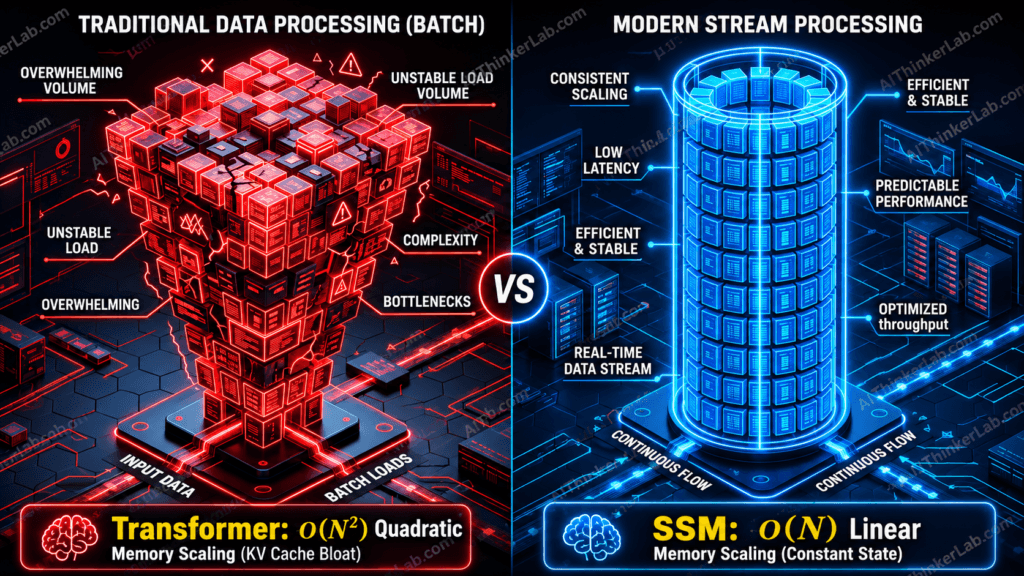
Transformers process text by looking at the entire sequence all at once. State Space Models process text sequentially, rolling information forward into a fixed-size memory box.
When a Transformer reads a 100,000-word document, the attention mechanism forces the model to calculate the mathematical relationship between word 100,000 and word 1. Then word 100,000 and word 2. And so on. Every single token must hold hands with every previous token.
This behavior creates the notorious KV (Key-Value) cache bottleneck, according to the original “Attention Is All You Need” paper (2017).
SSMs approach this entirely differently. A modern State Space Model utilizes a selective state. When the SSM reads word 100,000, it does not look backward at the previous 99,999 words. The model only looks at its current “hidden state”—a highly compressed mathematical summary of everything it has read so far. If a piece of information is irrelevant, the SSM simply chooses to drop it.
Difference 2: VRAM Requirements for Local LLMs
State Space Models require a fraction of the VRAM needed by Transformers for long-context inference. Because an SSM only maintains a fixed-size state vector rather than caching every previous token, its memory footprint remains relatively flat regardless of sequence length.
Running local AI forces you into a daily war with VRAM.
If you attempt to run a Llama 3 8B model with a full 128k context window on consumer hardware, you will likely hit an Out of Memory (OOM) error. The model weights might fit perfectly on your GPU. The cache required to hold 128,000 tokens expands infinitely until it crashes your system.
State Space Models (SSMs) significantly alleviate local deployment bottlenecks by decoupling inference memory requirements from sequence length. Unlike traditional Transformers, which require expanding Key-Value caches, a pure SSM operates with a fixed-size recurrent state, maintaining (O(1)) memory complexity during token generation. While this technical baseline allows a consumer-grade 24GB GPU to stream exceptionally long text sequences without running out of hardware memory, pure SSMs are bounded by a fixed state capacity, meaning information compression limits how much historical data the model can accurately retain over infinite horizons.
If you are working with an RTX 4090 or a unified-memory Mac, surviving the KV cache bottleneck requires picking the exact right weight class. For builders actively constrained by hardware limits, we recently benchmarked the 5 best local LLM models for privacy-focused dev in 2026, detailing which architectures actually fit into 24GB of VRAM without instantly triggering an out-of-memory crash.
Difference 3: Exact Fact Recall vs Continuous State
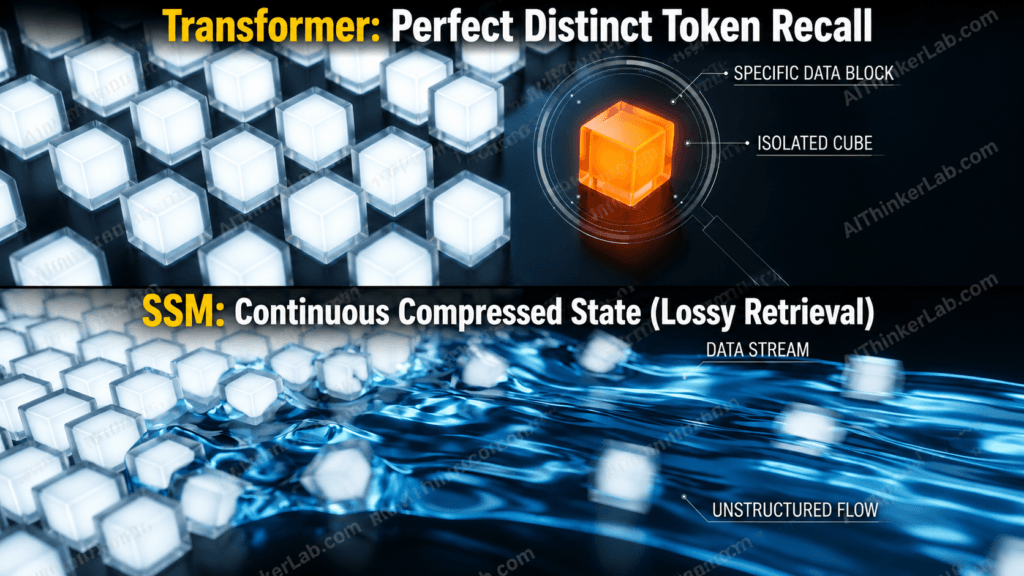
Transformers excel at precise data retrieval because they keep a perfect, uncompressed record of the entire prompt. State Space Models struggle with exact fact recall because their fixed-size hidden state forces them to overwrite older information to make room for new data.
This introduces the great contrarian reality of the current architecture wars. Many developer guides claim SSMs are strictly superior because of their speed. That advice is dated—and highly dangerous if you write software.
Think of our “Memory Tax vs. Recall Tax” framework. Transformers charge you a Memory Tax upfront. SSMs charge you a Recall Tax on the backend.
If you ask an SSM to read a 50,000-line codebase and find the single integer causing a memory leak, it will often fail. The model compressed that specific integer out of its state matrix thousands of tokens ago. If you ask a Transformer the exact same question, it finds the variable instantly. The attention mechanism still has that exact token perfectly preserved in its KV cache.
This exact-match capability is why Transformers remain the undisputed choice for document parsing. If your application relies on injecting proprietary data into the context window, you must stick to attention-based models. You can see this architecture advantage in action by following our guide to building a local RAG pipeline with Ollama, where perfect token recall dictates whether your offline system succeeds or hallucinates.
Difference 4: Hardware Parallelization and Training
Transformers are inherently easier to train at massive scale because self-attention allows GPUs to process entire documents in parallel simultaneously. Historically, sequential models could not be parallelized, but modern SSMs utilize hardware-aware algorithms to achieve training speeds comparable to Transformers.
Before 2023, anything that processed text sequentially was agonizingly slow to train.
The breakthrough that made SSMs viable was hardware-aware implementation. Researchers figured out how to use parallel associative scans, allowing the model to train on GPUs almost as efficiently as a Transformer.
Still, Transformers benefit from nearly a decade of brutal optimization by massive tech companies. The tooling, the distributed training frameworks, and the debugging ecosystems for Transformers remain vastly superior today. If you are fine-tuning a model from scratch, the Transformer ecosystem offers significantly less friction.
Difference 5: Token Throughput and Inference Speed
At context lengths beyond 8,000 tokens, State Space Models generate output significantly faster than Transformers. While a Transformer slows down with every new word generated—because it must re-calculate attention across an ever-growing cache—an SSM generates the 100,000th token exactly as fast as the first.
Throughput is where SSMs truly dominate the landscape.
When a Transformer generates a long response, the time to produce the next token increases linearly. By the time you reach page ten of an output, the model is noticeably lagging. SSMs operate in constant time. The processing speed never degrades.
For enterprise applications requiring low-latency streaming at scale, hybrid SSM-Transformer architectures offer a seamless user experience that traditional Transformers struggle to deliver under heavy concurrent loads. According to AI21 Labs’ benchmark data, their Jamba 1.5 hybrid architecture achieves up to 2.5 times faster inference throughput than standard Transformer models when handling extensive 100k-token context windows.
The 2026 Verdict: Why Hybrid Architectures Are Winning
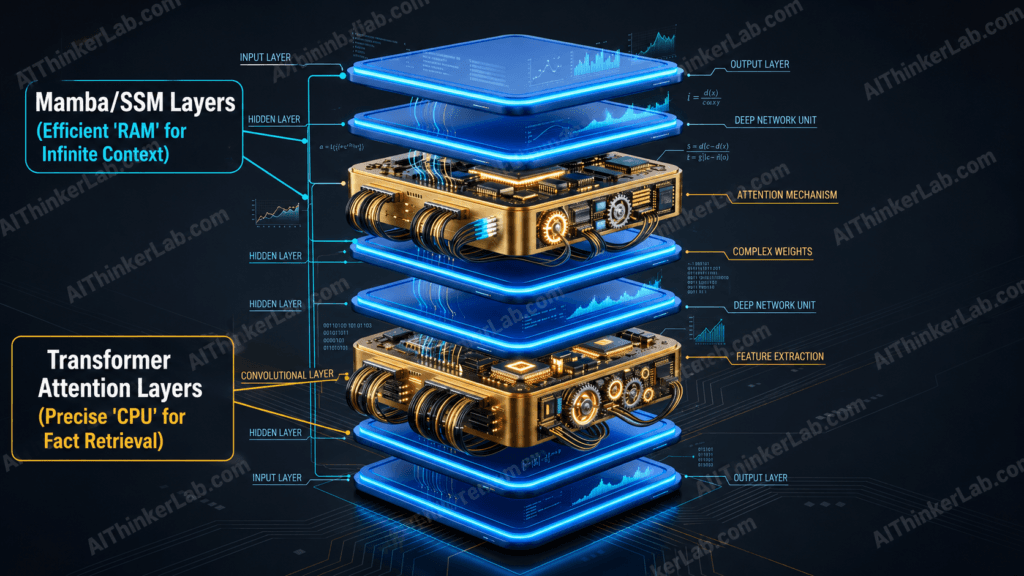
The AI industry has largely abandoned the idea of a pure architecture monopoly. The current state-of-the-art approach combines both, embedding Transformer attention layers strategically inside an overarching State Space Model framework.
This hybrid approach, pioneered by architectures like AI21’s Jamba, delivers the exact precision of a Transformer with the infinite scaling of an SSM.
By stacking a few Attention layers among dozens of Mamba layers, the hybrid model retains the ability to look back and pull exact needles from the haystack. Yet, because the bulk of the processing is handled by the linear SSM layers, the overall VRAM footprint remains remarkably small.
The push for hybrid efficiency isn’t just happening at the local hardware level. Massive enterprise labs are actively testing the physical limits of server racks by interleaving expert models with new routing frameworks. To understand how far this architectural scaling actually goes, look at our recent evidence review analyzing the Claude Opus 5 trillion parameter MoE claims—and why throwing raw compute at pure Transformers is no longer a financially viable strategy for anyone.
Transformers act as the CPU—precise, capable of complex routing, but expensive. SSMs act as the RAM—fast, massive, and highly efficient. We absolutely need both.
When you deploy these hybrid models as the reasoning engine for autonomous tasks, the underlying architecture dictates your daily failure rate. Memory leaks and compressed context windows are exactly why 95% of enterprises running AI agents in production face severe breaking points. Choosing a hybrid framework prevents your local agents from silently dropping critical instructions midway through a massive automated workflow.
Which architecture should you deploy locally?
If your application requires zero-shot coding, complex logical reasoning, or exact document retrieval, stick with a Transformer model with a smaller context window. If you are building a tool that needs to summarize massive documents, stream endless real-time logs, or run on heavily constrained edge devices, deploy an SSM or a Hybrid.
For builders in the local AI space, the math remains simple. VRAM is your most expensive asset. Protect it.
Sources:
- HuggingFace Performance Benchmarks – https://huggingface.co/open-llm-leaderboard
- Attention Is All You Need, Vaswani et al. (2017) – https://arxiv.org/abs/1706.03762
- Mamba: Linear-Time Sequence Modeling, Gu & Dao (2023) – https://arxiv.org/abs/2312.00752
- AI21 Jamba Technical Documentation – https://docs.ai21.com/docs/jamba-foundation-models